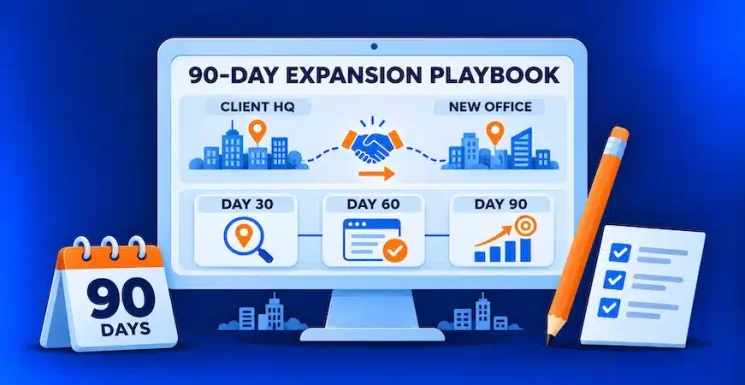
When an existing client brings your MSP into a new market, use the first 90 days to confirm service delivery, build credible local proof, and decide whether to fund customer acquisition. Supporting that client and marketing to other businesses are separate decisions. Commit to additional growth spending only when your capacity, target buyers, and test economics support it.
For a marketing lead at a $5–10M MSP, the trigger may be a client opening an office in Stamford, Boston, or Bethesda. The relationship gives you a reason to serve that location. It does not establish demand from other businesses, guarantee referrals, or make an advertising campaign viable.
This is MSP client-driven expansion: entering a geography because an existing customer needs support there. Part three of our Multi-Market Ads for MSPs series turns that situation into a repeatable operating plan. The milestones below are suggested checkpoints, not promises of results within 90 days.
| Market category | Starting allocation | Example at $10,000/month | What the spend should accomplish |
|---|---|---|---|
| Proven home or anchor markets | 65% | $6,500 | Sustain qualified acquisition where you have campaign history and customer proof |
| Established expansion markets | 25% | $2,500 | Grow in areas with delivery capacity, relevant proof, and early sales traction |
| One new client-driven market | 10% | $1,000 | Test a focused service offer and learn whether it generates suitable inquiries |
| Total | 100% | $10,000 | Balance current acquisition with controlled expansion |
Days 1–14: Confirm what you can deliver before promoting it
Start with an internal delivery brief. The immediate priority is meeting the anchor client’s needs without making promises your team cannot keep.
Document:
- Coverage: Supported locations, business hours, and the boundary between remote and onsite assistance.
- People: Who handles onsite work, who provides backup, and who owns escalations.
- Costs: Travel, partner charges, equipment logistics, and any additional staffing.
- Commitments: Response expectations and which services need separate scoping or pricing.
- Capacity: Whether the arrangement can support another client without weakening existing service.
For example, supporting a Bethesda office remotely with scheduled visits does not establish that you can offer rapid onsite response throughout Northern Virginia. Describe the actual arrangement before choosing a wider marketing area.
The owner and delivery lead should agree on what is commercially workable. Market size and competition still matter when considering acquisition investment, even if the original service request came from a client.
Check Business Profile eligibility before creating a new listing. Serving a customer in a city does not automatically qualify you for a separate Google Business Profile. Google’s eligibility guidelines allow separate profiles for service-business locations with separate staff and service areas, subject to its requirements. A rented mailing address where you do not operate is not an eligible office.
If there is no eligible new location, explain your coverage accurately on your website. If there is, manage the profile alongside your existing locations. Business groups help organize access; they do not transfer local credibility or reviews.
By day 14: Have an approved service brief, a named owner, and accurate public coverage information. A dedicated location page can follow when it has useful details beyond a city name.
Days 15–45: Build proof and decide whether to test acquisition
Turn the delivery brief into an offer for a specific buyer. “Managed IT support for professional services firms with a Bethesda office” gives the page and sales team a clearer focus than an unrestricted promise to serve the entire DC region.
Build a location page that explains who you support, what happens remotely, when onsite help is available, and who provides it. Include relevant experience and a clear next step. If you use a local service partner, describe that arrangement accurately.
Request a client example when there is something meaningful to document. Ask permission to describe the office rollout, the support arrangement, or an outcome you can substantiate. A new relationship does not guarantee an immediately available testimonial. If local results are still developing, use relevant company-wide proof with its location and scope made clear.
Our guide to the trust-signal gap in a new MSP market explains how to combine broader reputation with local evidence. Keep case-study approval separate from requests for honest public reviews.
Next, decide whether a paid test is ready. Check that:
- A defined group of suitable businesses exists within your serviceable area.
- The offer and page answer those buyers’ likely questions.
- Your budget can support a useful test of that offer.
- Forms, calls, and CRM attribution work.
- Sales has responsibility and capacity for timely follow-up.
Google’s Keyword Planner forecasts can inform the demand and cost assumptions by location. Treat forecasts as estimates, then compare them with actual inquiry quality.
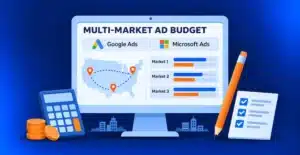
Use the multi-market Google and Microsoft Ads budget framework to assess the allocation. A small test may justify one platform and one offer before adding more. Your Google Ads management plan should specify the spending limit, qualification criteria, and review date.
A client-approved introduction or focused lunch-and-learn can also help you speak with relevant buyers. Choose it for access to the right people, and budget preparation, travel, attendance, and follow-up using the MSP offline and local marketing cost guide.
By day 45: Approve a bounded acquisition test, or record what must change before one starts. Review count alone should not decide.
Watch: Build a focused acquisition plan before adding more marketing
This video uses a $1M local business as its example, but its approach is useful when an established MSP enters a new market: choose a specific offer, use credible customer proof, and connect your marketing to clear sales follow-up. Apply those principles alongside the delivery and market checks above.
The Exact Plan I’d Use to Grow a $1M Local Business in 90 Days
Days 46–90: Choose whether to expand, keep testing, or stay service-only
Review delivery performance and commercial evidence together. Referrals are useful, but their absence does not establish that the market lacks opportunity. Consider prospect conversations, relevant search demand, qualified inquiries, proposals, and the cost of serving another customer.
Keep anchor-client expansion revenue separate from newly acquired clients. Otherwise, an existing relationship can make an unproven acquisition campaign appear successful.
Use three possible decisions:
| Decision | When it fits | Next action |
|---|---|---|
| Expand acquisition | Suitable opportunities are progressing, costs are acceptable, and delivery has capacity | Increase investment gradually and document the reason |
| Continue a bounded test | Buyer fit looks plausible, but evidence is limited or sales remain open | Set another spending limit, a specific learning goal, and a review date |
| Remain service-only | Acquisition is unattractive, delivery is constrained, or another market deserves priority | Support the existing client and define what would trigger reconsideration |
Day 90 is a checkpoint. A handful of inquiries cannot establish a dependable acquisition cost, and an open proposal is not signed revenue. Review the amount of evidence alongside your sales cycle before interpreting results.
Make the next client-driven expansion easier to manage
Keep a reusable market brief containing the service scope, target buyer, delivery costs, approved proof, page URL, test budget, lead owner, and decision history.
After each review, update the template with what your team learned. A page template can standardize the questions you answer, while each market still needs its own accurate coverage and evidence.
If a client has already brought your MSP into a new city, Pronto’s MSP marketing team can help assess the local search opportunity, landing page, and paid campaign plan. Bring the delivery brief first so the marketing reflects what your team can support.