


Every MSP owner has heard a number for what SEO or PPC “should” cost, usually from three different agencies quoting three different figures. The honest answer is that managed IT services is one of the more expensive categories to compete in online, and once you understand why, you can budget for it realistically instead of guessing.
Quick answer: What should a growing MSP spend on SEO, AEO, and PPC?
A growing MSP competing in a large, competitive metro such as New York City, Los Angeles, San Francisco, Miami, Dallas, Houston, or Austin should typically expect to invest $10,000–$20,000+ per month across SEO, AEO, PPC, content, and campaign management to build a meaningful, repeatable lead-generation program.
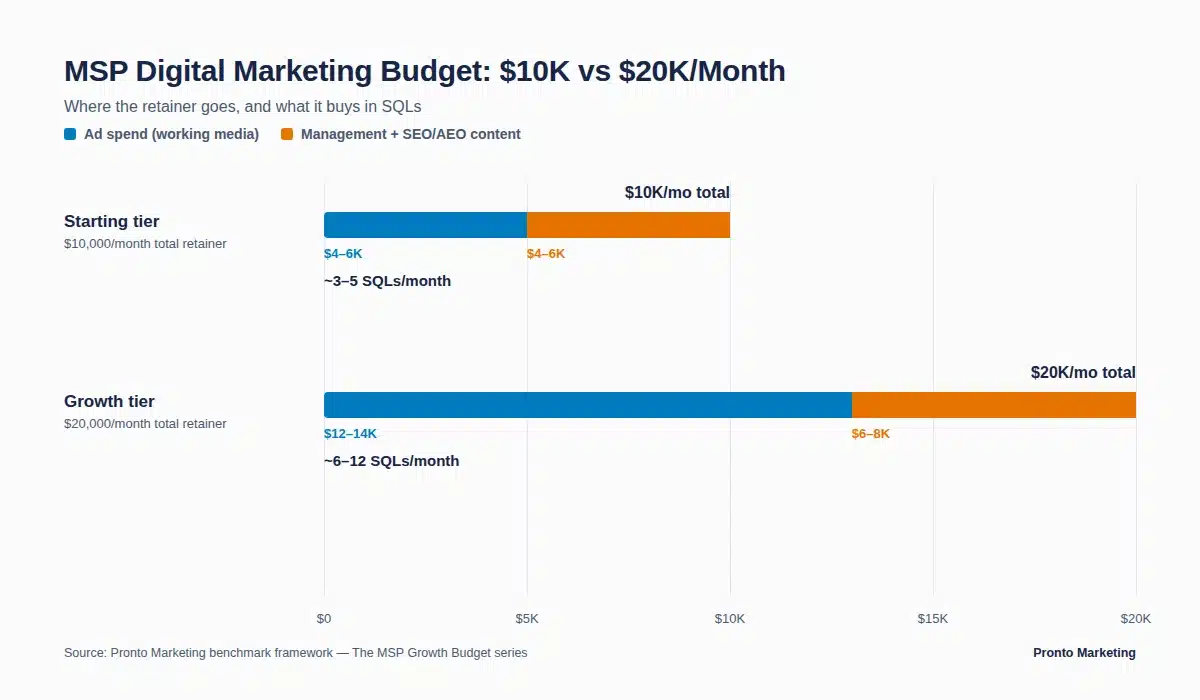
At around $10,000 per month, the goal is usually to establish the foundation: ongoing SEO and AEO content, professional campaign management, and roughly $4,000–$6,000 in direct ad spend. At $20,000 per month, there is more room to scale paid acquisition while continuing to build organic and AI-search visibility.
These figures are most relevant to MSPs targeting highly competitive markets in states such as New York, California, Florida, and Texas, where search costs and competition for high-intent IT services leads tend to be higher. MSPs in smaller or less competitive markets may be able to build an effective program with a lower overall budget.
The key metric is not just PPC cost per click or cost per lead. MSPs should also track their blended cost per sales-qualified lead across the entire marketing investment and compare it against average contract value and client lifetime value.
Why MSP clicks and leads cost what they do
Gartner’s most recent CMO Spend Survey found that CMOs are shifting a growing share of media budget toward digital acquisition channels, with awareness and conversion now making up over 62% of total media spend. That trend holds in B2B services generally, and it holds especially hard in managed IT: everyone selling MSP services is bidding for the same, relatively small pool of business owners actively searching for a provider.
WordStream’s 2026 Google Ads benchmark report put the average cost per click across all industries at $5.42, with B2B and professional-services categories running well above that blended average.
For managed IT, the more useful metric is not simply cost per click or cost per raw conversion, but cost per sales-qualified lead. Based on Pronto’s experience with MSP marketing campaigns, a blended marketing cost per SQL of roughly $2,000–$2,500 is common in competitive markets when you account for paid media, campaign management, and the SEO/AEO work supporting acquisition.
That can sound expensive until you compare it with what a single MSP client may be worth over a multi-year contract, typically $30,000 to $120,000 in lifetime value. That economics is what allows managed IT providers to sustain a higher acquisition cost than many other service businesses.
Sizing a realistic MSP Marketing budget
For MSP PPC campaigns, a useful paid-media range is $3,000-$5,000 per month in ad spend. At lower budgets, campaigns often struggle to generate enough click and conversion data to optimize reliably, particularly in competitive metro markets.
Mapped against a typical total marketing investment that includes ad spend, SEO/AEO content production, and agency management:
- At $10,000/month total, after management fees and ongoing SEO/AEO content production, roughly $4,000–$6,000 may be available for direct ad spend. At this level, a realistic target is around 3–5 sales-qualified leads per month, or a blended marketing cost of roughly $2,000–$3,300 per SQL. This is a starting tier, not a volume engine.
- At $20,000/month total, the same fixed costs leave closer to $12,000–$14,000 for direct ad spend, while SEO and AEO continue building organic visibility in parallel. A reasonable target is around 6–12 sales-qualified leads per month, equivalent to a blended marketing cost of roughly $1,700–$3,300 per SQL. At this level, the program starts to become a more predictable pipeline engine.
What MSP keywords actually cost, by market
| Market | Keyword example | Volume/mo | CPC | Difficulty |
|---|---|---|---|---|
| National (no city) | “managed it services” | 79,000 | $14.00 | 41 |
| Los Angeles, CA | “managed it services los angeles” | 1,300 | $30.00 | 14 |
| Manhattan, NY | “it support manhattan” | 900 | $15.00 | 4 |
| Tampa, FL | “managed it services tampa” | 2,500 | $10.00 | 2 |
| Dallas, TX | “managed it services dallas” | 1,500 | $12.00 | 12 |
| El Paso, TX (smaller) | “managed it services el paso” | 400 | $9.00 | 4 |
| Boise, ID (smaller) | “managed it services boise” | 150 | $2.50 | 1 |
The numbers above are national averages, and they hide a lot of variation. Pulling actual keyword data confirms the pattern: “managed it services los angeles” runs a $30 CPC against 1,300 monthly searches, while the same phrase for El Paso runs $9 against 400 searches, and Boise drops to $2.50. Big, competitive metros in NY, FL, TX, and CA cost more to advertise in, but not uniformly, and not always for the reason you’d expect.
How people actually phrase a search matters as much as the city itself: “managed it services new york” is a surprisingly low-competition phrase, but “it support manhattan” (closer to how people actually search) runs a $15 CPC. The practical takeaway: don’t budget off a national average or a single assumed keyword. Pull the actual local terms before setting a number, and expect your realistic floor to sit meaningfully higher than the blended figures above if you’re competing in a dense metro.
For a deeper look at Google-specific budget ranges, see our earlier breakdown on decoding MSP PPC ad budgets.
Google, Microsoft, and where the budget should actually go
Most MSPs default to Google Ads because it’s the largest search engine, and for broad reach, that’s still correct. But Microsoft Advertising (Bing, plus its Yahoo and AOL syndication) typically runs 30-40% cheaper per click on comparable B2B search terms, with an audience that skews slightly more business-oriented. A reasonable default split for most accounts is 75-80% Google, 20-25% Microsoft — enough Bing presence to capture the cheaper, still-qualified traffic without giving up Google’s larger volume.
SEO: the foundation AEO is built on
It’s tempting to treat AEO as a separate discipline from SEO. It isn’t. AI systems don’t have an independent way of judging whether your business is trustworthy — they lean on the same signals SEO has always optimized for: site structure, content depth, schema markup, and backlink authority. Google’s own guidance on optimizing for AI features confirms this directly: the fundamentals didn’t change, the emphasis did.
That means an MSP that hasn’t invested in core SEO, such as service pages, location pages, a real content library, has nothing for AEO to build on. Our full MSP SEO and AI Search guide walks through the on-site, content, and off-site fundamentals in more depth, and this short video breaks down why the two disciplines work better together rather than as a replacement for one another:
The practical order of operations: get the SEO foundation right first (it’s also what makes your Google Ads vs. SEO budget decision easier), then layer AEO-specific work (schema, FAQ content, location-specific pages) on top of it.
Where AEO fits, and why it's not optional anymore
Answer Engine Optimization (AEO), in other words making sure AI systems like Google’s AI Overviews, ChatGPT, and Gemini actually cite your business when someone asks a relevant question, is the fastest-moving part of this budget category. HubSpot’s research on AEO notes that AI assistants increasingly personalize answers by region, pulling from structured, location-specific content, meaning a generic national services page doesn’t compete as well as it used to.
The practical budget implication: line items like schema markup, FAQ-formatted content, and location-specific pages that used to be “nice to have” SEO extras are now a core part of the digital budget, not an add-on you fund if there’s anything left.
What this means for planning your 2027 MSP Search Marketing budget
Don’t treat “digital marketing” as a single line item you fund with whatever’s left after payroll. It’s really three sub-budgets — paid search, organic/AEO content, and the ongoing management to run both — and the volume of leads you can expect scales directly with how much you commit, not with how good any single campaign is.
If you’re trying to figure out what a realistic digital budget looks like against your own growth targets, see the full budget worksheet later in this series, or read how website and martech costs compete for the same dollars. For a direct read on where your current spend stands, Pronto’s SEO, AEO, and PPC team for MSPs can benchmark it against what similar-sized providers are actually spending.