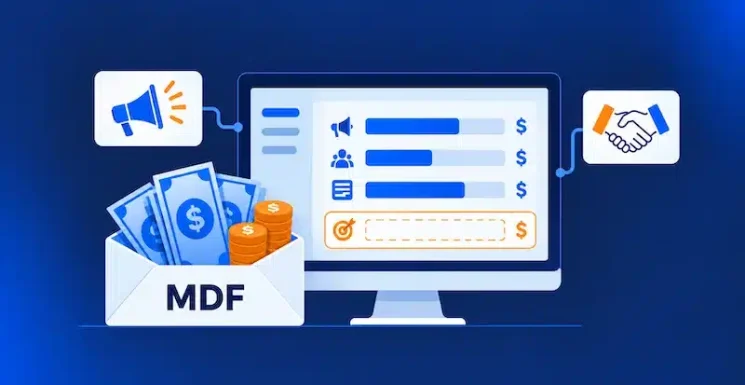
Market development funds (MDF) can help your MSP pay for approved marketing activities, including lunch-and-learns, webinars, and trade show booths. To secure funding, ask your vendor account managers about eligibility, submit a specific campaign plan, and confirm approval and payment requirements before spending.
For an MSP generating $3–10 million in annual revenue, checking vendor funding should be part of your 2027 marketing budget planning. Start with your existing RMM, PSA, security, and distribution relationships. The practical question is: which activities you already want to run could a vendor help fund?
What are market development funds?
Market development funds are resources vendors provide to channel partners to support sales and marketing. Support can include money, campaign materials, or access to marketing resources.
According to TechTarget’s MDF definition, eligibility can depend on partner status, revenue, certifications, or a partner’s potential to generate business.
MDF differs from co-op funding, which is typically tied to a percentage of a partner’s vendor sales. MDF generally supports individual activities, such as an event or webinar. Your vendor’s program rules determine what you can access.
Why do MSPs overlook MDF?
MSPs can miss vendor funding because they lack the time, marketing staff, or program knowledge to pursue it. Some do not realize their activities could qualify; others struggle to find vendors willing to support their plans.
In an August 24, 2026 Channel Dive report, Kaseya said it had approved approximately 1,300 MDF applications that year across a base of more than 40,000 partners. The report also described staffing constraints and uncertainty about eligible activities as barriers for MSPs.
Those figures do not establish an exact participation rate: applications are not necessarily unique partners, and eligibility may vary. But they give MSP owners a clear reason to ask about funding instead of assuming it is unavailable.
What marketing activities can MDF cover?
MDF can support events and campaigns, but your vendor must confirm which activities and expenses qualify. TechTarget identifies webinars, trade show booth space, and lunch-and-learns as examples of MDF uses.
When discussing a campaign with your account manager, ask about funding for:
- Local events: Lunch-and-learns, breakfast briefings, or educational seminars.
- Digital campaigns: Webinars and related promotional activity.
- Content: Co-branded assets or customer case studies.
- Outreach: Direct mail or targeted campaigns.
Treat these as discussion points, not a guaranteed list of covered expenses. Ask the vendor to review your actual campaign budget.
Can MDF pay for agency fees or other campaign costs?
Confirm each expense separately before including vendor funding in your budget. Approval for a campaign should not be treated as approval for every cost associated with it.
If an agency will help deliver the work, ask whether its planning, creative, campaign management, and reporting fees qualify. Check travel, calling services, software, and production costs separately.
Request written answers to five questions:
- Which expenses are eligible?
- What amount or percentage will the vendor cover?
- Is advance approval required?
- How and when will payment happen?
- What evidence and claim deadlines apply?
This gives you a usable funding agreement before you commit your own money.
How can your MSP apply for MDF?
Start with a specific campaign proposal and a clear funding request. Give the vendor enough information to assess the audience, activity, cost, and intended business outcome.
1. Ask your existing vendor contacts
Contact the account managers responsible for your strongest vendor relationships. Ask which MDF or partner marketing programs are available, whether your MSP qualifies, and where to find the application requirements.
2. Submit a focused campaign plan
Build a short proposal around one activity. Include:
- The target audience and business need.
- The campaign or event format and date.
- The total budget and requested contribution.
- The connection to the vendor relationship.
- Your success measures and sales follow-up plan.
For example, propose a cybersecurity lunch-and-learn for local business owners, with a defined invitation list, itemized costs, and a plan to follow up with attendees.
3. Confirm approval before committing spend
Ask about application lead times early. Channel Dive reported that Kaseya required requests at least 45 days before an event, along with costs, expected attendance, and a definition of success. Check your vendor’s current requirements when planning.
4. Assign responsibility for delivery and reporting
Give one person ownership of the application, supporting documents, deadlines, and results report.
If the program reimburses expenses after delivery, plan for the upfront cash requirement. Track both campaign activity and business outcomes so you can assess whether the effort was worthwhile.
Where should MDF fit in your 2027 marketing budget?
Use MDF to extend a planned marketing budget, and treat funding as conditional until the vendor approves it. Choose activities because they support your growth goals, then explore whether a vendor can contribute.
For illustration, a $4,000 event with a $2,000 approved and paid vendor contribution leaves your MSP with $2,000 in direct event costs. Your team’s time and any excluded expenses still need to be budgeted.
Keep the total campaign cost, expected vendor contribution, and payment timing visible in your plan. This helps you judge both affordability and results.
Start with one campaign and a few relevant vendor conversations. If you need help turning that idea into a documented proposal, Pronto’s MSP marketing team can help define the audience, budget, activities, and measurement plan for your vendor to review.