


If you’re staring down 2027 budget season with no real number to plan against, you’re not alone. Most MSP owners set a marketing budget the same way they set a lot of things: whatever’s left over after payroll, tools, and a comfortable buffer. That approach worked when growth came from referrals. It doesn’t work anymore.
The market has shifted. Referrals are drying up industry-wide, and Kaseya’s 2026 State of the MSP Report found that acquiring new customers is now the single biggest challenge MSPs report, ahead of hiring, delivery, and everything else. If new client acquisition is your top problem, your marketing budget stops being a discretionary line item and becomes the thing that determines whether you hit next year’s growth number at all.
So what’s the actual number?
The industry benchmark, and why it doesn’t fully apply to you
Gartner’s 2026 CMO Spend Survey put overall marketing budgets at roughly 7.8% of company revenue, essentially flat year over year. That’s a useful anchor, but it comes from a survey where most respondents run revenue north of $1 billion. Your unit economics, and your margins, look nothing like theirs.
For a services business specifically, APQC’s benchmarking definition frames it as combined sales and marketing spend as a share of revenue, which is closer to how an MSP actually experiences the cost of growth. You’re not separating “marketing” from “sales enablement” the way a billion-dollar enterprise does.
A more useful, MSP-specific range looks like this:
- 2-5% of revenue: maintenance mode. You’re coasting on an existing referral base and not actively trying to grow.
- 8-10% of revenue: growth mode. You’re investing deliberately in demand generation and expect to see it show up in new-client bookings.
- 10-20% of revenue: active expansion. You’re pushing hard for market share, opening new verticals or metros, or trying to outgrow a competitive threat.
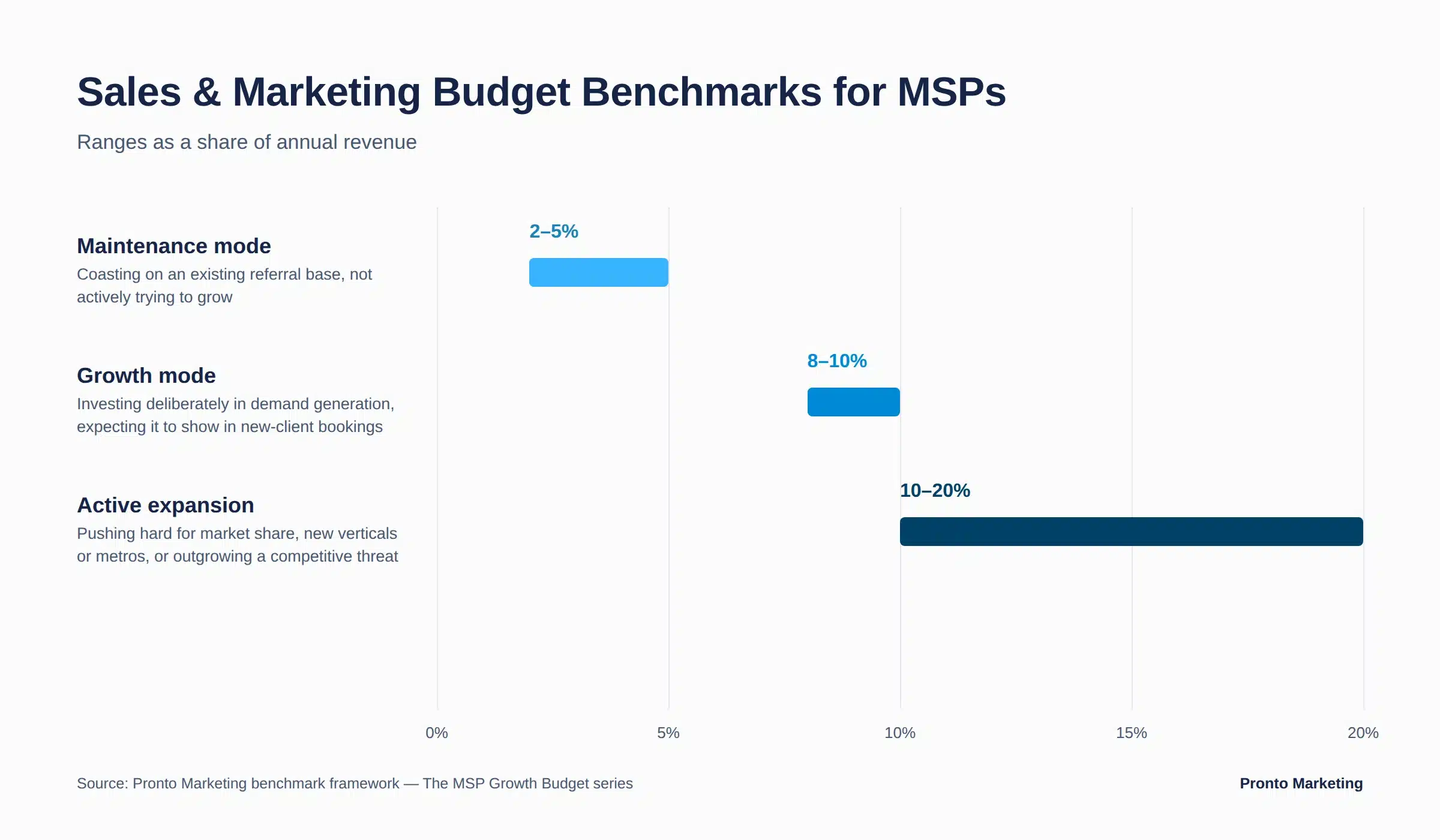
At $5M in revenue, that’s the difference between a $100K maintenance-mode budget and a $500-750K expansion-mode one. Neither number is “correct” in the abstract. It depends on what you’re trying to accomplish and what you can actually afford.
Why $3-10M is the inflection point
Below roughly $3M, most MSPs are still owner-led, and marketing decisions get made case by case rather than against a real number. Above $10M, you’re increasingly a target for private-equity roll-up activity, which changes who controls the marketing budget entirely.
The $3-10M range is where a real, planned budget starts to matter and where three things beyond revenue determine what you can actually afford:
Recurring revenue quality. If 65-85%+ of your revenue is contracted, predictable MRR, you can commit to a 6-12 month marketing plan with confidence. If a big chunk of your revenue is still project or break-fix work, your cash flow is lumpier than your revenue number suggests, and a smaller, more flexible budget is the safer call.
Margin cushion. A marketing commitment that eats 10% of EBITDA at one revenue level can eat 30-40% of it at another, even with the same top-line number. Run the EBITDA math before you set a dollar figure, not after.
What you’re already spending, just not calling “marketing.” This is the part most MSPs get wrong, and it’s the reason this is the first article in a series rather than a single post. Your website hosting and maintenance, your CRM and marketing automation tools, any vendor MDF you’re not using, and the lunch-and-learns or local sponsorships you already do all draw from the same growth budget, whether you’ve labeled them that way or not.
What this series covers
Over the next several posts, we’ll break down each piece of that real, holistic number:
- The real cost of SEO, AEO, and PPC for a growing MSP: what digital demand generation actually costs at your size, and what it should return.
- Lunch-and-learns, local sponsorships, and the marketing budget line nobody plans for: offline marketing isn’t dead, and it has real, plannable costs.
- MDF Funds for MSPs: How to Get Vendor Marketing Support: how to access co-op dollars that stretch your real budget further.
- Website, CRM, and martech: the hidden line items competing for your marketing budget: why your “IT costs” and your “marketing costs” are actually the same budget.
- Should you spend leftover 2026 marketing budget on PPC before December 31?: a clear-eyed look at a question every owner asks in Q4.
- Build your MSP’s 2027 sales and marketing budget: a worksheet: putting every piece above into one number you can actually plan against.
If you want help putting a real number behind your 2027 plan rather than guessing at one, Pronto’s MSP marketing team can walk through where your budget should go and what return is realistic at your size.