

Why should your MSP’s website maintenance and martech stack be budgeted as marketing growth spend rather than IT overhead?
Because your website, CRM, marketing automation, call tracking, and related systems directly support customer acquisition, conversion, attribution, and revenue growth.
For planning purposes, a $3–10M MSP should generally treat these as Sales & Marketing costs within SG&A, with website and martech expenses grouped under a separate Sales & Marketing Systems line rather than mixing them with payroll or Marketing Programs, Campaigns, and Advertising.
They may not look like traditional marketing spend, but they determine how efficiently the rest of your marketing budget performs.
Where website and martech costs should sit in your MSP budget
The mistake is not necessarily that MSPs fail to pay for these tools. Most already do.
The problem is that the expenses often sit in completely different budget categories.
Website hosting may be treated as IT overhead. CRM subscriptions may sit under software. Call tracking might be buried in an agency invoice.
That makes it difficult to see what your actual Sales & Marketing infrastructure costs.
A practical management-budgeting structure looks like this:
| Budget Level | Recommended classification |
|---|---|
| P&L | Selling, General & Administrative expenses |
| Functional category | Sales & Marketing Costs |
| Sub-category | Sales & Marketing Systems |
| Separate from | Sales & Marketing Payroll |
| Separate from | Marketing Programs, Campaigns & Advertising |
Under Sales & Marketing Systems, you would typically include expenses such as:
- Website hosting and maintenance
- CRM software
- Marketing automation
- Call tracking
- Analytics and reporting platforms
- Landing page or conversion tools
- Other software used to support marketing and sales execution
The exact chart-of-accounts structure will vary by business and accountant. The important point is the management view: these expenses should be visible as part of the cost of generating and converting demand, rather than disappearing into a generic IT or software bucket.
If you’re trying to determine the overall size of that budget first, our guide to how much an MSP should spend on sales and marketing provides the broader 2027 budgeting framework.
The website is not a sunk cost — it is where every other channel lands
Every dollar spent on SEO, AEO, PPC, email, partnerships, and other demand-generation activity is ultimately trying to move a prospect toward a conversion.
For most MSPs, the website is central to that process.
If the site is slow, poorly structured, difficult to update, or has not had a meaningful content or design refresh in years, you are paying full acquisition cost to send prospects into an asset that may be reducing conversion.
That makes website maintenance an ongoing growth expense, not a one-time project cost.
At minimum, that usually means budgeting for:
- Hosting
- Security and technical maintenance
- Page-speed and performance work
- Content updates
- Landing page creation
- Conversion improvements
- Periodic design or structural changes
A useful gut check: if your website has not had a meaningful content, conversion, or design update in more than two years, it may be acting as a drag on your other marketing channels rather than functioning as a neutral asset. However, your website isn’t a marketing machine by itself. If there are no marketing campaigns and advertising pointing to it, then looking at your entire marketing lead generation system may be in order first.
Your martech stack is part of the acquisition system
The same applies to your CRM and marketing technology.
A CRM, marketing automation platform, and call-tracking platform are not just administrative software.
They are the systems that tell you:
- Where leads came from
- Which channels produce qualified opportunities
- What happens after someone converts
- Which campaigns generate pipeline
- Where prospects fall out of the process
- Which marketing investments are actually producing revenue
Without that infrastructure, an MSP can spend heavily on SEO, AEO, paid media, and content while still having an incomplete view of what is working.
At minimum, a $3–10M MSP’s martech stack will often include:
CRM
Your CRM should do more than store contact records.
It should let you track lead source, lifecycle stage, opportunity value, close rate, and ideally revenue by acquisition channel.
If you cannot reliably tell whether an opportunity came from organic search, paid search, referral, events, or another source, your marketing reporting has a structural problem.
Marketing automation
Email automation and nurture sequences help convert prospects who are interested but not ready to speak with sales immediately.
Without this layer, many leads simply enter the CRM and then receive little or no structured follow-up.
Review-generation
Your CRM and/or your marketing automation platform should also be acting as review-generation system. The better you can connect your Marketing, Sales, and CSAT systems together, the more you’ll be able to automate this process. Do not discount the importance of this effort and consider it when deciding how you should invest in your marketing automation platform.
Reviews influence buyer trust and can support local search visibility.
For MSPs competing in a specific metro area, review volume, quality, and recency can materially affect how credible the company appears when a prospect compares providers.
Call tracking
A meaningful share of inquiries may arrive by phone rather than through a form.
Without call tracking, those conversions can be disconnected from the marketing activity that generated them, which makes channels appear less effective than they actually are.
Buying the software is not the same as having the system
There is another budgeting problem: licensing a tool is not the same as using it effectively.
Gartner’s 2026 CMO Spend Survey found that labor represented 24.5% of marketing budgets, up from 21.9% the previous year, even as AI and automation tools became more widely available.
The lesson for a smaller MSP is straightforward: software does not eliminate the need for someone to configure, maintain, interpret, and use it.
A CRM that is poorly configured can still produce bad attribution.
A marketing automation platform with no useful nurture sequences is just another subscription.
An all-in-one Sales & Marketing platform that nobody actively uses will not create reviews.
A call-tracking system that is not tied back to source and opportunity data will still leave reporting gaps.
When planning the budget, account for both the technology and the work required to make that technology useful.
Sales & Marketing Systems are not the same as campaign spend
This distinction matters.
Your website, CRM, and martech stack belong in the broader Sales & Marketing budget, but they should not be mixed into the same line as PPC spend, sponsorships, events, or content campaigns.
Those are different types of expenses.
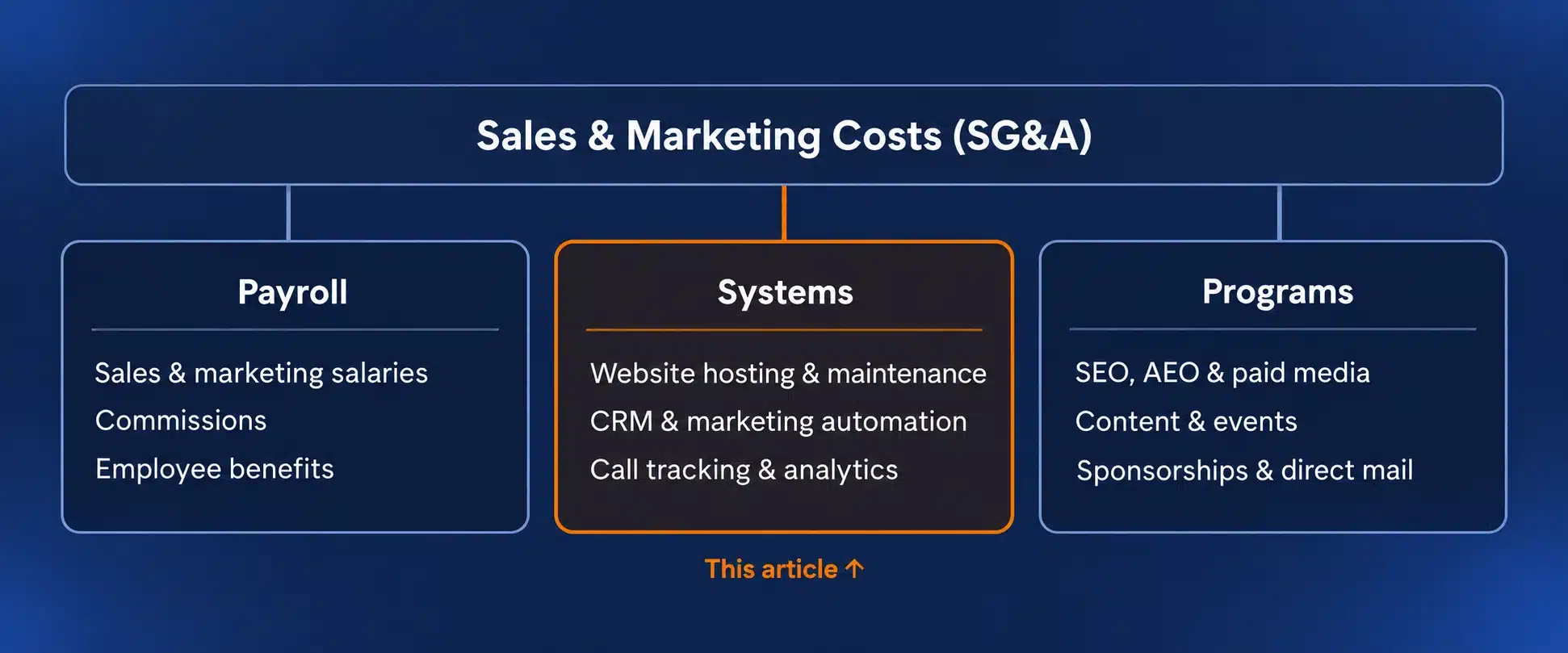
A useful internal structure is:
Sales & Marketing Costs
1. Payroll and employee-related costs
- Sales salaries
- Marketing salaries
- Commissions
- Benefits and related employee costs
2. Sales & Marketing Systems
- Website hosting, maintenance and support
- CRM
- Marketing automation
- Call tracking
- Reporting and analytics platforms
- Other recurring sales and marketing technology
3. Marketing Programs, Campaigns & Advertising
- PPC media spend
- SEO and AEO campaigns
- Content production
- Events
- Sponsorships
- Direct mail
- Paid media
- Other campaign-specific spend
Those program costs can include activities beyond digital marketing. For example, our guide to offline and local marketing for MSPs looks at lunch-and-learns, sponsorships, and other local demand-generation investments.
This separation makes the budget easier to manage.
It shows how much you are spending on the infrastructure required to run marketing versus the programs that actually create demand.
Why this belongs in the same planning conversation as your ad budget
The categories should be separate in the budget, but they should be planned together.
Suppose you increase paid search spend by $50,000 next year but your website still converts poorly, your CRM attribution is unreliable, and calls are not being tracked.
You have increased demand-generation spend without fixing the system that captures and measures the demand.
The reverse can also happen.
An MSP might spend heavily on HubSpot, reporting platforms, and website maintenance but underfund the programs required to actually bring new prospects into the funnel.
Both create imbalance.
That is why website and martech costs should be reviewed at the same time as SEO, AEO, PPC, content, events, and other growth investments.
They are different budget lines, but they are part of the same acquisition system.
The systems budget should also be planned alongside the actual cost of acquisition channels. Our breakdown of SEO, AEO, and PPC costs for growing MSPs shows what those programs can cost at different stages of growth.
For a broader view of how these investments fit into your overall growth plan, see our MSP marketing strategies guide, covering the main channels MSPs can use to generate more leads.
Use the full cost when benchmarking your marketing investment
This also matters when comparing your marketing spend with industry benchmarks.
If one MSP calculates its marketing budget using only advertising, SEO, and agency retainers while another includes CRM, website maintenance, marketing software, and internal systems, the percentages are not comparable.
For benchmarking operational and financial performance across IT solution providers, the ConnectWise Service Leadership Index is one of the industry’s established sources for comparing sales, marketing, and operating cost structures by business model and company size.
Whatever benchmark you use, make sure you understand what is included in the numerator before comparing your own percentage against it.
Otherwise, you may think your MSP is underspending or overspending when the real difference is simply how expenses have been categorized.
The practical fix
When you build your 2027 growth budget, put website and martech costs on the same planning calendar as your advertising, SEO, AEO, content, and campaign spend.
Start by identifying the full annual cost of your current Sales & Marketing Systems:
- Website hosting and maintenance
- CRM
- Marketing automation
- Call tracking
- Analytics and reporting
- Other sales and marketing technology
Then separate those expenses from both payroll and campaign spend.
If a website redesign, CRM cleanup, or martech upgrade is not funded this year, that may be a perfectly legitimate decision.
But it should be a deliberate budget decision, not something that happens because those costs were classified as IT overhead and left out of the growth planning process.
Your marketing budget should show not only what you spend to generate demand, but also what you spend on the systems required to capture, convert, and measure it.
Before assuming every program has to come entirely from your own budget, also check whether your vendors offer MDF funds for MSP marketing, which can help offset eligible campaign costs.
If you’re not sure whether your current website and martech stack are helping or hurting the return on your other marketing investments, Pronto’s MSP team can audit the system and identify where the main gaps are.