


“What should we do first?” is a question we hear often from law firm owners who are ready to spend real money on marketing for the first time. It usually arrives with a second question attached: which of these things will actually produce return on investment (ROI)?
Most agencies answer with whatever service they happen to sell. Our honest answer is that it depends on the state of your firm, and that answer only helps if we show our work. So this article does something different. We take one realistic example firm, run the same research we would run for a paying client, and lay out what we would do first, second, third, and fourth, with the numbers behind each call.
The short answer to “what marketing should an estate planning law firm do first?”
For a referral-built law firm, fix the foundation first: lead tracking, a fast website, and a page for each service. Then build reviews, so your Google Business Profile can carry paid ads. Then capture the demand that already exists with Local Services Ads and a tightly targeted search campaign. Invest in search rankings and AI visibility last, because they take six months or more to pay off, and by then the ad data will tell you exactly where to aim.
The order matters more than the channel mix. Each step makes the next one cheaper and more measurable, and skipping ahead is how marketing budgets get wasted. Here is how we get there.
How a Referral-Built $2M Estate Planning Firm Can Build Toward $4M
Who This Answer Is For
Law firms are an exception to the usual rules of business growth. Along with accounting firms and medical practices, a firm can reach $2 million or $3 million in revenue on the founding partners’ networking, a good name in the neighborhood, and the reviews that come from doing right by clients. They have done the free kind of marketing well. What they have never done is buy demand, or measure it. There is no ad spend, no customer database, and a website nobody has touched in years. When growth flattens and the partners decide to invest, they are starting from square one on everything that costs money.
That is why they ask what to do “first.” It is also why they ask about return, because lawyers are analytical and protective of their capital, and they want a proven path before they write a check. If your firm is in that $1.5 million to $3 million band, this article was written for you. If you are past $5 million with an in-house marketing team, you are asking a different question.
Meet the Firm: Bellwether Estate Law
Bellwether Estate Law is a made-up firm, but every detail comes from real client situations we see every month. Four attorneys in Bay Ridge, Brooklyn. About $2.1 million a year, almost all of it from referrals. The partners want to reach $4 million within three years, which works out to roughly 20 to 25 additional new clients a month, and a typical new client is worth about $4,500.
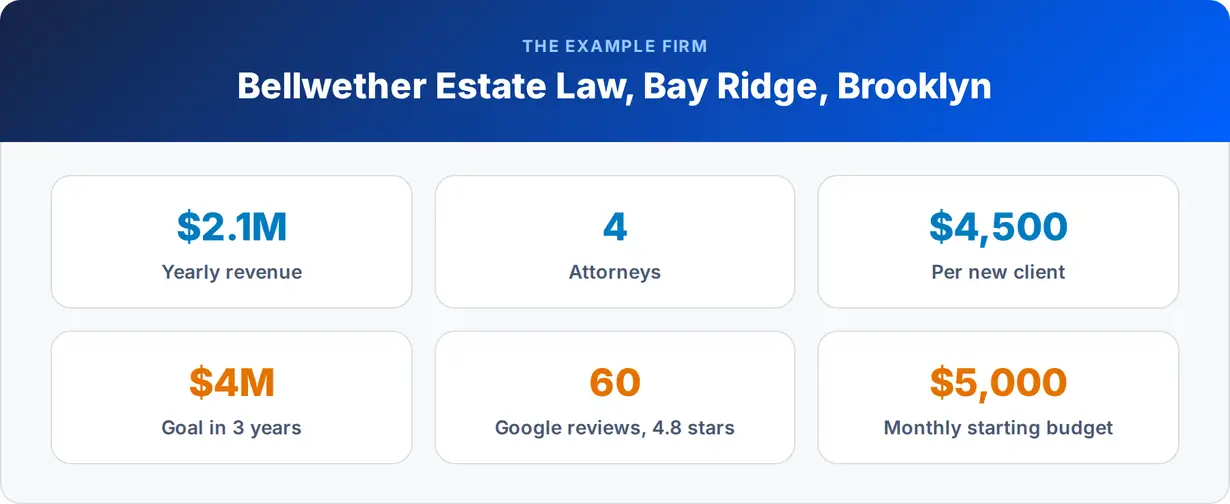
The example firm at a glance. Every figure is drawn from firms we have worked with or spoken to.
Where their marketing stands today is the part that matters. They cannot tell where their calls and inquiries come from. The website is six years old, loads slowly, and has one general services page. They have about 60 Google reviews at 4.8 stars, a solid base, but the firm that dominates the local map has more than 200. They spend $1,500 a month on an ad campaign nobody has reviewed since 2023, they do not use Google’s Local Services Ads, and if you ask ChatGPT for an estate planning lawyer in Brooklyn, they are not mentioned.
How Much Should a $2 Million Estate Planning Law Firm Spend on Marketing?
| Priority | Channel | When to start | Role |
|---|---|---|---|
| 1 | Tracking + website foundation | Weeks 1–4 | Measure and convert demand |
| 2 | Reviews + GBP | Week 2 onward | Establish local trust |
| 3 | Local Services Ads | Months 1–3 | Capture highest-intent demand |
| 4 | Google Search Ads | Months 1–3 | Expand measurable demand |
| 5 | SEO + AI visibility | Build early; expect longer payoff | Compound long-term acquisition |
What It Would Really Take, and What They Are Willing to Spend
Before recommending a channel, we do the math. In legal marketing, a healthy cost to acquire a client is 10 to 20 percent of the case value. At 15 percent of $4,500, that is about $675 per client. Multiply by 25 new clients a month and the budget the math wants is roughly $17,000 a month, or about $200,000 a year, which is close to 10 percent of current revenue. For a firm trying to double in three years, 10 percent of revenue is a standard, conservative benchmark.
Now the other side of the table. These partners built a $2.1 million firm on referrals, so their historical cost per client is close to zero. They are looking for a starter budget that proves itself before it grows. Telling them to wire $17,000 a month to an agency they have never worked with ends the meeting.
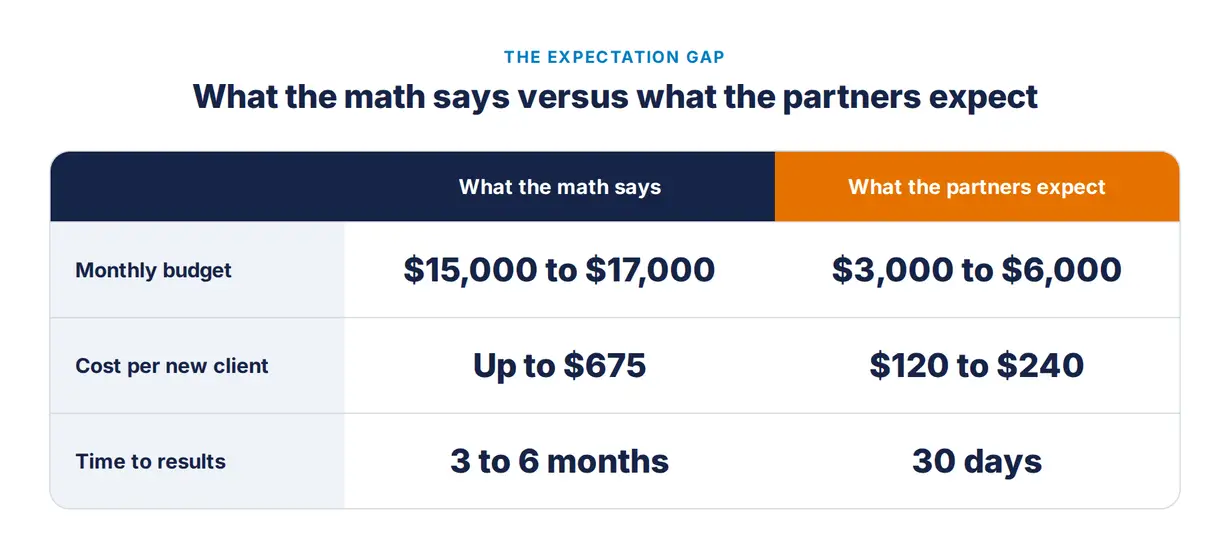
The gap between what a healthy budget looks like and what a referral-built firm expects to spend.
The gap looks unbridgeable until you notice one thing: the number the partners hope a client will cost is not a fantasy for every channel. Local Services Ads, where firms pay per inquiry rather than per click, can land an estate planning client inside that range. So we do not ask for $17,000 up front. We break the engagement into two phases.
Phase one, months one to three, is a proof of concept: $5,000 to $7,500 a month on the foundation work and the highest-intent channels, aimed at Bay Ridge and Brooklyn specifically. The goal is not 25 clients yet. The goal is to prove that a $4,500 case can be bought for well under $700. Phase two, from month four, is the scale phase. Once the partners see a report showing that last month’s $6,000 produced nine signed retainers, the math clicks, and they become the ones asking how much more they can spend.
That instinct, spend carefully and prove it works, is exactly right. The research below is how we earn the right to the bigger budget.
Local Services Ads vs. Google Ads vs. SEO: What Should an Estate Planning Firm Do First?
The Research We Do Before Recommending Anything
- Is demand for this service growing?
Interest in estate planning is rising nationwide, driven by retiring baby boomers. Searches for the core phrase have more than doubled since the 2021 to 2023 baseline, from about 25,000 a month to about 56,000, and LegalShield’s data shows estate planning is now 1 in 6 consumer legal inquiries, up from 1 in 9 a decade ago (reported by InvestmentNews, August 2026). Bellwether is fishing in a pond that is getting bigger.
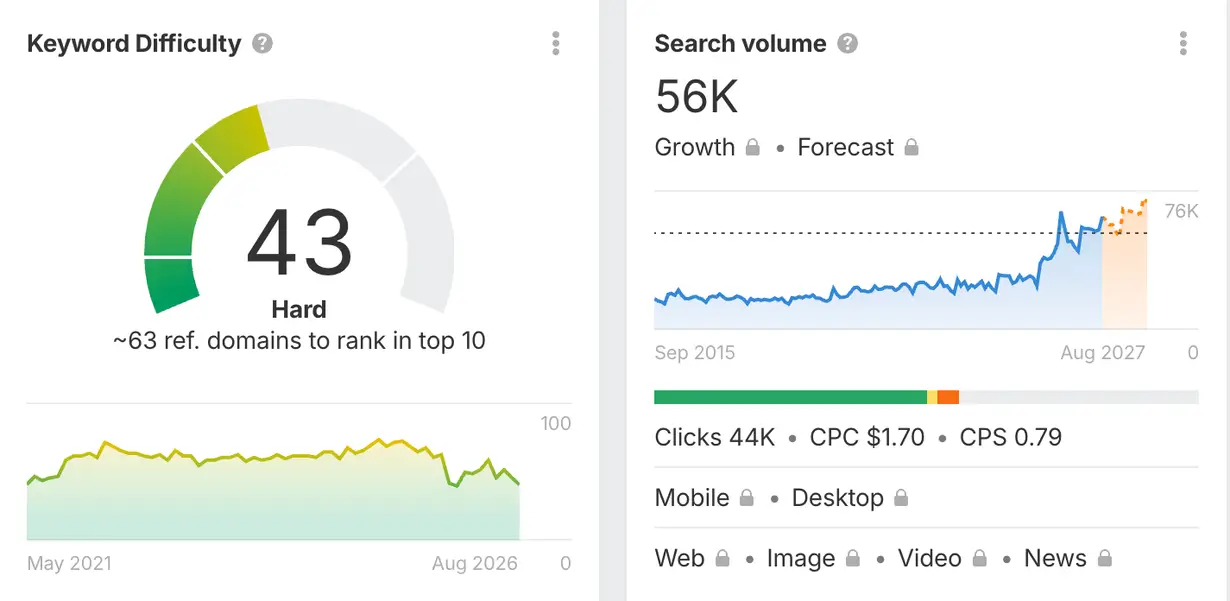
US search interest in “estate planning,” with the keyword difficulty score on the left. Source: Ahrefs.
- How many people nearby are actually searching?
National demand does not pay a Brooklyn firm’s bills, so we check the local phrases. “Estate planning attorney nyc” gets about 900 searches a month, and Brooklyn, Queens, and Long Island variations add roughly 400 more. Exact-phrase counts understate real demand, because many people search “near me” or type a generic phrase with local intent, but the direction is clear.

Combined monthly searches for ten New York estate planning phrases over the last two years. Source: Ahrefs.
- What would paid ads cost, and does the budget cover them?
Legal is the most expensive of the 23 industries tracked in WordStream’s 2026 benchmarks, at $9.87 per click on average across more than 13,000 campaigns. That average is inflated by injury and accident firms. The estate planning phrases we checked run $2.50 to $4 per click, a fraction of the category number.
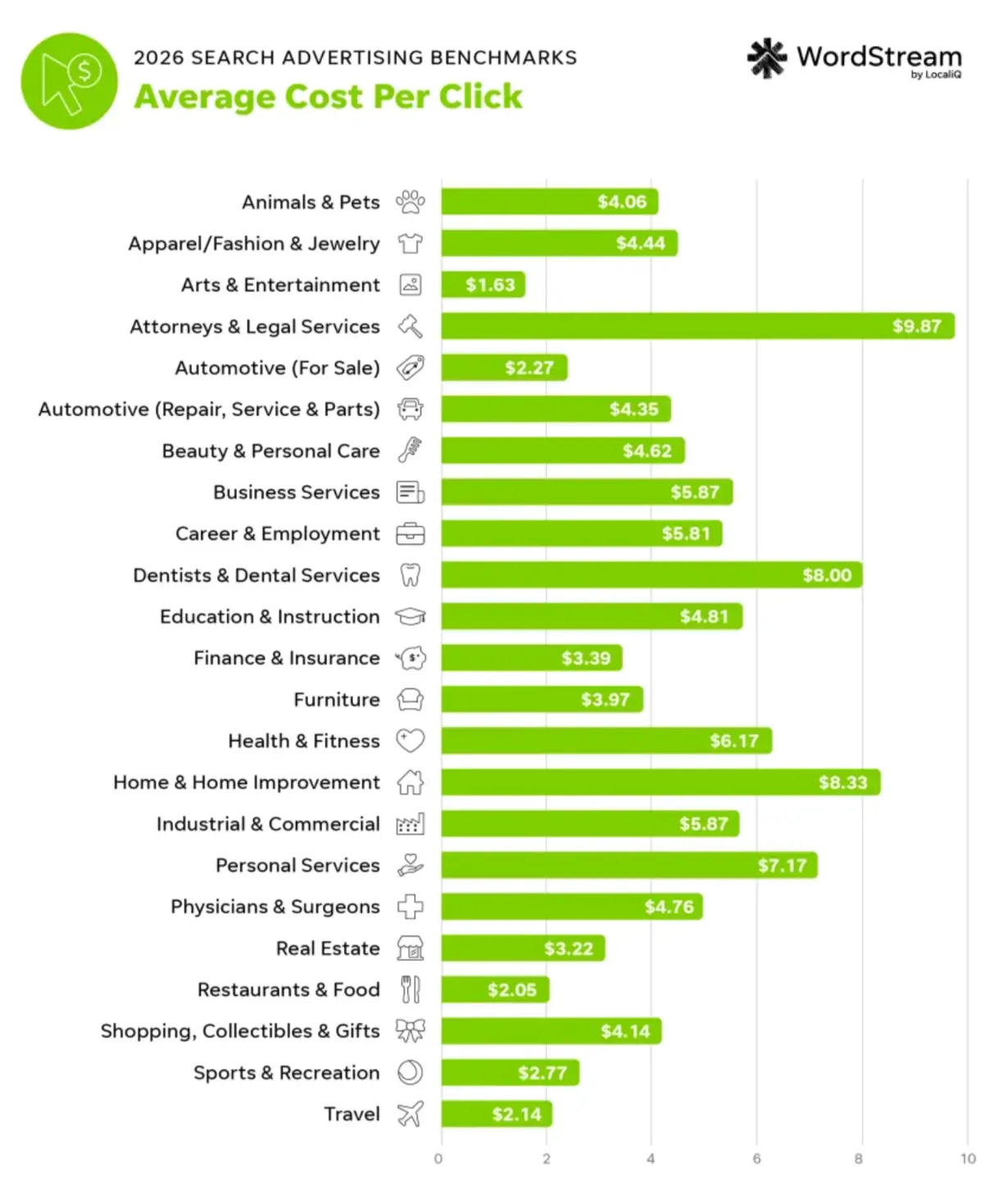
Average cost per click by industry. Source: WordStream, May 2026.
Google’s Local Services Ads change the math again. These ads sit above the regular results and charge per inquiry rather than per click, and an estate planning inquiry runs about $50, with roughly four in ten becoming cases, according to My Legal Academy’s 2026 guide for law firms. That works out to about $125 per signed client, well under the $675 ceiling from the budget math.
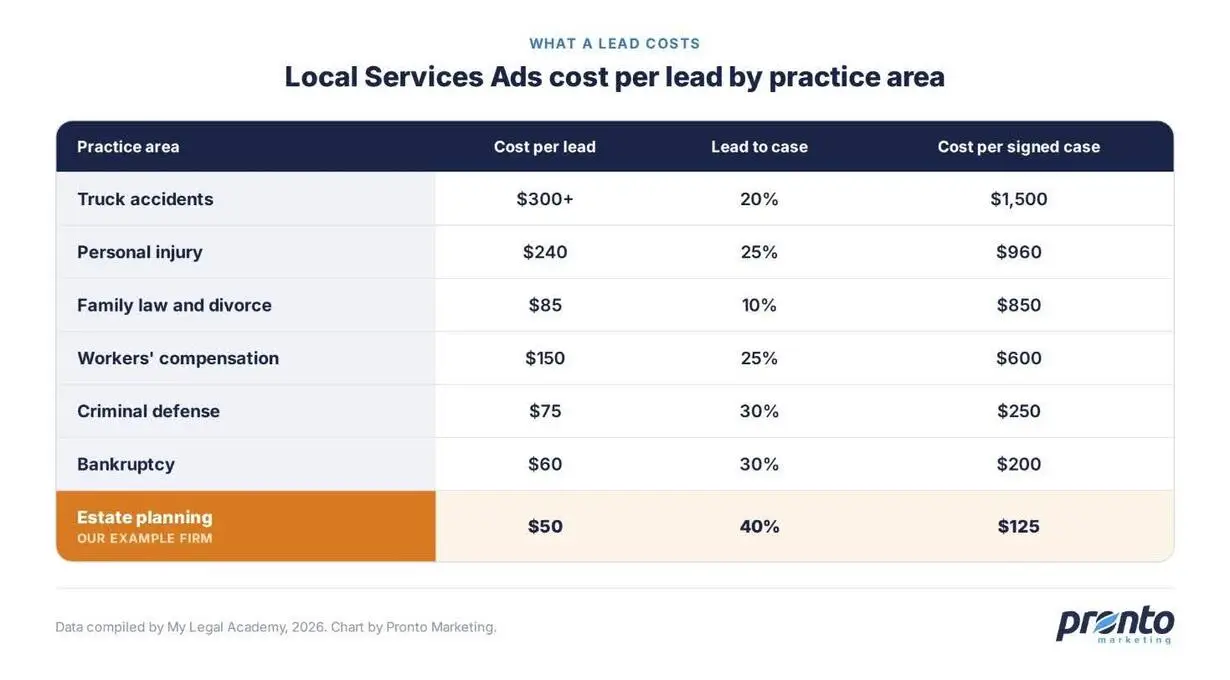
Local Services Ads cost per lead by practice area. Estate planning has the cheapest leads on the board and the highest rate of turning into cases.
- How do their reviews compare with the firms winning on Google Maps?
Map results decide who gets the call for a local service, and reviews decide the map. The three firms that appear most often for estate planning in Bay Ridge have 212, 83, and 51 reviews with ratings of 4.9 to 5.0. Bellwether’s 60 reviews at 4.8 put it in the conversation but not at the top of it. We also check whether the firm is listed correctly in the legal directories that matter, since those listings feed both Google and AI answers.
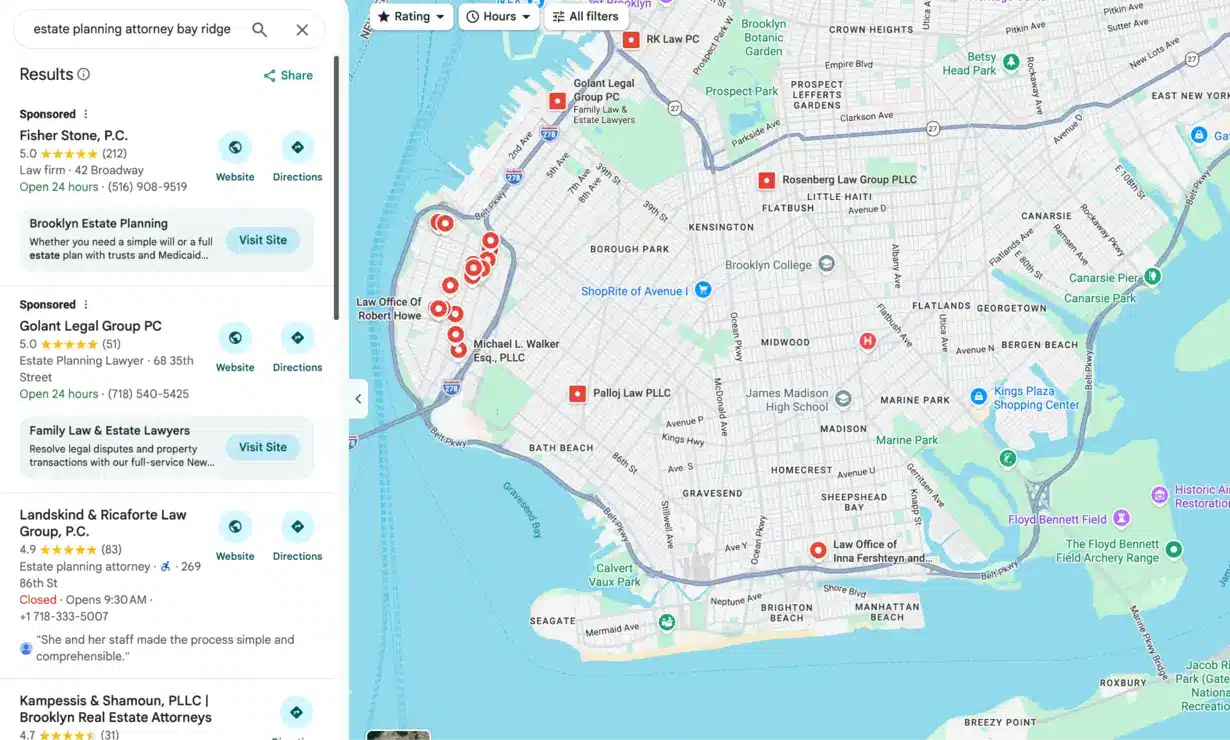
Google Maps results for “estate planning attorney bay ridge,” August 2026. The top two results are paid placements bought through Google Ads.
- Can they realistically rank in Google search yet?
Ahrefs, the search data tool we use, rates the phrases Bellwether needs as hard to rank for and estimates that a site needs links from roughly 60 other websites to compete for the top ten, while the firm’s website has very little authority today. Rankings will come, but not in month one. We also look at what information their audience needs while deciding, because nobody impulse-buys an estate plan. People compare credentials, read reviews, and take weeks to choose.
- What do AI tools say?
We asked ChatGPT to recommend an estate planning lawyer in Brooklyn.
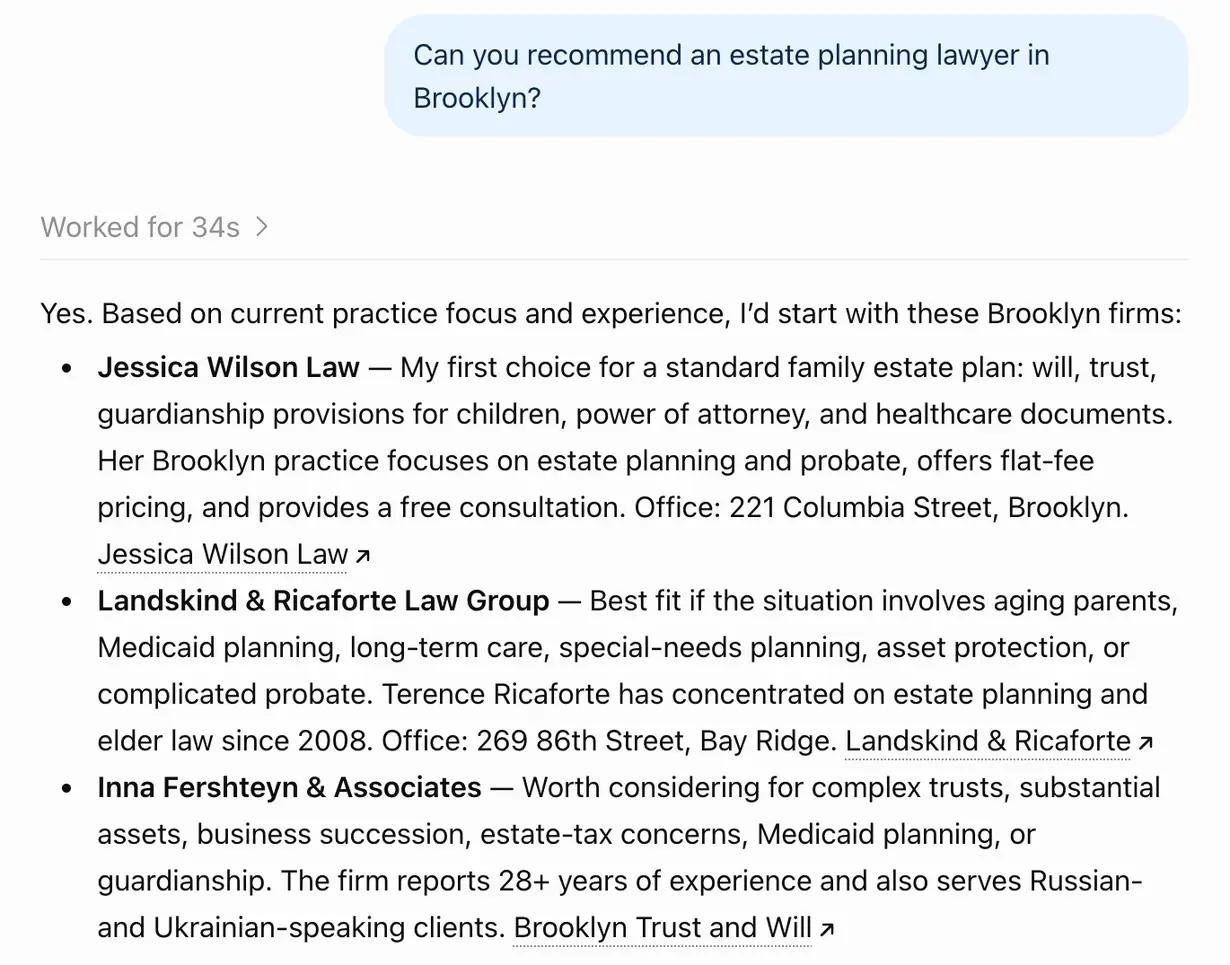
ChatGPT’s answer to “Can you recommend an estate planning lawyer in Brooklyn?”
It answered with three firms, one of them the firm at the top of the unpaid map results in check 4, and for each it cited the details a good website makes easy to find: the services offered, flat-fee pricing, years in practice, and the office address. Bellwether does not appear, and it will not until the fundamentals above are fixed. This is not a separate project with separate tricks, and we explain why in our video, Why AI Search Recommends Your Competitors Instead of You.
The signals that win Google’s map and search results are the same signals AI assistants use to decide whom to recommend.
- Can results even be measured?
The last check is the least glamorous and the most important. Bellwether cannot tell which calls came from the website, the ad campaign, or a referral, so nobody can say whether the $1,500 a month is working. Until inquiries can be tracked back to their source, every other recommendation is a guess.
What We Would Do First, in Order
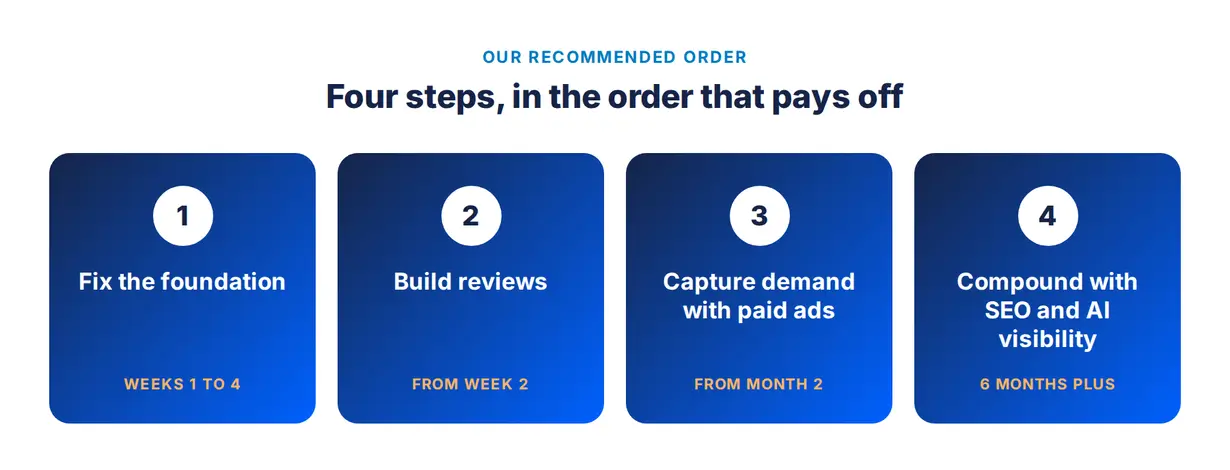
The sequence we would recommend for the example firm. A firm with a strong website or a large review base would enter at a later step.
- Fix the foundation (weeks one to four)
Set up call and form tracking before spending anything new, so every later dollar can be measured. Speed up the website. Create a page for each service, trusts, probate, and elder law, because a single general services page cannot rank for any of them or convince a visitor who came looking for one. Nothing in this step generates a lead by itself, and everything after it depends on it. That is exactly why it comes first.
- Build reviews and the Google Business Profile
Ask every satisfied client for a review, and encourage them to mention the service and the neighborhood in their own words. Grow from 60 reviews past 100 and keep going, which is what our most successful estate law clients do. Fix outdated directory listings while you are at it, and keep the Google Business Profile complete and current. This step starts in week two and never really ends.
- Capture the demand that already exists with paid ads
Begin with Local Services Ads. They run off the Google Business Profile, which is why step two comes first, and they fit a proof-of-concept budget because you pay per inquiry rather than per click. Then rebuild the neglected search campaign so it targets specific services and boroughs and filters out irrelevant searches. If the benchmarks hold, a Local Services Ads client should cost around $125 to win and a search ads client a few hundred dollars, both far below the $675 ceiling against a typical value of $4,500. The tracking from step one will prove it either way.
- Invest in search rankings and AI visibility for the long term
Pages for each service and neighborhood, answers to the questions clients ask before hiring, and steady work earning links from reputable websites. This takes six months or more to pay off. By then, the ad data will show exactly which searches produce clients, so the content investment goes where the money already is.
This order is not theory. An estate planning client of ours in the Chicago suburbs, in the same revenue band as Bellwether, went through it in exactly this sequence: one-off website and SEO fixes to secure the foundation, then a Local Services Ads campaign that produced results quickly, then continued investment in search rankings. Today the firm has more than 100 reviews and a steady flow of signed matters from a modest Local Services Ads budget.
What We Would Tell Them Not to Do Yet
Brand advertising, social media as a main channel, sponsorships, cold outreach, and long SEO contracts signed before the website can turn a visitor into an inquiry. None of these are bad. They are simply the wrong first dollar for a firm in Bellwether’s position, because none of them can be measured yet and none of them capture demand that already exists.
Paid legal directories deserve a special mention. This summer 2026, one of our law firm clients forwarded us a paid directory pitch and asked whether it was necessary. Our SEO team’s advice was to claim the free profiles first, and our account manager’s verdict was that the same money would return more in Local Services Ads, paid search, or SEO, with paid directories well down the list. The client passed on the directory and put the budget into ads and SEO instead.
If Your Business Is Not This Firm
A firm with plenty of reviews, an established website, or a different kind of client would get a different order. A personal injury firm paying $100 or more per click starts with very different math. An accounting firm with 300 reviews and a fast site can skip to step three on day one. The diagnosis stays the same: check demand, check cost, check what you already have, and put the first dollar where it can be measured.
Frequently Asked Questions
How much should a law firm spend on marketing?
A firm that wants to grow meaningfully typically spends around 10 percent of revenue on marketing, and a healthy cost per new client is 10 to 20 percent of the case value. A referral-built firm does not need to start there. Begin with a budget that can prove itself, then scale it as the cost per client comes in.
Should a law firm choose SEO or Google Ads?
Both, in the right order. Ads and Local Services Ads capture demand that already exists and produce results in weeks, which funds the longer work. SEO builds authority that keeps producing after the ad spend stops, but it takes six months or more. Skipping ads means waiting, and skipping SEO means renting your leads forever.
How long does SEO take to work for a law firm?
For competitive local legal terms, expect three to six months for meaningful movement and longer for the hardest phrases, because a new site has to earn authority before Google trusts it. Results compound from there. Anyone promising page one in weeks is a red flag.
What is the fastest way for a law firm to get new clients?
Local Services Ads on a strong Google Business Profile. They appear above the regular results, charge per inquiry rather than per click, and can start producing calls within days. The catch is that they lean on your reviews, so a firm with 20 reviews will get far fewer of them than a firm with 100.
The Bottom Line on What Law Firm Marketing to Do First
There is no single best first channel, and anyone who tells you otherwise is selling one. For a referral-built law firm with a real budget and a weak foundation, the order is clear: make results measurable, build the reviews that everything else leans on, capture existing demand with pay-per-inquiry ads, then invest in rankings and AI visibility once the data shows where to aim. Each step earns the budget for the next.
Would you like us to run this same research on your firm? Schedule a free consultation and we will show you the numbers before we recommend anything.