

SEO works by making your website easier for search engines to find, understand, trust, and match with the searches your potential customers make.
For a small business, that means identifying what customers search for, creating useful pages that answer those searches, making those pages easy for Google to crawl and understand, and building enough credibility through links, reviews, mentions, and business information for search engines to trust them.
In practical terms, SEO works in four stages:
- Search engines discover and index your website.
- They determine what each page is about.
- They compare its relevance and credibility with competing pages.
- They rank the pages they believe best answer each search.
The result you want isn’t simply more traffic. For a small business, SEO should make you visible when potential customers are actively searching for the products, services, or expertise you provide.
What Is SEO? (in Plain English)
Search engine optimization (SEO) is the process of improving your website so that search engines can understand it and potential customers can find it when they search for relevant information, products, or services.
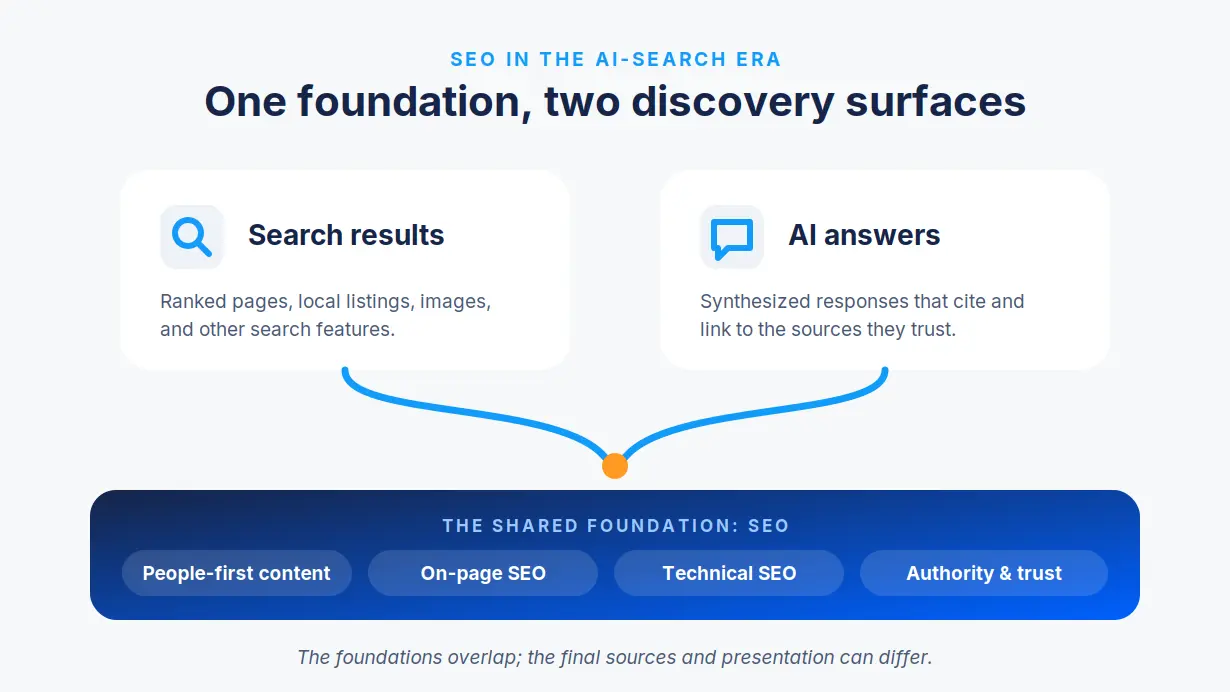
SEO isn’t one activity. It combines useful content, on-page optimization, technical website improvements, and signals of authority and trust.
Separate SEO from its paid sibling, too. Ads buy a temporary spot at the top of the page, while SEO earns a position that keeps working after the spending stops. Neither guarantees a specific rank, but organic visibility compounds in a way an ad budget never does.
One more correction: the goal is not traffic, it is the right traffic. An IT provider gains more from ranking for “ransomware recovery plan” than from ten thousand visitors who only want a definition of malware. Qualified visibility beats raw volume every time.
SEO’s reputation problem is that the rules seem to change every quarter.
The reassuring truth is that tactics change but the job does not. Interfaces and algorithms shift, and SEO’s basic job stays fixed: make the best answer easy to find, understand, trust, and use. Every major update Google has shipped in twenty years, and every AI answer engine since, rewards exactly that.
How Does SEO Work, Step by Step?
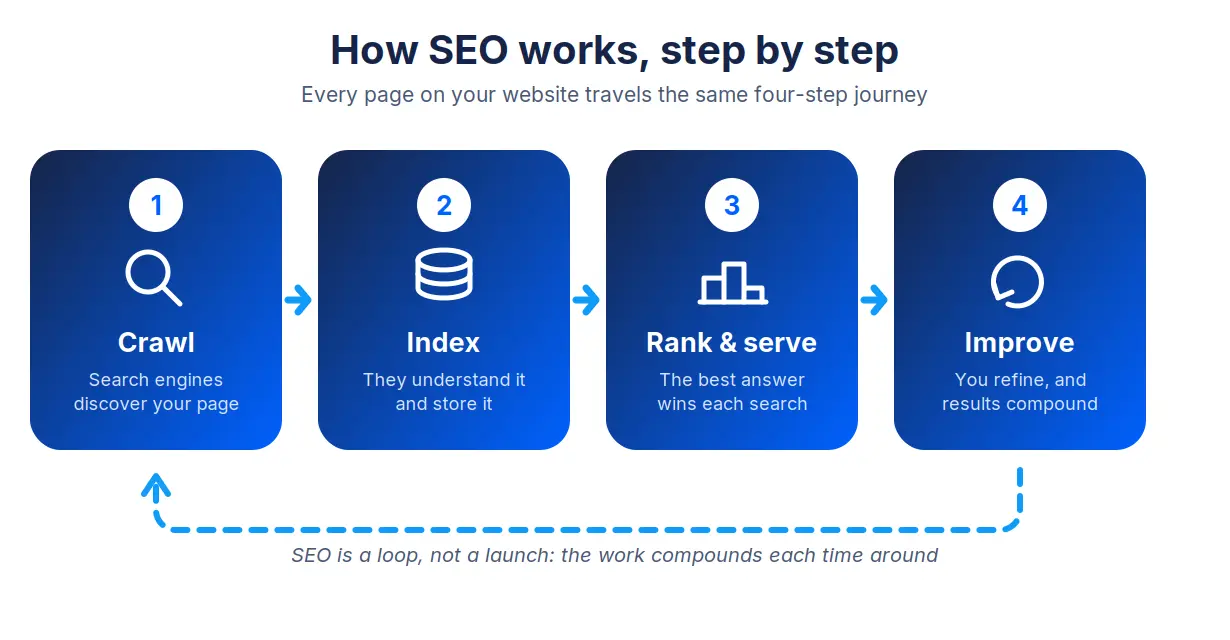
SEO works by helping search engines discover your pages, understand what they’re about, and determine whether they deserve to appear for a particular search.
This is not our framework; it is how Google itself describes Search: crawling, indexing, and serving. The clearest way to see the machine is to follow one page through it. Say you run a managed IT services business and you have just published a page called “Ransomware protection for small businesses: what it costs and how it works.” Here is the journey that page takes.
Step 1: Crawling, where search engines discover your page
Search engines run automated programs called crawlers that follow links from page to page, helped by your sitemap. Your new ransomware page gets discovered because your services page links to it and your sitemap lists it.
This step is pass or fail. If a crawler cannot reach the page, whether from broken navigation, a stray “noindex” tag, or a blocked folder, nothing else in SEO can help it.
For SEO to work, search engines first need to be able to access your important pages.
Step 2: Indexing, where they understand and store it
Once a page is crawled and discovered, a search engine analyzes its content and attempts to understand what it is about.
It considers elements such as:
- The main content on the page
- Page titles and headings
- Internal and external links
- Images and other media
- Structured information about the page
- How the page relates to other pages on the website
If the search engine decides the page is suitable for its index, it can become eligible to appear in search results.
Being crawled does not guarantee being indexed, and thin or duplicate pages are the usual casualties.
The surprise: a page that loads fine in your browser is not necessarily searchable. Clear structure earns its keep here, because your headings literally tell the engine what each section of the page is about.
Step 3: Ranking and serving, where the best answer wins
When someone performs a search, the search engine evaluates pages in its index and determines which ones are most likely to satisfy that search.
There isn’t one universal “SEO score” that determines the order.
Search engines evaluate many signals, but for a business website the practical factors generally come down to:
- How relevant the page is to the search
- How useful and complete the content is
- Whether the website is technically accessible and usable
- Whether the business and website demonstrate credibility and authority
- Whether the page provides a good experience for the person searching
SEO is the process of improving these factors so your pages have a better chance of being selected.
For example, when a facilities manager searches “ransomware protection for small business,” the engine compares every indexed page that could answer her and serves the ones that score best on relevance, quality, usability, and trust, weighed against context like location, device, and freshness.
Two honest caveats belong in any explanation of ranking: no single factor decides it, and no rank is permanent. You are not “position 4”; you are position 4 today, for that query.
Step 4: Improving, where the loop repeats
This is the step most owners never see. You watch which searches actually bring people in (Google Search Console shows this for free), spot where the page underperforms, and improve it. The data tells you which fix each page needs: impressions without clicks means a weak title, traffic without inquiries means no clear next step, and no impressions means a discovery problem.
SEO is a loop, not a launch, and every trip around the loop makes your page harder to displace. That is why monthly SEO investments compound while ads simply stop.
How Does SEO Work for Small Businesses?
SEO works for a small business by connecting the searches potential customers make with the pages on your website that best answer those searches.
For example, a local accountant might optimize for “small business tax accountant in Denver,” while an IT provider might create a page answering “managed IT services for small businesses.” SEO helps Google discover those pages, understand their relevance, and decide whether they deserve to appear ahead of competing results.
SEO is not a switch that pushes your website to the top of Google. It is a connected system, and the rest of this guide unpacks it, from the mechanics to the four fundamentals to what really changes with AI.
It requires a strategy around what potential customers might search.
For that same example accounting firm in Denver, valuable, non-branded searches might be:
- “small business accountant Denver”
- “bookkeeping services for small business”
- “how much does a small business accountant cost?”
- “tax accountant for LLC near me”
Those searches represent different customer needs and different stages of the buying process.
The accounting firm’s SEO strategy would involve creating or improving pages that genuinely satisfy those needs. Search engines then need to discover those pages, understand their relevance, and determine whether they are credible enough to appear ahead of competing results.
The basic process looks like this:
- Customer searches
- Relevant business page
- Search engine crawls and indexes it
- Relevance and credibility are evaluated
- Page can appear in search results
- Potential customer visits the website
- Visitor can become a lead or customer
This is why effective small-business SEO isn’t about trying to rank for as many keywords as possible.
It’s about becoming visible for the searches made by the people the business actually wants to reach.
The Four Fundamentals That Make SEO Work in 2026
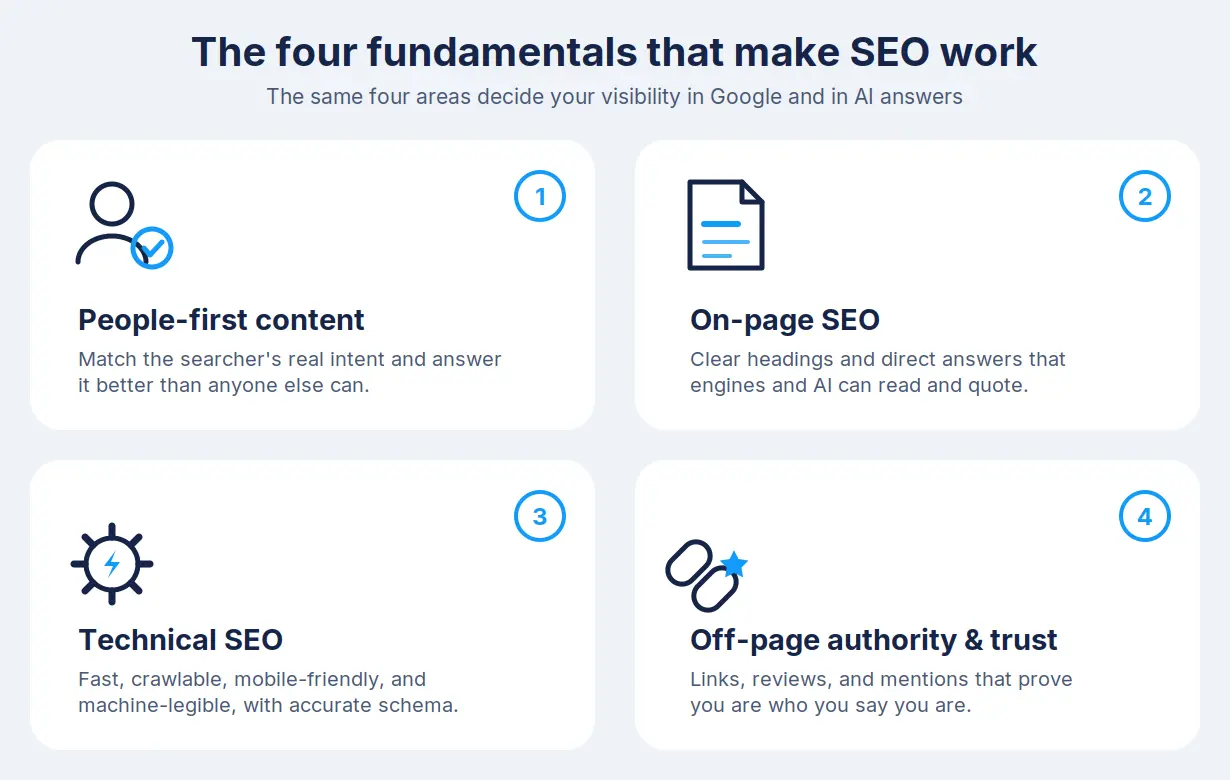
While SEO involves many individual tactics, most of the work falls into four broad areas.
The four steps explain the machine. The four fundamentals decide whether the machine favors you. SEO gets divided into specialties, but it only produces results as one system: great content earns nothing if the page cannot be indexed, a flawless page that says nothing useful earns nothing either, and strong links cannot rescue a confusing site. Every strategy we run is some mix of the same four areas.
1. People-first content
SEO content gives search engines something useful to show people when they search.
A business website needs pages that satisfy the questions and needs of its potential customers.
Depending on the business, that might include:
- Product or service pages
- Location pages
- Guides and educational articles
- Case studies
- Comparison pages
- Frequently asked questions
Good SEO content isn’t created simply to include keywords. It should provide a genuinely useful answer while making the subject of the page clear to search engines.
Everything starts with search intent. A person searching “how much does managed IT support cost” wants numbers, not a lecture about the importance of technology. Work out whether the searcher wants to learn, compare, or hire, then answer that exact question at that exact depth. Relevance to intent is the closest thing SEO has to a master switch. Then add what a competitor cannot copy: your data, your examples, your first-hand experience. Generic content is now invisible twice over, because it neither ranks in Google nor gets cited by AI.
2. On-page SEO
On-page SEO helps search engines and users understand what an individual page is about.
This includes elements such as:
- Page titles
- Headings
- URLs
- Internal links
- Image information
- Page structure
- Clear topical focus
These signals help reinforce the meaning and purpose of a page.
In other words, on-page SEO is how you package the answer. Descriptive headings that say what each section covers, a direct answer placed near the top, page titles and descriptions that match the words people search, and internal links that connect related pages. The structure that wins featured snippets is the same structure an AI model can lift and quote, and that is not a coincidence. Both systems reward pages that make the answer easy to extract.
3. Technical SEO
Technical SEO makes it easier for search engines to access, crawl, understand, and index your website.
Common technical SEO considerations include:
- Crawlability
- Indexability
- Website speed
- Mobile usability
- HTTPS
- Site architecture
- Canonicalization
- Redirects
- Structured data
A technically sound website doesn’t automatically rank well, but serious technical problems can prevent otherwise good content from performing.
Done well, technical SEO keeps the machine’s path to your content clear: pages that load fast, work on phones, can be crawled without obstacles, and carry structured data (schema) that accurately describes what is visibly on the page. None of it is glamorous, and none of it is optional, because a site that crawlers cannot parse is a site AI systems cannot read either.
4. Off-page SEO
Off-page SEO helps demonstrate that your business and website are credible beyond what you say about yourself.
Search engines do not only listen to what you say about yourself; they ask the rest of the web about you. Links from relevant sites, customer reviews, mentions in directories and industry press, and consistent business details everywhere all vouch for you. This is reputation, not a numbers game: one legitimate mention from an industry association can outweigh dozens of links from unrelated sites. And one myth worth retiring: “domain authority” is a diagnostic score from third-party tools, not a number Google uses. It is a useful thermometer and the wrong thing to optimize.
Links from other websites have historically been an important part of this, but authority can also be reinforced by broader signals such as brand mentions, reviews, citations, expert recognition, and consistent business information.
For small businesses, this means real-world reputation and online visibility increasingly overlap.
Once you understand these fundamentals, the next step is turning them into an actionable SEO strategy for your digital marketing.
How Does SEO Help a Small Business Get Customers?
SEO helps a small business get customers by increasing its visibility when potential customers are actively searching for a problem, product, or service the business can address.
This distinction matters because not all website traffic has equal commercial value.
Consider three searches:
Informational:
“How much does a roof replacement cost?”
Commercial:
“Best roofing company for flat roofs”
Transactional/local:
“Roof repair company near me”
All three searches could be relevant to a roofing business, but they represent different levels of buying intent.
Someone researching replacement costs may be early in the decision process. Someone searching for a roofing company is much closer to choosing a provider.
A good SEO strategy therefore doesn’t optimize purely for traffic volume. It identifies searches that can contribute to the customer journey and creates the right pages for each stage.
For most small businesses, the useful question isn’t:
“How much organic traffic can we get?”
It’s:
“Are the right potential customers finding us when they search?”
SEO for Small Businesses: What to Do First
A small business should start SEO by making sure search engines can access its website, identifying searches with genuine customer intent, creating or improving pages for those searches, strengthening credibility, and measuring business results rather than rankings alone.
A practical starting sequence is:
1. Make Sure Your Website Can Be Crawled and Indexed
Before investing heavily in content, confirm that search engines can access and index the pages you want people to find.
Technical issues can undermine everything else you do.
2. Identify How Your Customers Search
Keyword research shouldn’t begin with search volume alone.
Start with your customers.
What problems are they trying to solve? What services do they search for? What questions do they ask before contacting you? Does location matter?
Those questions help identify the searches most likely to have business value.
3. Match Important Searches With the Right Pages
Once you understand what customers search for, determine which page should provide the best answer.
Some searches require a service page. Others are better served by an educational article, comparison, location page, case study, or FAQ.
Avoid forcing unrelated searches onto one page.
4. Strengthen Trust and Authority
Make it easy for both potential customers and search engines to verify who you are and why your business is credible.
Depending on the business, this can include:
- Customer reviews
- Relevant backlinks
- Industry memberships
- Expert authorship
- Case studies
- Accurate business listings
- Original research or expertise
- Clear contact and company information
5. Measure Leads and Revenue, Not Just Rankings
Rankings can help diagnose SEO performance, but they’re not the ultimate business objective.
Track outcomes such as:
- Qualified organic traffic
- Contact-form submissions
- Phone calls
- Appointments
- Demo requests
- Ecommerce sales
- Other meaningful conversions
SEO is valuable when search visibility contributes to business results.
How Long Does SEO Take to Work for a Small Business?
SEO usually takes time because search engines need to discover changes, evaluate pages, and compare your website with established competitors. Meaningful improvement often takes several months, although there is no universal timeline.
How quickly SEO works depends on factors including:
- How competitive your market is
- The current condition of your website
- Your existing authority and reputation
- The quality of competing pages
- The searches you’re targeting
- The scale and quality of the SEO work
- Whether you’re improving existing pages or starting from scratch
An established business improving a page that already ranks may see movement much sooner than a new website entering a competitive market.
For most small-business sites, meaningful movement takes three to six months, and competitive keywords take longer; Google’s own guidance notes that site-wide quality work can take several months to be reflected. Results compound from there.
Treat anyone promising page one in weeks as a red flag.
A more useful approach is to monitor whether important pages are being indexed, gaining relevant impressions and visibility, attracting qualified visitors, and ultimately contributing to leads and sales.
Does SEO Still Matter Now That People Use AI Search?
Yes. AI search does not replace SEO; it consumes it. When ChatGPT, Perplexity, Claude, or Google’s AI Overviews assemble an answer, they draw on web sources and cite them, and the sources they trust are overwhelmingly the pages that already do the four fundamentals well.
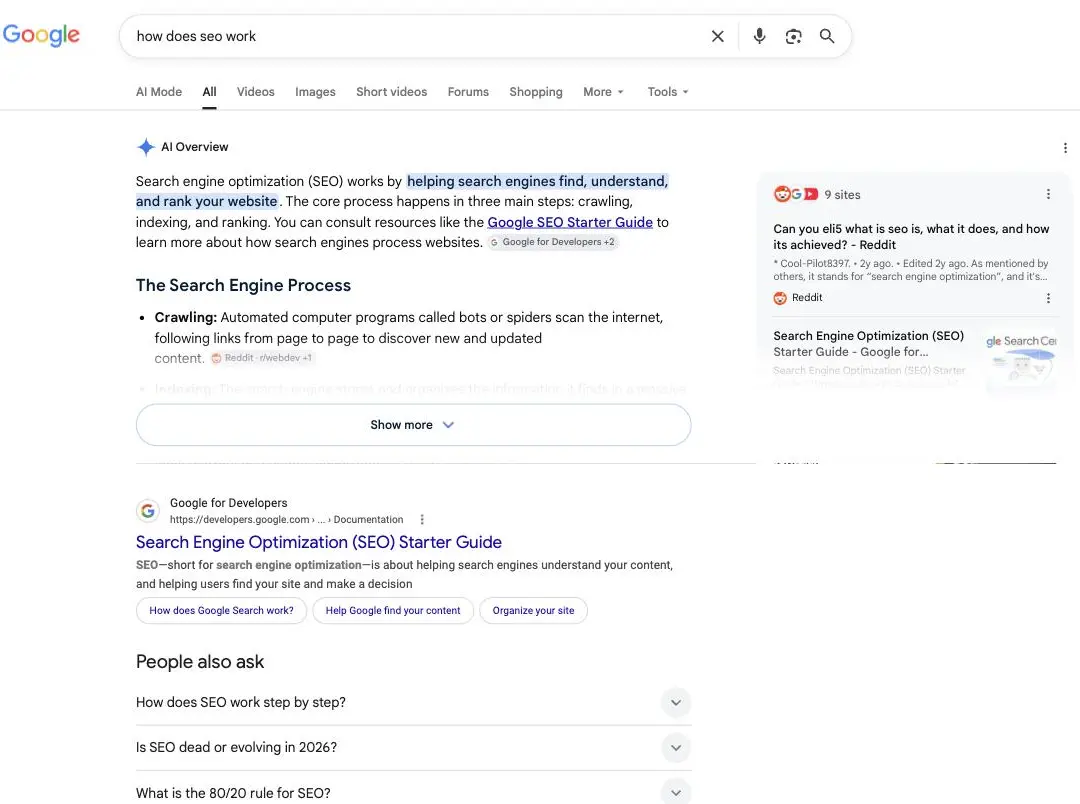
The live SERP for “how does seo work,” July 2026: an AI Overview answers first. Source: Google Search.
A quick definition: Google’s AI Overviews and AI Mode, plus assistants like ChatGPT, Claude, and Perplexity, all summarizing the web and linking to their sources. Our clients raise it themselves:
“I just wanted to make sure that with the new AI, if people are using AI to do searches, that our organization kind of filters towards the top just like it does with Google.”
MSP client,
Jun 2026
That instinct is exactly right, and Google agrees in writing. Its guidance for AI features says that foundational SEO best practices apply, with no additional requirements. The same guidance includes a line that vendors selling “AI SEO” packages tend to skip: doing SEO well makes you eligible to be cited, and nothing makes a citation certain. That distinction matters the moment someone tries to sell you a guarantee. (Sources: Google’s AI features guidance and AI optimization guide.)
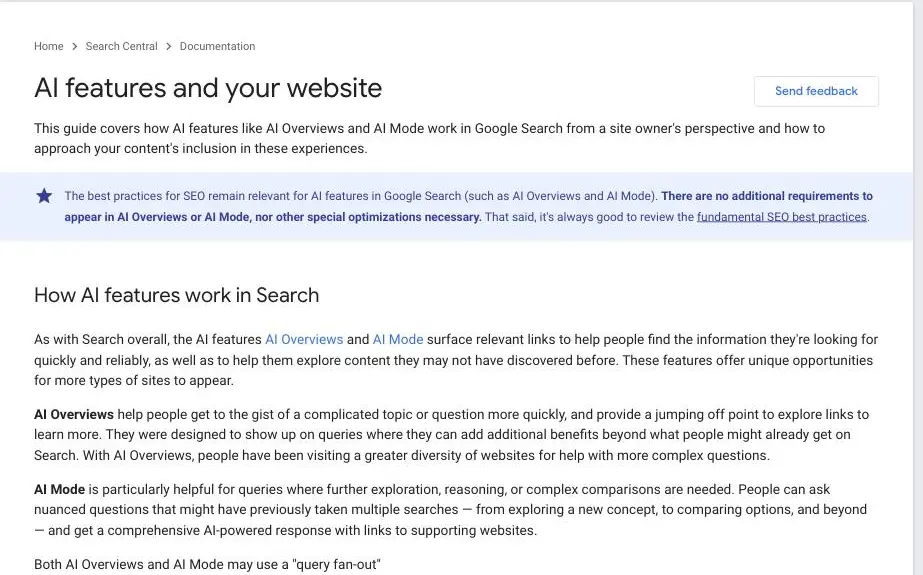
Google’s own guidance, highlighted: SEO best practices remain relevant for AI features. Source: Google Search Central.
How AI Search Is Changing SEO
AI search changes how people receive answers, but it doesn’t eliminate the need for businesses to create useful, accessible, trustworthy information.
Traditional search usually presents a list of results for the user to investigate.
AI-powered search experiences can instead synthesize information from multiple sources and present an answer directly.
That creates a second visibility question for businesses:
Can search engines find and rank your content?
and increasingly:
Can AI systems understand, trust, and use your content when constructing an answer?
Many of the fundamentals overlap.
On top of the fundamentals sits a thin, genuinely new layer:
- Be easy to quote. Lead sections with direct, self-contained answers and original data an AI can lift verbatim and attribute to you.
- Keep your business entity consistent. The same name, services, and facts on your site, your Google Business Profile, and directories, so AI systems are certain who you are.
- Show up where AI looks. Reviews and reputable third-party mentions feed these answers too, not just your own pages.
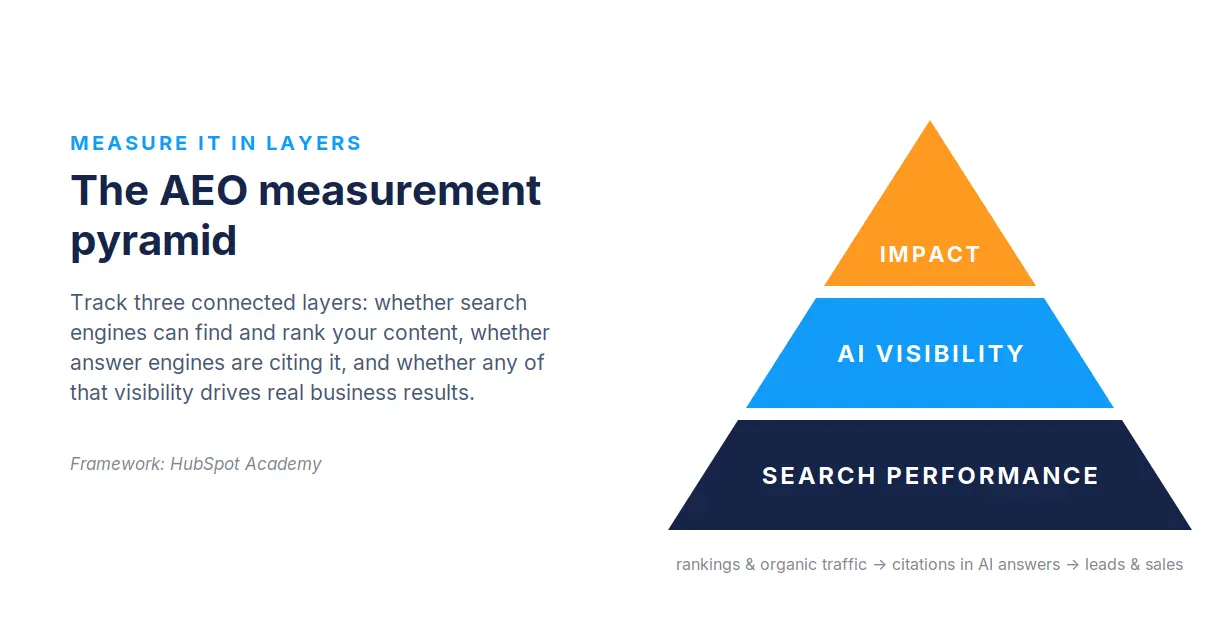
- Measure it in layers. Search performance and AI visibility overlap, but they are separate scoreboards on the way to actual business impact.
That doesn’t mean traditional SEO and AI visibility are identical. It means businesses increasingly need content that works well both as a webpage for humans and as structured, understandable information that search and AI systems can interpret.
One honest nuance: an AI answer may cite different sources than the classic top ten, and no special schema markup or llms.txt file changes that. There is no AI-search trick, only the foundations plus the thin layer above. When you are ready for the full tactical playbook, we keep it in a dedicated guide: How to Show Up in AI Search Results.
What Not to Do With SEO
The fastest way to waste an SEO budget is to buy shortcuts. Keyword stuffing reads badly to humans and machines alike, because modern search systems understand related language and context without the repetition. Mass-produced thin content gets filtered, not ranked. Links bought from irrelevant sites are a liability dressed up as an asset. And “AI SEO hacks” that promise citations while skipping the fundamentals deliver nothing durable, because the citing systems read the same site the crawlers do.
Above all, be wary of anyone who promises a specific rank or a guaranteed AI citation.
Avoid tactics such as:
- Publishing large quantities of thin or repetitive content
- Stuffing keywords unnaturally into pages
- Buying low-quality links solely to manipulate rankings
- Creating dozens of near-identical location pages
- Copying competitors’ content
- Optimizing exclusively for search volume without considering customer intent
- Treating AI-generated content as a substitute for genuine expertise
- Measuring success only by rankings
These approaches can create activity without creating meaningful business value.
The better objective is straightforward: be the most useful and credible result you can reasonably provide for the searches that matter to your customers.
SEO improves your eligibility and your odds; the search system decides each result. What actually compounds is the unglamorous work: useful content, clean structure, a healthy site, and a real reputation.
Where to Start: A Five-Step Checklist
You do not need to do everything at once. Work in this order; each step makes the next one better.
- Confirm your site can be crawled and indexed. Set up Google Search Console (free) and confirm your most important pages appear in its index report.
- Choose real customer questions. Pull them from sales calls, support tickets, and search data, phrased in the customer’s own words.
- Build the best answer to each one. One page per question, specific and useful enough that a generic summary cannot compete with it.
- Strengthen the four fundamentals as one system. Content, on-page, technical, and trust work together or not at all.
- Measure what matters. Track rankings and traffic, but judge success by leads and conversations, and watch AI visibility as its own layer.
Frequently Asked Questions
Do I need SEO for my small business?
SEO is most relevant when potential customers use search engines to research problems, compare providers, find local businesses, or look for the products and services you sell. How much you should invest depends on customer behavior, competition, margins, and the importance of organic search within your overall marketing strategy.
Does SEO work for small businesses?
Yes. SEO can help a small business become visible when potential customers search for its services, products, expertise, or solutions. Its value depends on targeting searches that are relevant to the business and converting that visibility into qualified traffic and customers.
Is SEO just about Google?
No. Google remains an important search platform, but SEO principles also help make information understandable and discoverable across other search engines and, increasingly, AI-powered discovery experiences.
Is SEO still worth it now that people use AI search?
Yes. AI answers are assembled from search-visible content, so the work that ranks you is the same work that gets you cited. Skipping SEO removes you from both scoreboards at once.
Can I do SEO on my own?
The basics, yes. Google Search Console, one genuinely useful page per customer question, and clean structure will already beat plenty of competitors. The honest constraint is time and consistency, which is usually the point where businesses bring in help.
What is domain authority, and does it still matter?
Domain authority is a score from third-party tools such as Moz and Ahrefs that estimates how strong a site’s reputation is. It is useful for comparing competitors, but Google does not use it: a thermometer, not a target.
How do I get my business to show up in ChatGPT or Google AI answers?
Do the four fundamentals well, then add the AI layer: quotable direct answers, a consistent business identity, and reviews and mentions that AI systems can corroborate. Our guide to showing up in AI search results walks through it step by step.
The Bottom Line on How SEO Works
AI answers are changing how results get presented, but they have not changed what wins. Publish material that deserves to be found, make it easy to access and interpret, and back it with credible evidence. No single tactic carries the system; that is why shortcuts fail and fundamentals compound.
SEO in 2026 is not a mystery, and it is not dead. It is a system you can see: crawl, index, rank, improve, powered by four fundamentals that now feed two scoreboards. Wondering where your website stands on either one? Start with Pronto’s SEO Audit with AI Visibility Action Plan for a prioritized view of both.