
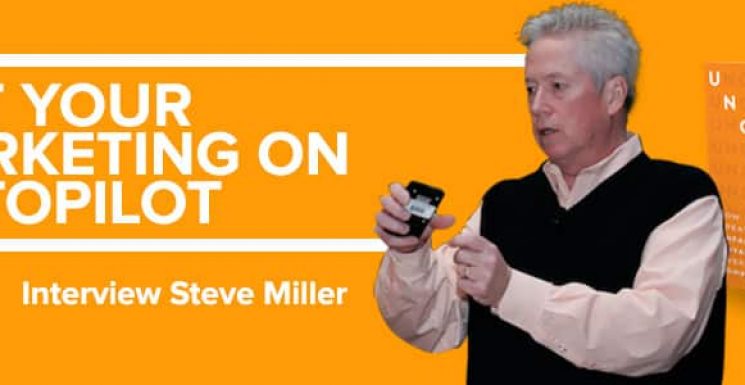
In this insightful interview, Marketing Gunslinger and ‘UNCOPYABLE’ author Steve Miller talks about his satisfaction in helping small businesses increase revenue, the key to effectively promoting a roller-coaster ride without using the word “roller-coaster,” and why your brand must have a distinct personality.
Don’t miss out on the special offer from Steve at the bottom of this interview to gain access to his Put Your Marketing On Autopilot webinar.
Q.1 You’ve worked with some really big names throughout all types of industries, but your book tends to focus on helping the little guy (small business). What are the differences you find between the two? Do the same strategies apply to both?
There are several pretty big differences between working with big companies, like Starbucks, Caterpillar, Boeing, and Coca-Cola, and small businesses.
As a marketing specialist, my objective is to ultimately increase revenues for my clients. That’s, frankly, tough to do for highly diversified, billion-dollar corporations. I can only help move the needle just so much.
It’s rare for me to work with the CEO at this level, so my role tends to be isolated in a silo – the events & sponsorship division of Coca-Cola, for example.
The good side of big boys is they accept big contracts much easier, so that’s nice.
My preference, though, is to work with the smaller companies. I can have a much bigger impact on them, and that’s extremely satisfying. Most of the time, my contact is the CEO or someone who reports to the CEO. The CEO is often the owner, so the money they pay comes out of their pocket. This gives them a much higher stake in results, which is preferable. When someone hires me and it’s their money, there’s a much higher dedication to implementing my recommendations.
This is what makes my work extremely satisfying. For example, one of my small-business clients, Incisive Computing, had a 46% increase in revenues after one year as a result of working with me. That’s very different from selling a little more sugar water for Coca-Cola.
That said, advice tends to be somewhat similar. I’m a very measurable-results-oriented guy, and work to keep things as basic as possible. Who’s your target market? What important problem or situation do they have that my product/service will solve? How do I deliver that message as efficiently and effectively as possible? (I’m very laser-beam focused rather than shotgunning.) And finally, how do I get them to only think of me when they decide to buy?
I call these steps being Brilliant at the Basics and they apply equally to big and small businesses. It’s funny, though, how big businesses tend to make the steps far more complicated than they really need to, making it tougher and tougher to generate provable results.
For the most part, this happens when a company reaches a point where they establish a marketing department. Unfortunately, the vast majority of educated “marketers” aren’t taught how to create measurable revenue, and that’s sad. A lot of money is pretty much wasted because of this. When I come in to work with somebody new, the first thing I do is establish an attitude of, “If we can’t ultimately connect to sales, we’re not doing it.”
Q.2 Your book talks about how to become uncopyable. Differentiating yourself from your competitors. But how do you do it yourself?
That’s a great question. It’s interesting that very few people ask me that.
Everybody says they’re different from the competition, but their actions and language aren’t different. I decided it would be absolutely clear that I was different from all the other options available. If I was going to help companies separate themselves from the crowd, then I had to clearly walk my talk. For example:
- I don’t have any marketing materials or brochures. When someone asks to see my information, I simply share my list of clients as proof.
- I don’t advertise my speaking or consulting. I fly fairly low under the radar in those communities and rely on word-of-mouth to fill my funnel.
- When someone initially contacts me, they are required to agree to my Rules before we continue a conversation. This does a couple of things. First, I’m establishing the relationship rules up front, not them. Once someone reads my rules, they will either think, “I want to work with someone like Steve,” or “I hate this guy.” They are either already beginning to decide to hire me or we aren’t going to work together, which is a great way of culling out future problem clients.
- My Rules establish that I operate a No-Spin Zone. I’m edgy. I’m not PC. I’m a terrible diplomat. I get that out of the way up front.
- I have declared Orange as my brand color. I KILL my clients with orange. I always wear orange when I’m working. My book cover is orange. When I send gifts, most of the time they are something orange. My giveaways are orange. Orange, orange, orange.
- I use my own language. My title is “Kelly’s Dad and Marketing Gunslinger.” My benchmarking technique is “Stealing Genius from Aliens.” My blog readers are my BFFs. I don’t have clients. I have Club Members. People often identify themselves to each other using my terms.
- My business card is extremely congruent with who I am. One side is orange with my contact info. The other side has a cartoon of two unidentifiable beings. One says, “Are you mentally undressing me” The other responds, “No, I’m mentally marketing myself.” Funny and edgy.
- I don’t negotiate and I don’t do RFPs.
Q.3 A lot of the IT service providers we work with have several local competitors who offer similar services. What recommendations do you have for standing out when the industry as a whole is often very similar?
This is exactly why I wrote my book. IT service providers are no different than pretty much every other industry on the planet. I guarantee you aren’t alone!
Technology has advanced to the point where everything has become a commodity and traditional types of competitive advantage have gone out the window. It’s almost impossible now to have a strong first-mover advantage. A brand new product introduced today and unlike anything else before will have direct competitors hit the market within a matter of weeks, sometimes days. Product quality is a given regardless of price. It wasn’t that long ago when it was accepted that cheaper cars were also poorer quality. No more. All cars have high-quality built in.
Even geographical advantage is going away. The ability of Amazon for same-day delivery has essentially eliminated local advantage for many industries.
But I’m not telling you anything you don’t already know. Based on traditional rules of competition it’s become extremely difficult for IT service providers to stand out.
In Uncopyable, I encourage businesses, especially small businesses, to break from the traditional product/service/price definition and look at business growth from entirely new perspectives.
For example, what Promise are you currently making to the marketplace?
Essentially, your Promise to your marketplace is your Branding Proposition. What are you currently promising? Great products? Timely delivery and service? Fair prices?
Yawn. That’s what everybody else promises! And, frankly, that’s not really what your customer cares about. They care about peace of mind. They care about convenience. They care about no hassles. They care about having a “partner” who has their back while they sleep or are on vacation.
Stop selling stuff and start selling Attachment. Start realizing that B2B is NOT a business selling to a business. It’s still a person selling to a person. And people have personalities, so why wouldn’t a business? Apple has a personality. Ben & Jerry’s has a personality. You should have a personality.
Q.4 Because of the similarities within the industry, we sometimes see IT service providers pay more attention to beating competitors through price or customer experience. What are your thoughts on that? And how can they redirect that energy into developing a more meaningful unique selling proposition?
Let’s look at both of those separately – price and experience.
You never want to compete on price…for a lot of reasons.
Most important, the reason why it would boil down to price is because the prospect simply doesn’t see any difference between you and the competition. That’s bad.
Competing on Price also creates a perception about you – a perception that would be extremely hard to break away from. Once a customer is used to lowballing you, they want to maintain that path. Again, that’s bad.
And, of course, your margins take a hit when you compete on price. Bad, bad, bad.
The second thing you mentioned was competing on customer experience. This is actually in the right direction, except for one thing. The vast majority of the time, OUR definition of this is merely a “better” experience than the competition. We answer the phone better. We return calls faster. Our service times are sooner. Etc., etc.
As I emphasize in UNCOPYABLE, being “better” than the competition is both a short-term proposition and a me-to-me-too strategy. When we create something that’s better, competitors see it and often quickly respond with something even BETTER. Then we respond with something better. The cycle continues.
Historically traditional methods for competing in the marketplace have pretty much become losing fights. They’re no longer good enough for the simple reason they’re no longer sustainable advantages.
This means one thing. We have to find a paradigm-busting way to deliver both High Value and a Different Experience to our customers that go far beyond the traditional.
This is really, really hard. This thinking requires seeing both Value and Experience through different eyes. We pretty much need to change our heuristics.
For example, when I look up IT service providers in my area, everybody offers some version of “Our highly skilled experts provide 24/7 tech support, the best Disaster Recovery, Real-Time Monitoring, Network Assessments, Cloud Solutions, and Cyber Security.” OK, that’s all well and good, but if that’s what everybody is offering, how do I pick one?
Does DisneyWorld promote exciting roller coasters and themed kiddy rides? No, they promote Moments of Magic, Enchanted Escapes, and where your Fantasy becomes Reality. Their roller coasters “zoom through the galaxy, brave a ghostly mansion and embark on high-seas adventures during the Golden Age of Piracy!” And they never use the word “roller-coasters.”
One of the methods I teach in UNCOPYABLE is to generate new thinking and new ideas by studying examples of successful aliens and taking their ideas. I call it Stealing Genius©. Look at Disney again, for example. Disney is an alien. They do not compete with you. Disney figured out a long time ago they could completely separate themselves from other “amusement parks” by changing the experience and the language. Disney tells “stories.” They don’t offer “rides.”
Can I steal that concept for IT services? Maybe. You see, I don’t need IT Services per se. I need a really big body guard…no wait, a SUPER HERO who protects me from getting killed…who has powers and abilities far beyond those of mortal providers…who shows up EXACTLY when I need them…even BEFORE I realize it…one who I have unquestionable trust in!
This idea can be expanded into a huge story and experience. New language can be created. New branding. An immersion and deliverable that would be almost impossible to copy.
That’s only one example of using Stealing Genius to generate new thinking. What other examples can you think about?
Q.5 Sometimes it’s very difficult to be able to assess yourself and even harder when people feel like they don’t need to. Your book talks all about not being scared to get out of your shell. Have you ever had any trouble changing a client’s mind? What tips do you have for helping business owners reflect on themselves and their business?
Another great question!
Let me first say that it’s very hard for me to judge myself. I am blessed/cursed with a pretty high IQ, so my natural tendency is to think I’m always right and few people can teach me something. For many years this kept me from achieving the success I wanted.
One of the simplest facts about people is nobody changes their mind, the way they see the world, the paths they choose, or the way they do things until they become dissatisfied with their current situation. That’s it. Pure and simple.
The easiest sale of all is to the prospect who is already dissatisfied and looking for your solution. The hardest sale is to someone who is satisfied and doesn’t believe they have a need. It’s not impossible, but it is extremely difficult to change their mind. I usually walk away from those people. More often than not, trying to change somebody’s mind is a waste of my valuable time and an exercise in frustration.
We don’t grow in business or in life if we aren’t dissatisfied. That means we must challenge ourselves to do things that are uncomfortable. Nobody learned how to walk, drive a car, give a speech, ask a girl out on a date, or learn how to play the piano without being uncomfortable at first.
What I do encourage my clients to do is practice “healthy paranoia.” Even if things are going really well, I assume someone’s out there who wants to put me out of business. This forces me to continually innovate, test, fail, and try new experiences. These stretch my mind and keep me dissatisfied.
I also expose myself to other alien experiences. I’ve attended and spoken at the main TED Conference. Let me tell you, when you’re giving a speech in front of some of the most successful, famous, and powerful people on the planet – Jeff Bezos, Richard Branson, Melinda Gates, Peter Gabriel, Matt Groening, Sir Ken Robinson, Kareem Abdul Jabbar, Sheryl Sandberg, Yves Behar, and Tim Berners-Lee, for example – well, you are WAY out of your comfort zone.
One big thing I’ve learned about incredibly successful people, like the TED gang, is they also push themselves to stretch boundaries. They are great examples to study.
So what is my big tip for learning how to push your boundaries? Go deliberately do something, experience something, or learn something that makes you uncomfortable. Are you an engineer? Take a painting class, or learn to play the guitar. Are you a coder? The next time you’re looking at magazines at the airport, pick up two or three that have NOTHING to do with tech. Buy Country Living, Quilter’s World, Modern Farmer, Street Rodder, or Combat Handguns. Read about a world you are unfamiliar with.
Ask yourself every day – “When was the last time I did or learned something for the first time?”
Q.6 Going against the tide is a scary thing for business owners, so the sentence “Look at what everyone else is doing and don’t do it” really caught my attention. If you do something radically different within an industry, couldn’t that confuse your future prospects? What risks come along with trying to differentiate your business?
Look at successful new products, companies, and people and you’ll find something in common. Most of them broke the rules. Nobody asked for DisneyLand, the iPhone, the automobile, the Internet, the 8-Track, or even the airplane.
These are extreme examples, of course, but the point is if you continue to look and act like everybody else, then don’t expect different results.
One of the most important marketing concepts I teach clients is “Don’t try to sell to everybody.” It’s far smarter and usually more profitable to be a big fish in a small, but rich, pond, than to be a small fish in a big sea.
For example, in 2016 the Apple iPhone had 14.5% market share of worldwide smartphone sales. It’s market share of PROFIT, however, was 83%! They deliberately chose a smaller, but richer market segment. They’ve established clear differentiation based on design, capabilities and performance – not on price. Wouldn’t you prefer that, too?
The biggest risk to me is trying to be all things to all people. Prospects want to think you have a solution that’s exactly right for them. The better you can identify a target market, the less risk.
What exactly is a target market? Here are my criteria:
- It fits the profile I’ve identified.
- It agrees it has a need for my solution.
- It’s large enough to grow with in the future.
- It’s responsive enough to survive with right now.
- It has money.
- It’s willing to give me money.
For the most part, if you really study what everybody else is doing, they aren’t actually trying to separate themselves from the crowd. They’re following the crowd. That is not a formula for long-term success.
Q.7 What’s next for the Marketing Gunslinger?
There are too many small businesses in the U.S. and around the world who struggle every day with growing their business.
Many businesses are started by people who are good at something or have a love for something. I remember talking with a small business that made fishing lures. The owner had been an avid fisherman. He designed his own lures and, apparently, they worked. Friends started asking him to make lures for them. At some point, somebody said, “Hey, you should start a business selling lures!”
It sounded like a great idea. What could be better than making a living on something you love to do?
Except making lures for yourself and starting a business with a production line – employees, designs, inventory, and a facility – are two very different things. And, what, I have to SELL these, too? And I have competition?
Not all small businesses start like this, but many do. Regardless, one alarming weakness of many small businesses is their lack of strategic marketing acumen.
Strategic marketing accomplishes several things. First, it defines your target market. It defines the need you are solving for that market. It differentiates your business from the competition. It communicates with the market. And it moves prospects closer to the purchase decision. Sometimes it moves them all the way to the decision.
Teaching companies how to market themselves better is a great first step, but they also need to differentiate themselves.
That’s why I wrote UNCOPYABLE. And I’m going to be pushing the word out as hard as I can for the foreseeable future.
Now I’m going to give you a very special offer…an ethical bribe, if you will.
I want you to get my book, UNCOPYABLE: How to Create an Unfair Advantage Over Your Competition. And I’ll reward you when you do. Follow these steps:
- Go to this link right now and order my book: https://amzn.to/2kyftKD (Kindle version doesn’t count)
- Forward the confirmation email from Amazon to me: st*********@**********re.com
- I will send you permanent access to Put Your Marketing On Autopilot – a 60-minute webinar that sells for $197 where I teach how to automate the lead identify and capture process, so you can hand your salespeople higher- quality leads. And getting more high-quality leads means more sales!
When I last looked on Amazon, my book was listed for $19.46. You can get a $197 bonus for FREE.
No strings. I just really want you to read my book!
Thanks for this opportunity to share with you and everybody in the Pronto Marketing universe! If you have any questions, please feel free to contact me at st*********@**********re.com.
Always remember…
BE UNCOPYABLE!
Steve Miller
Kelly’s Dad, Marketing Gunslinger
https://www.theadventure.com/