
Primary finding
The practice area shapes how an AI tool backs up what it tells someone about a law firm. Ask about personal injury lawyers and the answer leans almost entirely on what the firm says about itself. Ask about family law attorneys and the answer gets checked against outside sources most of the time. The same pattern shows up again, in a different form, once market size shrinks.
Key takeaways
- When someone compares options without naming a firm, directory listings dominate across every practice area tested. Family law and estate law searches also pull in community discussion; personal injury searches don’t.
- When someone checks up on a specific named firm, how independently verified that answer is depends heavily on the practice area. Personal injury answers draw on the firm’s own site about three times out of four. Family law answers do the opposite, pulling outside corroboration two-thirds of the time.
- The same self-citation pattern shows up by market size. In the smallest market tested, AI answers relied on the firm’s own site the least, not because the AI was less confident, but because there was less of a firm-controlled web presence to draw from in the first place.
- ChatGPT and Gemini differ sharply in how often they cite anything at all. ChatGPT cited at least one source in 81 percent of responses. Gemini cited at least one source in 36 percent of responses, and in several cases answered specific, checkable questions, named firms, addresses, fee estimates, with no citation at all.
Methodology
| Variable | Details |
| Practice areas |
|
| Buyer scenarios | Two per practice area |
| Markets |
|
| AI tools |
|
| Mode | Each tool’s default free-tier mode |
| Source classification | Business’s own site, directories and marketplaces, review platforms, licensing and regulatory bodies, informational and trade content, social and community discussion |
The findings below come from two points in a buyer’s search: a comparison question, where someone asks for the best options in a practice area without naming a firm (“best family law attorneys in Rochester”), and a validation question, where someone has already found a specific firm and is checking it out by name (“is [firm] good for a contested custody case”). These two moments produce meaningfully different citation behavior, which is why the findings are broken out by stage rather than blended together. A third question type, generic cost and consultation questions that don’t name a firm either (“how much does a will cost in Rochester”), supports the broader pattern discussed at the end of this piece.
Finding 1: comparison answers lean on directories everywhere, but community discussion only shows up in some practice areas
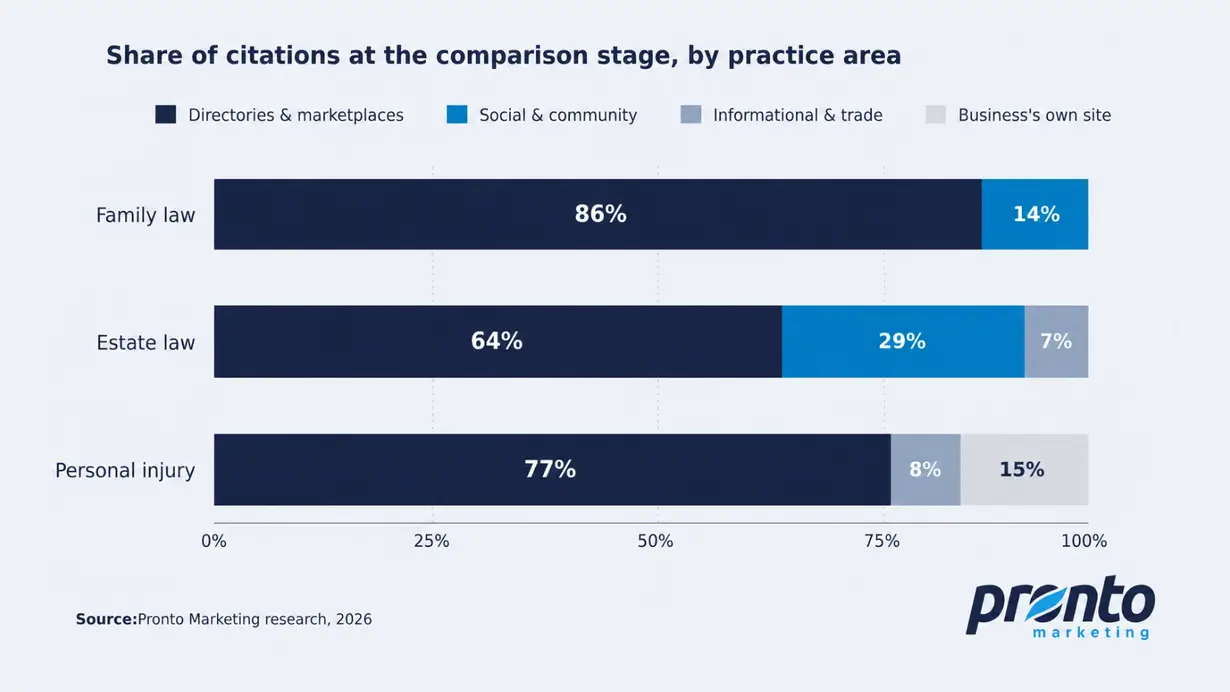
Directory listings make up the large majority of what gets cited across every practice area, generally two-thirds to over four-fifths of citations. That part doesn’t vary much by practice area.
What does vary: family law and estate law comparisons also pull in community discussion, forum threads and similar informal sources, in roughly one in seven to nearly one in three citations. Personal injury comparisons never do. That gap is worth taking seriously. It suggests personal injury search behavior in AI tools stays closer to a directory-driven, high-commercial-intent pattern, while family law and estate law leave more room for informal, community-sourced input to shape the answer.
One limitation worth stating: at this stage of the buyer journey specifically, Gemini returned no citations at all, in any practice area, in any market. ChatGPT cited a source in every single comparison response tested. That means the table above describes ChatGPT’s behavior at this stage, not a blended average across both tools. Whether Gemini’s gap holds at other stages, or is specific to open-ended comparison questions, is worth testing further.
Finding 2: how independently verified a firm’s AI answer is depends on practice area, and on market size
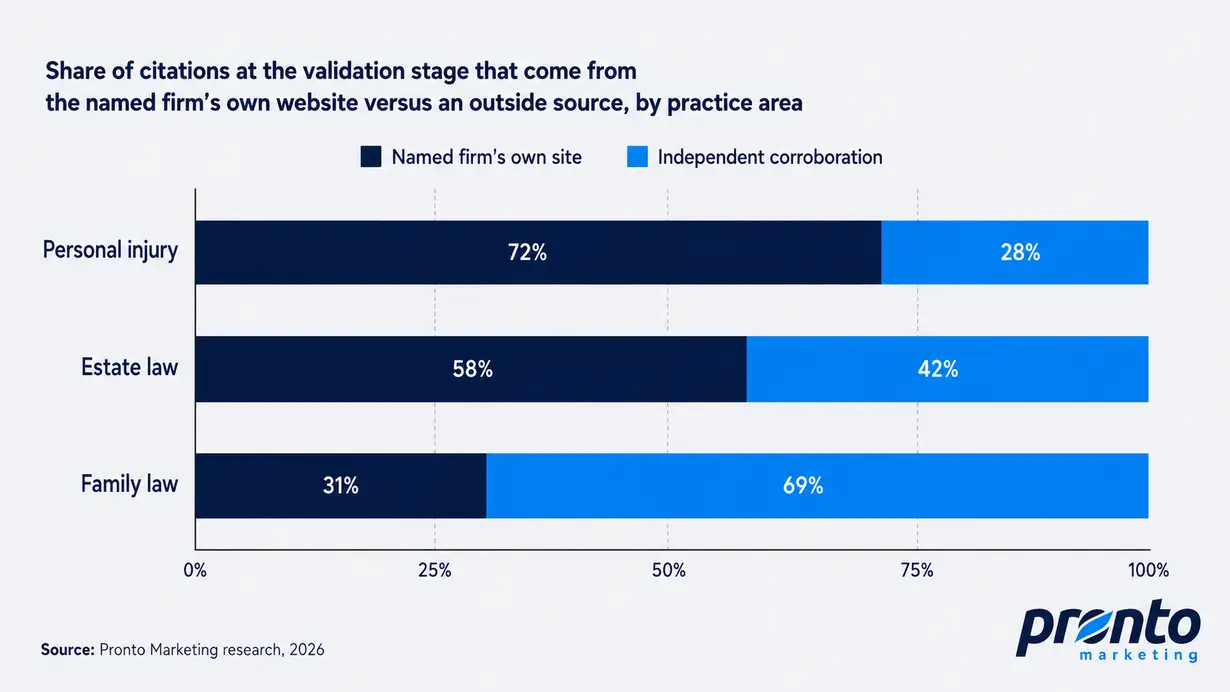
Family law stands out as the practice area where an AI tool’s answer about a specific firm is most likely to be checked against something other than that firm’s own marketing. Personal injury stands out as the practice area where it’s least likely.
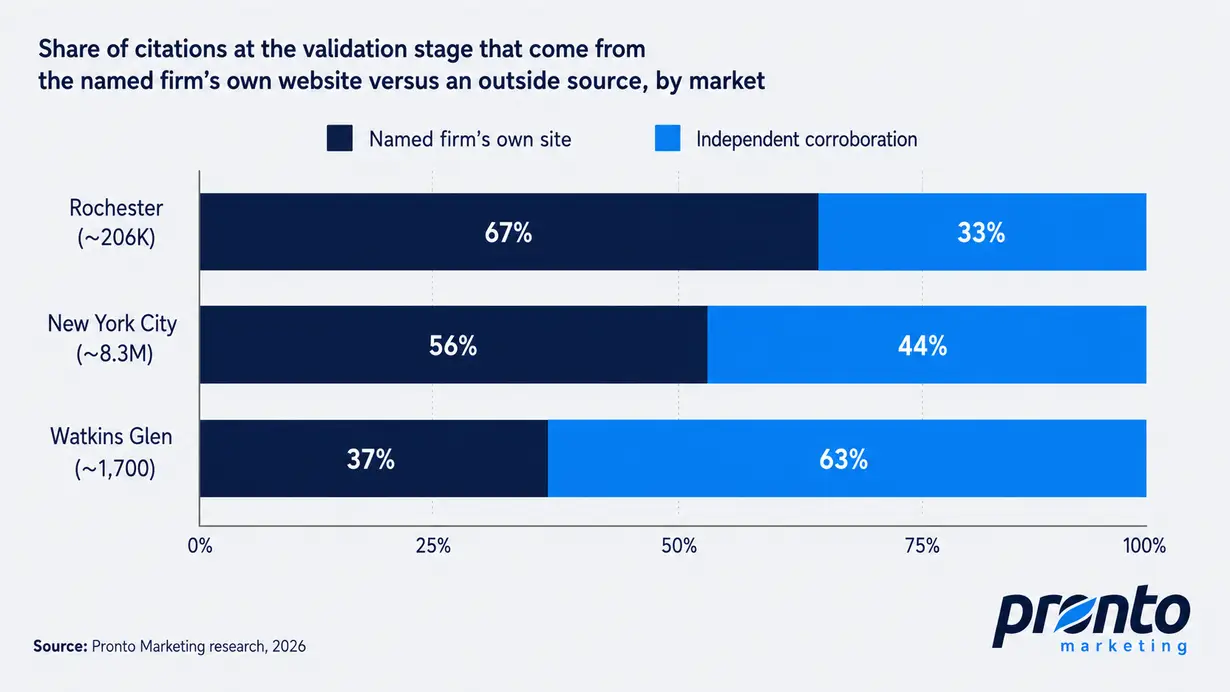
As the market gets smaller, AI answers rely less on the firm’s own site, not more. In Watkins Glen, roughly two-thirds of validation-stage citations came from outside directories rather than the firm’s own website, compared to about a third in New York City. The likely explanation isn’t that AI tools trust small-town firms less. It’s that small-town firms typically have less built-out websites for an AI tool to draw from in the first place, so the model falls back on directory listings by default.
Put together, both tables point to the same underlying mechanic: an AI tool’s reliance on a firm’s own self-description depends on how much verifiable material that firm actually has behind it, whether the constraint comes from the practice area’s information ecosystem or from the size of the local market.
Worth flagging, not yet a confirmed finding
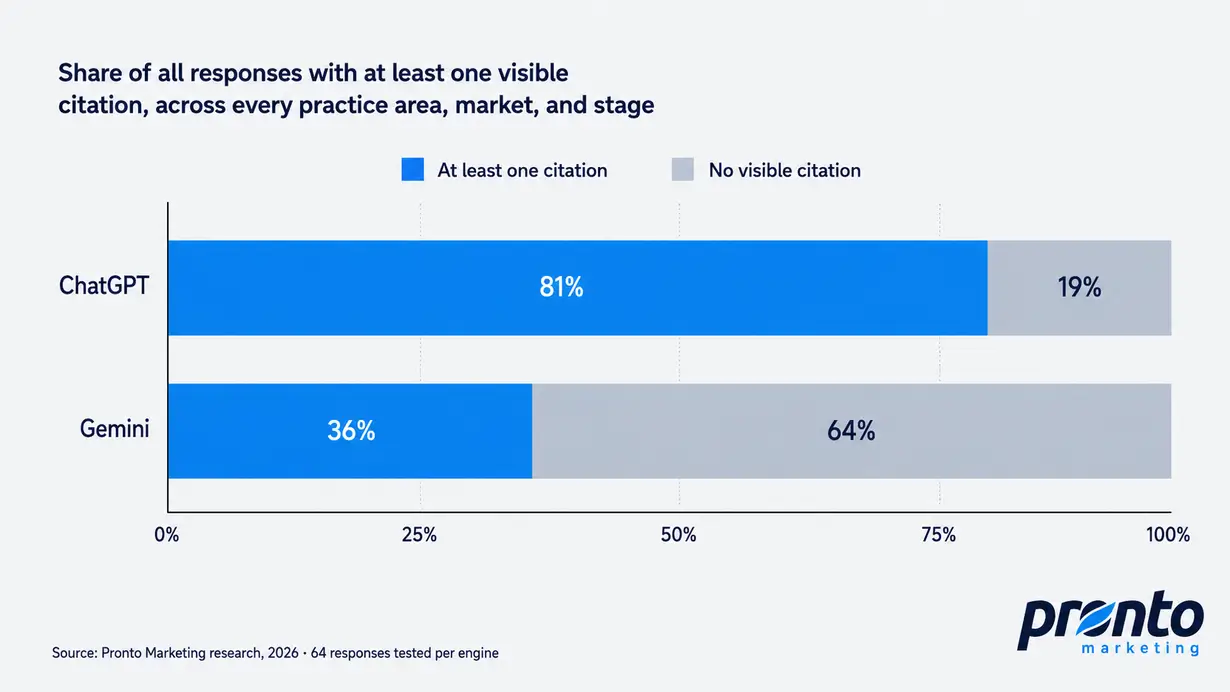
The same self-citation lens from Finding 2, applied to engine instead of practice area or market, adds another layer to this:
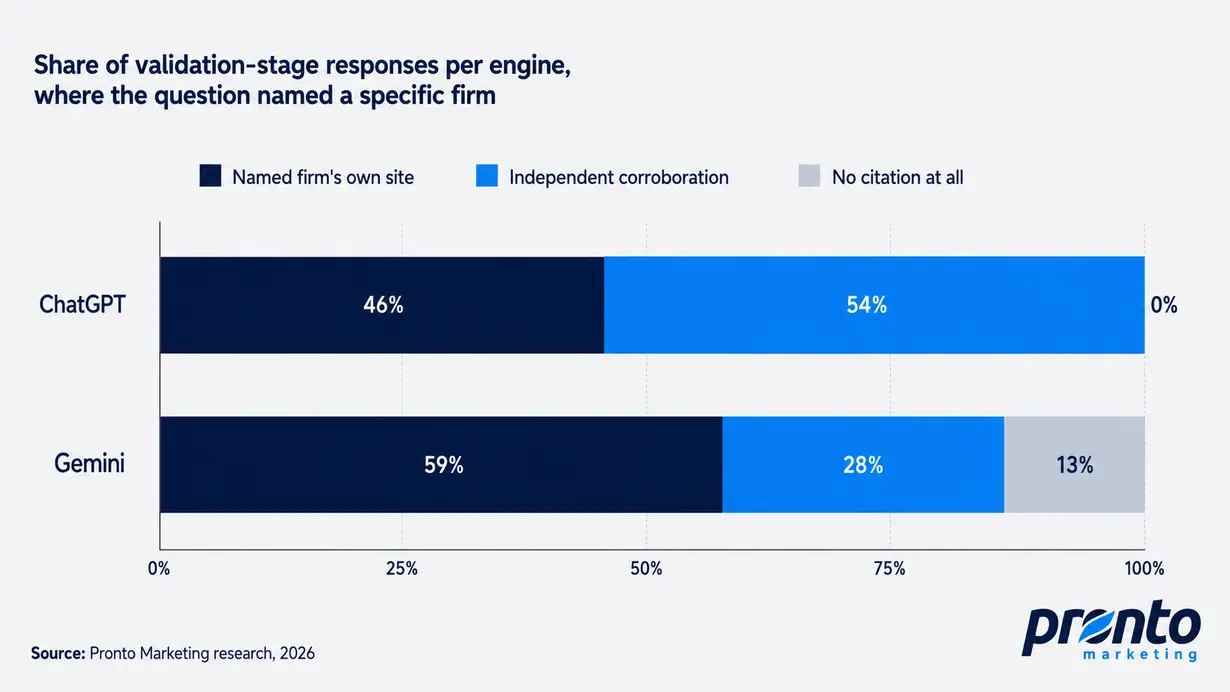
ChatGPT never left a validation-stage question uncited, and split roughly evenly between the firm’s own site and an outside source. Gemini left about one in eight validation-stage questions completely uncited, and when it did cite something, leaned harder on the firm’s own site than ChatGPT did. So Gemini’s citation gap isn’t just about citing less often overall, it also shows up as citing more narrowly, toward the firm’s own self-description, on the occasions it does cite something.
Across many specific, checkable questions, named firms, addresses, fee ranges, professional history, Gemini answered with confident, detailed specifics while citing no source in a majority of cases. This showed up consistently enough across practice areas and markets that it’s unlikely to be random. In one instance, Gemini gave two different, incompatible accounts of the same attorney’s professional background across two separate prompts.
This study didn’t independently verify the accuracy of those uncited claims, so it isn’t presented here as a confirmed finding. But it raises a real question for any business relying on Gemini to represent them accurately: if the AI has no visible citation trail, there’s no way to know whether its answer is accurate, outdated, or simply invented, and no way for the business itself to correct it. That’s a reasonable direction for follow-up research, not a conclusion this study can support yet.
What this means for practice area marketing
The findings above describe what AI tools do. This section is about what a law firm can reasonably do in response, based on those patterns rather than on assumptions.
Directory presence matters everywhere, but isn’t equally sufficient everywhere. Since directory listings dominate comparison-stage citations across all three practice areas, appearing accurately and completely across the major legal directories is close to a baseline requirement, not a nice-to-have, regardless of practice area. But it’s a bigger lever for personal injury firms specifically, since personal injury comparison answers rarely pull in anything beyond directories and the firm’s own site. Family law and estate law firms have a second channel available: both practice areas showed AI tools pulling in community discussion at the comparison stage, which directory listings alone don’t capture.
Website content carries different weight depending on the practice area. Personal injury firms should treat their own website as the primary source shaping how AI tools describe them once someone is checking the firm out by name, since roughly three-quarters of validation-stage citations in that practice area came from the firm’s own site. Family law firms are in a different position: AI answers about a specific family law firm lean on outside sources roughly two-thirds of the time, so directory accuracy, review presence, and third-party mentions likely matter more than website copy for how the firm gets represented once someone already knows its name.
Firms in smaller markets should expect directories to do more of the work. The same self-citation pattern that shows up by practice area also shows up by market size, and for the same likely reason: AI tools rely less on a firm’s own site when there’s less built-out website content to draw from, which is more common for firms outside major metro areas. A firm in a small market is likely better served by making sure its directory listings and third-party mentions are accurate and current than by investing heavily in website content the AI may not be pulling from in the first place.
Gemini’s confident, uncited answers are worth checking, not trusting by default. Because a majority of Gemini’s specific claims about named firms in this study carried no visible source, firms relying on Gemini to represent them accurately have no way to verify or correct what it says. Periodically checking what Gemini says about your firm by name, rather than assuming accuracy, is a reasonable precaution until this pattern is better understood.
The broader pattern underneath all three findings
Family law, estate law, and personal injury aren’t just three arbitrary categories that happened to behave differently. A closer look at how people search within each one points to a more general driver: how much genuine research a buyer does before picking someone, rather than the specific practice area itself.
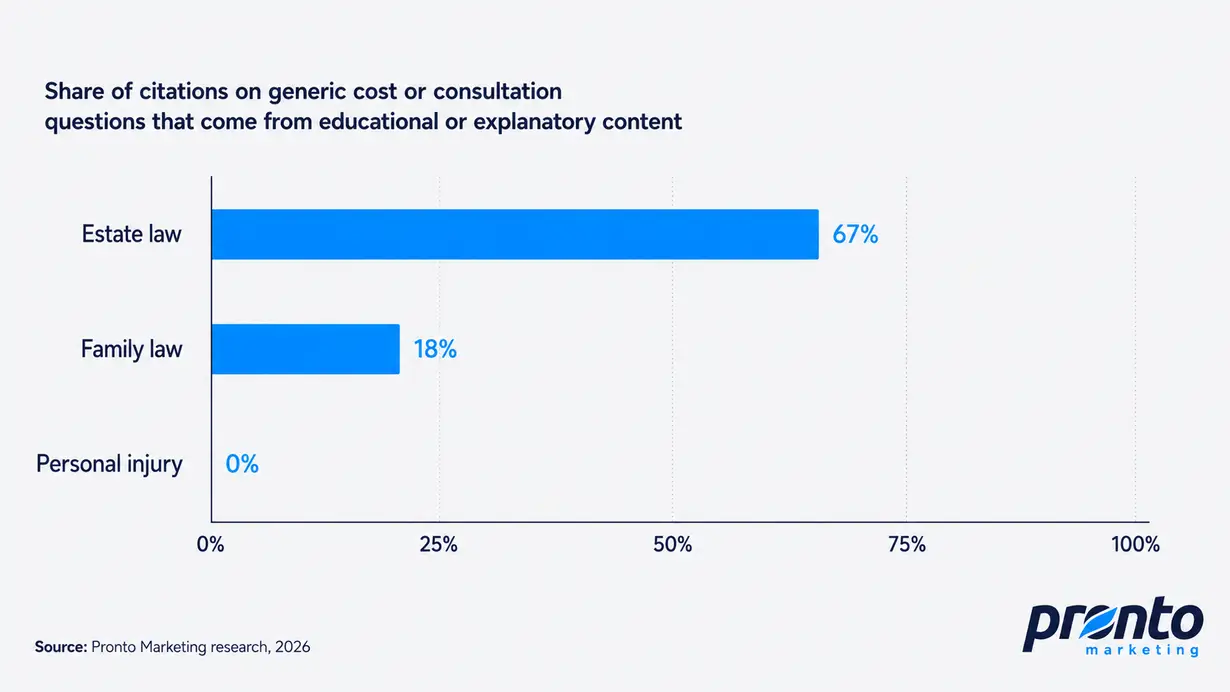
Estate planning is a low-urgency, long-consideration decision, most people researching a will or a trust aren’t in crisis, they’re trying to understand their options before they act. That shows up directly in the data: two-thirds of what gets cited on generic estate planning questions is educational content, by far the highest share of any practice area tested. Personal injury sits at the opposite end. It’s a high-urgency, fast-decision search, and the citation data reflects that too, none of the generic personal injury citations pulled in educational content at all, only directories and firm websites. Family law lands in between, which fits its mixed nature: often urgent, but with real research and decision-making involved.
The practical implication for any professional services firm, not just the three practice areas tested here, is that content marketing investment should track how much genuine research happens before a buyer picks someone, not be applied uniformly across service lines. A slow, considered decision creates real room for educational content to shape an AI’s answer. A fast, urgent decision doesn’t. No matter how good that content is, because the buyer and the AI both move past it too quickly for it to factor in. Firms in low-urgency categories are underinvesting if they skip content marketing; firms in high-urgency categories may be overinvesting in it relative to what actually shows up in how they get cited.