
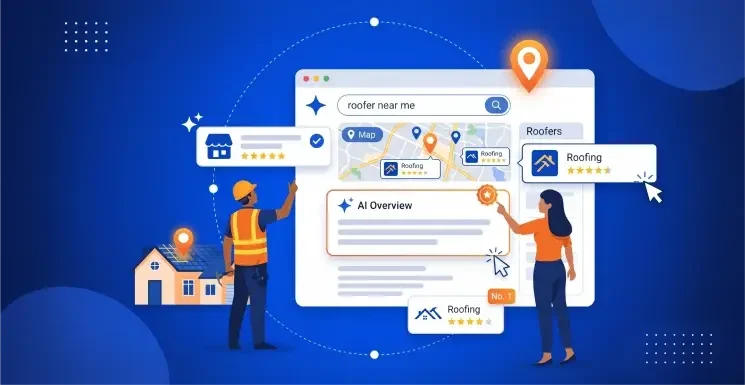
For most roofing companies, the Google Business Profile wins the click in small towns. Website pages only pay off in the bigger suburbs where people actually search “roofer + city.” So keep your profile strong everywhere, build real pages for the few markets with searches to win, and make sure every source says the same thing about you so AI tools can repeat it.
Key takeaways
- In small towns near your office, the map pack and AI Overviews answer most roofing searches. A better location page rarely changes that.
- In growing suburbs, there’s measurable search volume, and a page with real local proof can rank.
- Keep pages for every town where you actually work. Cut templated pages for towns you don’t serve, and pages for services you don’t offer.
- AI answers use the same signals as the map pack: your profile, your reviews, directories, and pages that show real local work.
Where roofing searches go today
A homeowner who searches “roofer near me” sees ads, the map pack, and often an AI Overview before any regular website result. For many homeowners, the search ends right there.
Google says local results rank mainly on relevance, distance and prominence. Distance is out of your control: the searcher is wherever they are. Relevance and prominence you can build. Google’s prominence signals include reviews, links, articles, directories, and where your website ranks in regular search results.
That last point matters. Your website still feeds the map pack, even when nobody clicks through to it. A thin or generic site holds your profile back. We cover the profile side in more depth in our Google Maps marketing guide.
Winning roofing local searches: small towns vs. suburbs
Decide market by market. A small town near your office and a busy suburb 30 minutes away need different work.
| Market | What wins the click | Where to put your effort |
|---|---|---|
| Small town or rural county near your office | Map pack (distance works for you), AI Overview, directories | Profile, reviews, photos, and a short, accurate location page |
| Growing suburb with real search volume | Map pack and regular search results | A unique location page with local projects, plus links that build prominence |
| Big city you rarely work in | Competitors with bigger budgets and stronger sites | Don't chase it. Mention it as part of your region, not as your target |
Here’s what that looks like in practice. One roofing company we work with already dominated the map pack in its home county. Our keyword tools showed no measurable searches for town-level terms there, and the regular results were crowded with ads, the map pack, an AI Overview and big directories. Rewriting that page wouldn’t have moved much.
In two nearby suburbs, terms like “roofing contractor + city” had real search volume. That’s where the page budget went.
The same company’s old site was built around the nearest big city, because it was the biggest market on paper. The owner rarely works there. If your site targets a market you don’t want, fix that before anything else. See why your website is attracting the wrong clients.
How to audit location pages: keep, rewrite, or cut
Keep a page for every town where you really work. Rewrite the few with search volume, and cut the rest. Zero traffic alone is not a reason to delete a page.
Ask two questions about each location page:
- Do you work there regularly? If not, delete the page and 301 redirect it to your service area page.
- Is there measurable search volume for it?
- Yes: rewrite it with content only you could write. That means projects in that town, photos, neighborhoods you’ve worked in, and reviews from local customers.
- No: keep it short and accurate, and add real projects over time. It still helps Google and AI tools understand where you work, even if it never gets a measurable keyword.
The pages to watch for are the templated ones: the same paragraph with the city name swapped. They rarely rank, and a site full of them looks thin.
Do the same with services. If your site has a page for a roof type or service you no longer offer, remove it and redirect it. Search engines and AI tools repeat what your site says, so it should be accurate.
For more on town-level tactics, read our beginner’s guide to hyperlocal SEO.
How to show up in AI Overviews and AI answers
AI tools recommend roofers they can confirm across several sources. The job is to be consistent and show proof, not to find a trick.
- Say the same thing everywhere. Use the same business name, address, phone number, services and service area on your website, your Google Business Profile, and directories like BBB, Yelp and your shingle manufacturer’s contractor listing.
- Get reviews that mention the job and the town. “Replaced our roof in [town] in one day” helps more than “Great service!”
- Answer real homeowner questions plainly. Repair or replace? Will insurance cover storm damage? What does the warranty cover? What affects the cost? Put the answers on your service pages as FAQs, and add FAQ structured data (schema) so search engines can read them.
- Show your work. Photos of real projects, tied to the towns where you did them, on both your profile and your location pages.
- Only list what you actually do. If your site still advertises a service you dropped years ago, AI tools may repeat it.
AI visibility is harder to measure than rankings, because many local queries have no keyword data. Track it with an AI visibility tool, and watch calls and form leads alongside it. For the full playbook, see how to appear in AI search results and how to get your company recommended by ChatGPT. If a competitor keeps getting named instead of you, start with why competitors show up in ChatGPT and you don’t.
The 90-day local SEO action plan for roofers
Fix what’s wrong first, then strengthen the profile, then rewrite the few pages worth rewriting.
- Month 1: Make it accurate.
- List the towns you actually work in and the services you actually offer.
- Remove or redirect pages that don’t match.
- Check that your name, address and phone number match everywhere.
- Make sure every website form and call reaches you: connect call tracking, and send form leads into your CRM.
- Month 2: Strengthen the profile.
- Set the right primary and secondary categories, and list each service.
- Post project photos every week.
- Ask every finished job for a review.
- Cut templated location pages for towns you don’t serve.
- Month 3: Rewrite the pages worth rewriting.
- Pick the 3 to 5 location pages with real search volume, and rewrite them with local projects and reviews.
- Add FAQ sections with structured data to your core service pages.
- Record a baseline for rankings, calls, form leads and AI visibility so you can measure what changes.
After that, prominence is the long game: directory listings, local links and steady reviews. Our guide on how to get backlinks covers the tactics that work for local businesses.
FAQs
Do roofers still need a website if the map pack gets the clicks?
Yes. Your website feeds the relevance and prominence signals behind your map ranking. It’s also where homeowners check you out before they call.
Should I create a location page for every town I serve?
Only for towns where you regularly work. Make each one specific to that town. Ten real pages beat fifty templated ones.
Should I delete location pages that get no traffic?
Not if you work in that town. Keep the page accurate and add local projects over time. Delete pages for towns you don’t serve.
Can AI Overviews send me leads?
Yes, when they name your business. They often don’t send a click you can track, so watch calls, form leads and AI visibility together.
How long until location page changes show results?
Plan on a few months. Record a baseline the week the pages go live so you can measure from that date.
Get one team on your search, profile and website
Pronto helps home-service businesses show up where homeowners now decide: AI answers, the map pack and regular search. A dedicated WordPress Site Manager keeps your website accurate and fast. A Search Specialist handles AI search, local SEO and your profile, and both work from the same plan.
- AI Search Optimization
- Local SEO services
- Google Business Profile management
- Dedicated WordPress support
New to the basics? Start with our plain-English guide to how SEO works.