

Get the complete report with all data tables and charts as a PDF.
How Google search data reveals a fundamental shift in the way American businesses think about their online presence
An original analysis of Google search data by Pronto Marketing – May 2026
Authored by Pierre Mol, Head of Marketing, Pronto Marketing
Key findings
Pronto Marketing analyzed the monthly U.S. search volume for 159 business-related queries using Ahrefs Keywords Explorer, one of the industry’s leading search intelligence platforms. The analysis captures what American business owners and professionals are actively searching for on Google as of May 2026. Here is what the data reveals.
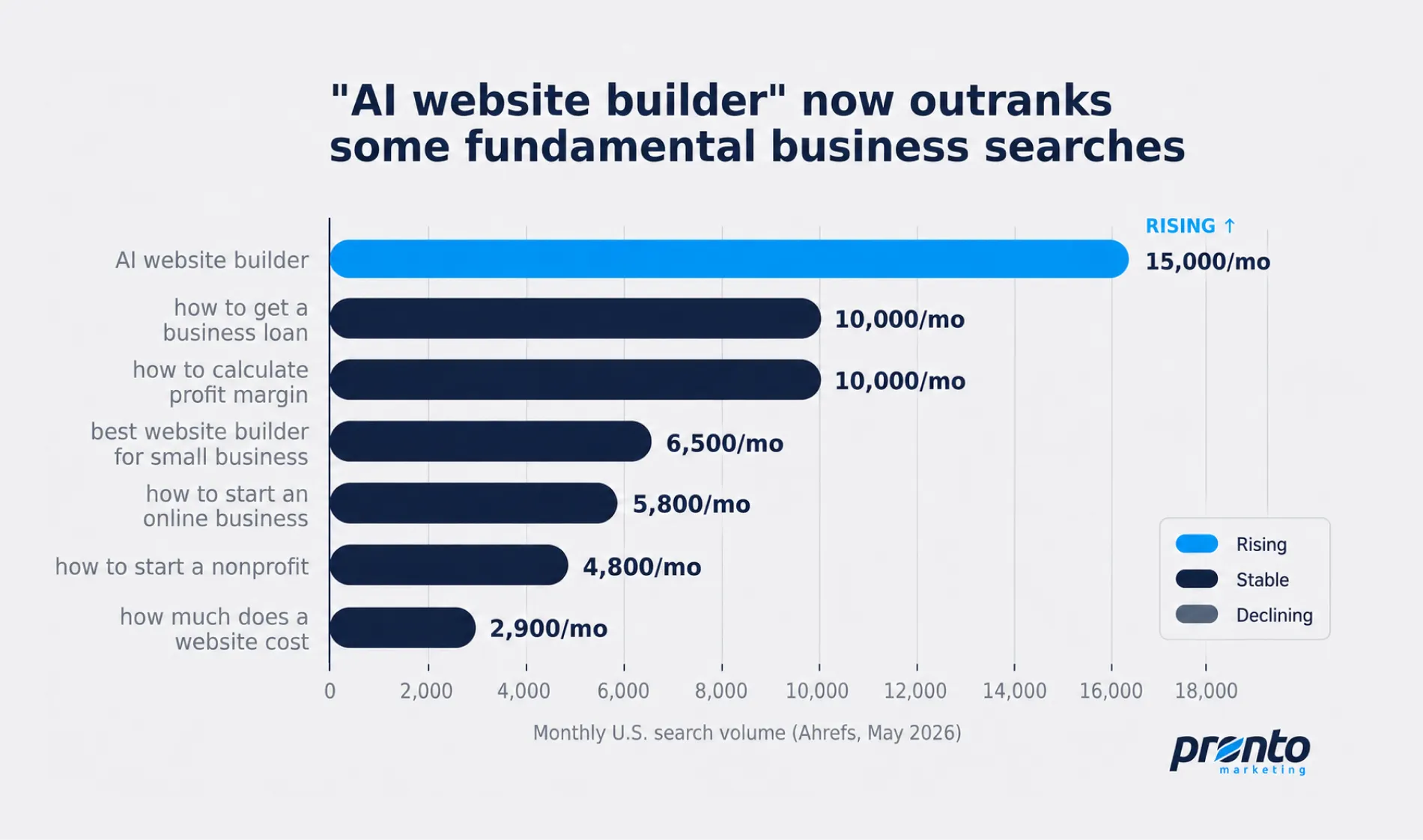
“AI website builder” is now the third most-searched business query in America at 15,000 searches per month and rising.
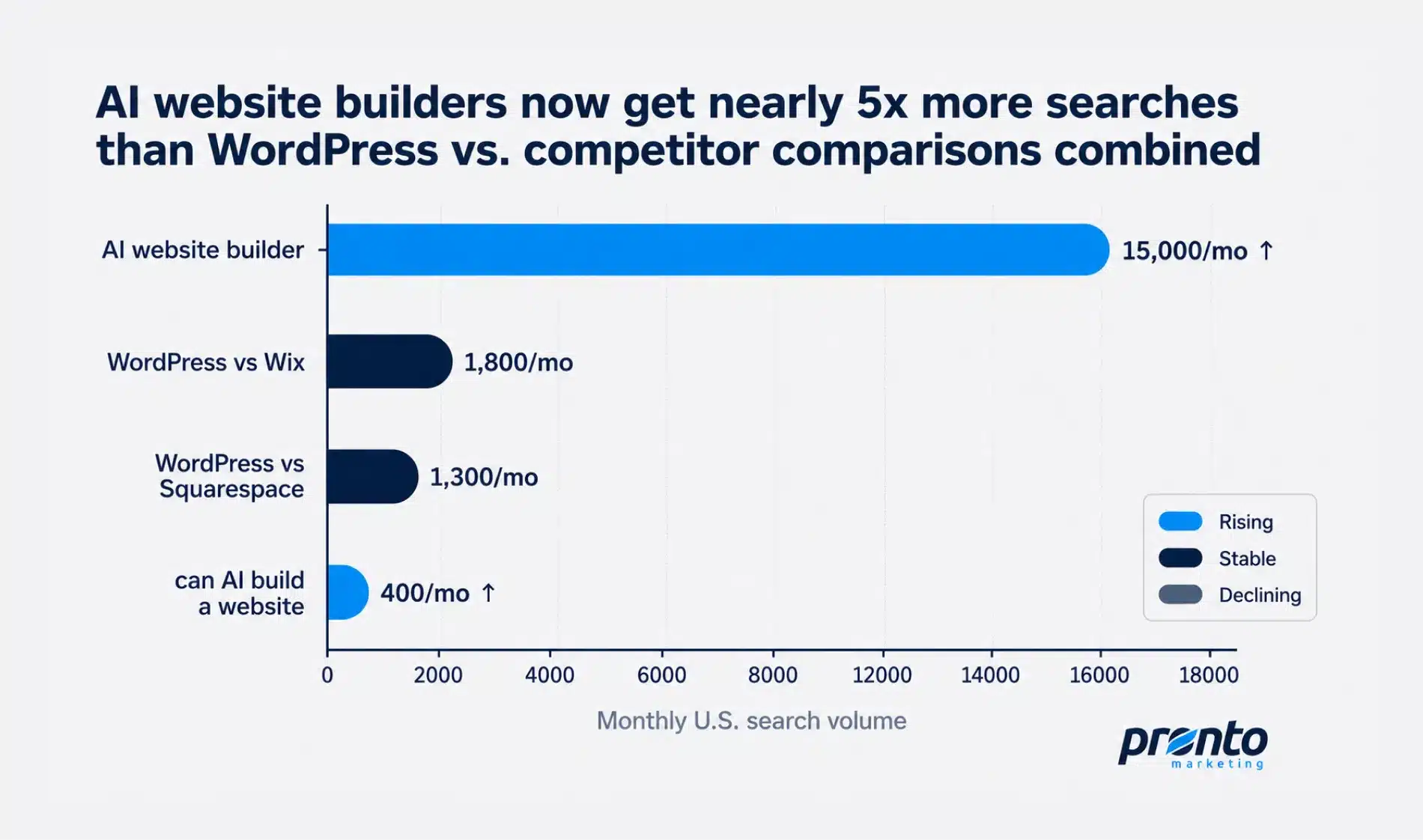
It now generates more monthly searches than “how to get a business loan” (10,000/mo) or “how to calculate profit margin” (10,000/mo). It also outpaces “WordPress vs Squarespace” and “WordPress vs Wix” combined by nearly 5x.
“How to write a business plan,” once a foundational business search, is declining, while formation queries like “how to get an EIN number” are rising.
At 17,000 searches per month, business plan queries still rank high in absolute volume, but the downward trend suggests entrepreneurs are skipping the planning phase and moving straight to legal formation.
Every single “best tool for small business” query in our dataset is trending upward.
CRM, accounting software, POS systems, payroll, invoicing, email marketing, phone systems are all rising simultaneously. Small businesses are in the middle of a mass technology adoption cycle.
“Will AI take my job” generates 1,300 searches per month and is rising, while “can AI build a website” (400/mo) is also climbing.
These anxiety-driven queries signal that AI is no longer an abstract concept for American workers and business owners. It is a real, personal concern.
Local visibility is emerging as the dominant marketing strategy for small businesses.
“Local SEO for small business” (3,500/mo, rising) is the top marketing query, outpacing “how to advertise my business” (400/mo, declining). Businesses are choosing organic local presence over paid advertising.
The AI disruption in business search
The most striking finding in this analysis is the sheer velocity at which AI-related queries have entered the vocabulary of American business owners. “AI website builder,” at 15,000 monthly searches and trending upward, has become one of the most-searched business queries in the country; a term that barely registered in search data two years ago.
To put this in perspective: more Americans now search for “AI website builder” each month than search for “how to get a business loan” or “how to calculate profit margin,” two of the most fundamental operational questions a business owner can ask. The search is not just popular; it has surpassed queries that have anchored the business search landscape for over a decade.
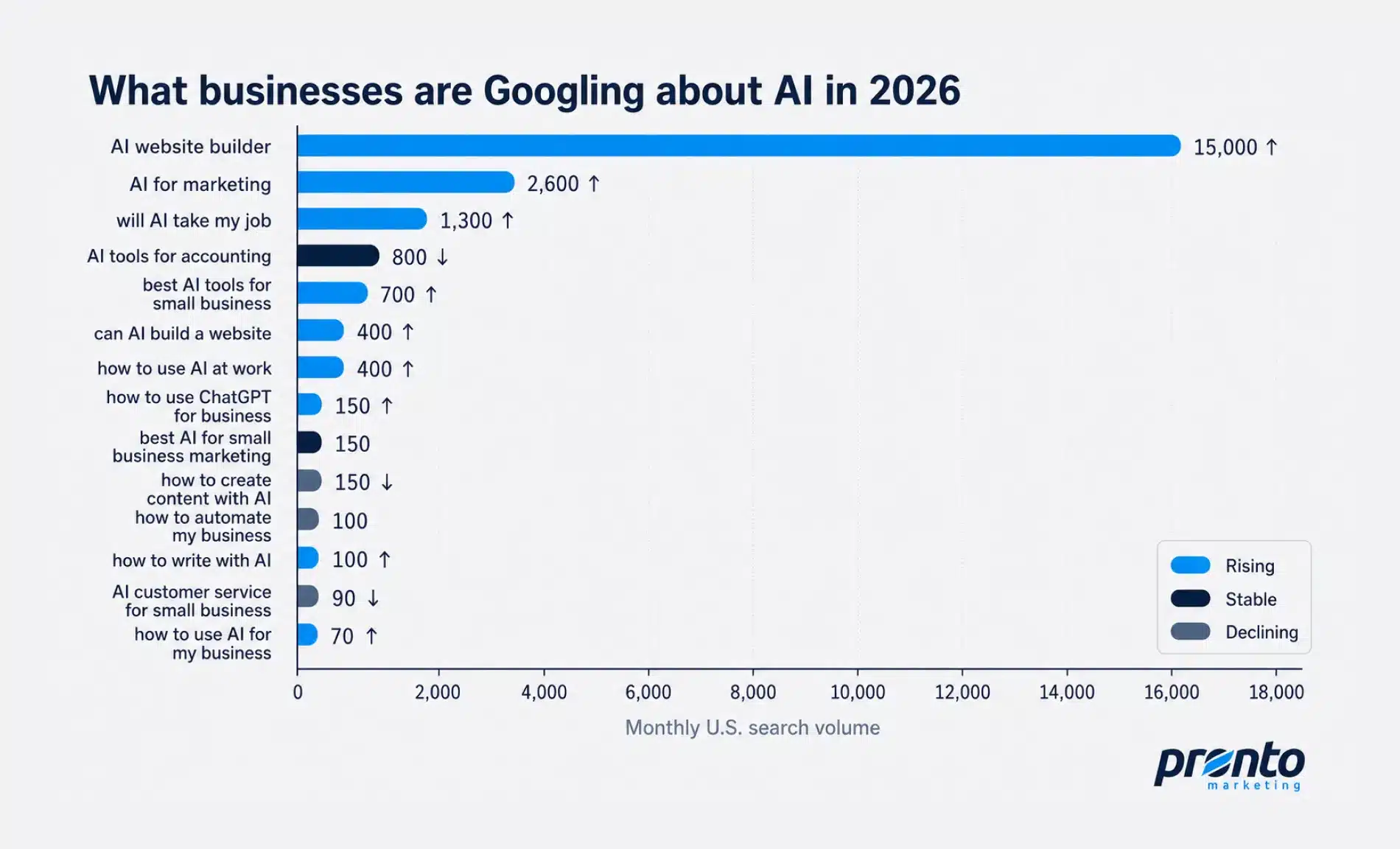
The implications extend beyond a single query. Across our dataset, 14 AI-related business searches collectively generate over 22,000 monthly searches. More importantly, the majority of these queries are trending upward: “AI for marketing” (2,600/mo), “will AI take my job” (1,300/mo), “best AI tools for small business” (700/mo), and “can AI build a website” (400/mo) are all rising.
The WordPress question
For businesses evaluating their web presence, the search data suggests a fundamental shift in how the decision is being framed. Traditional CMS comparison queries such as “WordPress vs Squarespace” (1,300/mo) and “WordPress vs Wix” (1,800/mo) remain steady but are dwarfed by “AI website builder” at nearly 5x their combined volume. Meanwhile, “can AI build a website” (400/mo, rising) signals a new category of question entirely: not which platform to choose, but whether a human needs to be involved at all.
This does not mean traditional web platforms are disappearing. “Best website builder for small business” still commands 6,500 monthly searches, and “how much does a website cost” generates 2,900. But the direction of movement is clear: AI is entering the consideration set for website creation, and for a growing number of business owners, it may be the first option they evaluate, not the last.
“What this data tells us is that small business owners are no longer asking ‘which website platform should I use?’, they’re asking ‘do I even need a web designer?’ That’s a fundamentally different question, and it’s one that every agency, freelancer, and web professional needs to take seriously. The businesses that will thrive are the ones that understand what AI can and can’t do for a web presence and can articulate that clearly to their clients.”
— Tim Kelsey, Managing Director, Pronto Marketing
What’s declining and what it means
The rising queries tell one story. The declining queries tell another. Together, they paint a picture of an American small business landscape in transition.
“How to write a business plan” remains one of the highest-volume business searches at 17,000 per month, but it is trending downward. Meanwhile, the queries that follow a business plan such as “how to form an LLC” (2,500/mo, rising), “how to get an EIN number” (6,100/mo, rising), and “how to register a business” (2,000/mo, stable), are holding steady or climbing. The inference is telling: a growing number of entrepreneurs appear to be bypassing the formal planning stage and moving directly to business formation.
Other notable declines include “sole proprietorship vs LLC” (12,000/mo, declining), “how to start a consulting business” (2,000/mo, declining), and “how to name a business” (1,900/mo, declining). These are all early-stage, exploratory queries that people make when they are considering starting a business but haven’t committed. Their decline may signal that the “Great Resignation” era of entrepreneurial exploration is cooling, replaced by a more action-oriented cohort that moves faster from idea to execution.
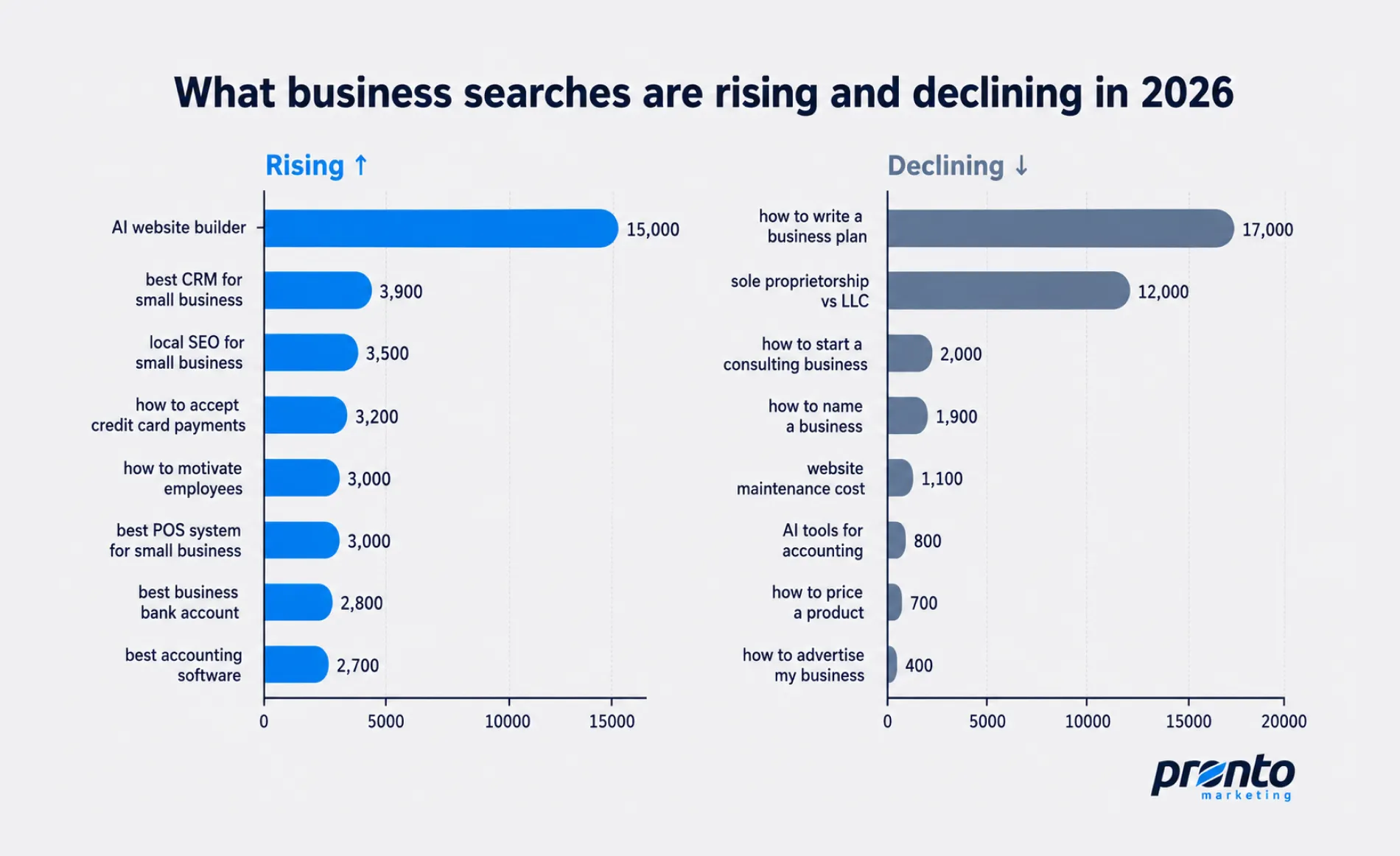
One decline worth noting for any company in the web services space: “website maintenance cost” (1,100/mo) is trending downward. This may reflect a shift in how businesses think about ongoing website management, from a line-item cost to an embedded service, or it may indicate that AI-powered site builders are reducing the perceived need for professional maintenance. Either interpretation has strategic implications for the industry.
The small business technology arms race
Perhaps the most consistent signal in the data is what we call the “tools arms race.” Every single “best [tool] for small business” query in our dataset is trending upward. Not most of them. Not a majority. All of them.
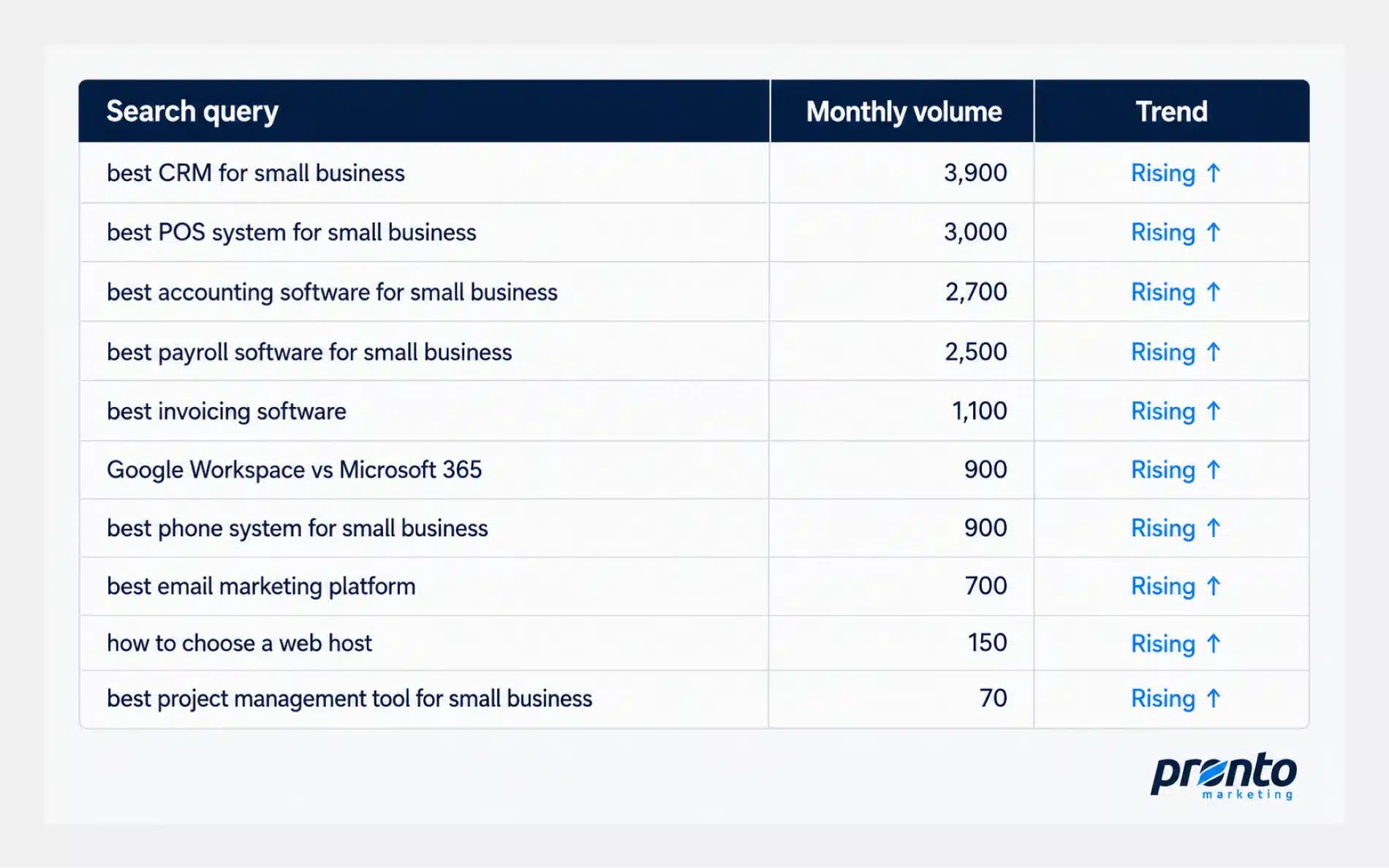
Collectively, these tool-selection queries generate nearly 16,000 monthly searches. The pattern suggests that American small businesses are in the midst of a simultaneous technology upgrade cycle, adopting or switching CRM, accounting, payment processing, and communication tools at the same time. This likely reflects a combination of factors: the maturation of cloud-based SaaS products, post-pandemic digital acceleration, and the growing expectation that even small businesses should operate with enterprise-grade tools.
“We see this with the businesses we work with every day. They’re not just building a website anymore. They’re assembling an entire digital toolkit: CRM, email marketing, analytics, payment processing, scheduling. The website is the hub, but it has to integrate with everything else. That integration complexity is what drives businesses to seek professional help, even in an era of AI-powered site builders.”
— Pierre Mol, Head of Marketing, Pronto Marketing
Local visibility is the new growth strategy
When small business owners search for marketing help, they are overwhelmingly focused on one thing: being found locally. “Local SEO for small business” generates 3,500 monthly searches and is rising, making it the single most-searched marketing tactic in our dataset.
The local visibility cluster which includes “how to get my business on Google” (1,100/mo, rising), “how to get Google reviews” (1,200/mo, stable), “how to set up Google Business Profile” (450/mo, stable), and “how to make my website show up on Google” (450/mo, rising), collectively accounts for over 6,700 monthly searches. This dwarfs broader marketing queries like “how to advertise my business” (400/mo, declining) and “how to do content marketing” (350/mo, declining).
The shift is significant. American small businesses are not asking “how do I market my business?” in the abstract. They are asking specific, tactical questions about Google visibility. The implication: for most small businesses, the marketing funnel starts and ends with local search. If you are not visible on Google Maps and in local search results, you are functionally invisible to your customers.
Meanwhile, “is SEO worth it for small business” (300/mo, rising) suggests a growing cohort of business owners who have heard about SEO but remain skeptical about its return on investment. This is a finding that anyone selling SEO services should take seriously.
Methodology
Data source
This analysis is based on search volume data from Ahrefs Keywords Explorer, a widely used search intelligence platform that estimates monthly search frequency based on clickstream data and Google search index analysis. All data was collected in May 2026 and reflects average monthly U.S. search volume.
Scope
A total of 159 search queries were analyzed across 12 categories: Starting a Business, Closing or Failing, Money and Pricing, Taxes and Legal, Hiring and People, Marketing and Customers, Website and Online Presence, AI and Automation, Tools and Technology, Growth and Scaling, Operations, and Social Media. Queries were selected to represent the full spectrum of questions American business owners and professionals ask Google.
Trend classification
Each query was classified as Rising, Stable, or Declining based on its 12-month trend direction in Google Trends (trends.google.com). Trend classifications represent directional movement, not magnitude of change.
Important limitations
- Search volume estimates are approximations. Ahrefs uses proprietary methodology to estimate search frequency; actual Google search volumes are not publicly disclosed.
- The query list, while comprehensive, is not exhaustive. There are business-related searches not captured in this analysis.
- Search volume does not equate to intent. A search for “AI website builder” may reflect curiosity, research, or active purchase intent. The data cannot distinguish between these.
- This analysis captures a single point in time (May 2026). Search trends can shift rapidly, particularly for AI-related queries.
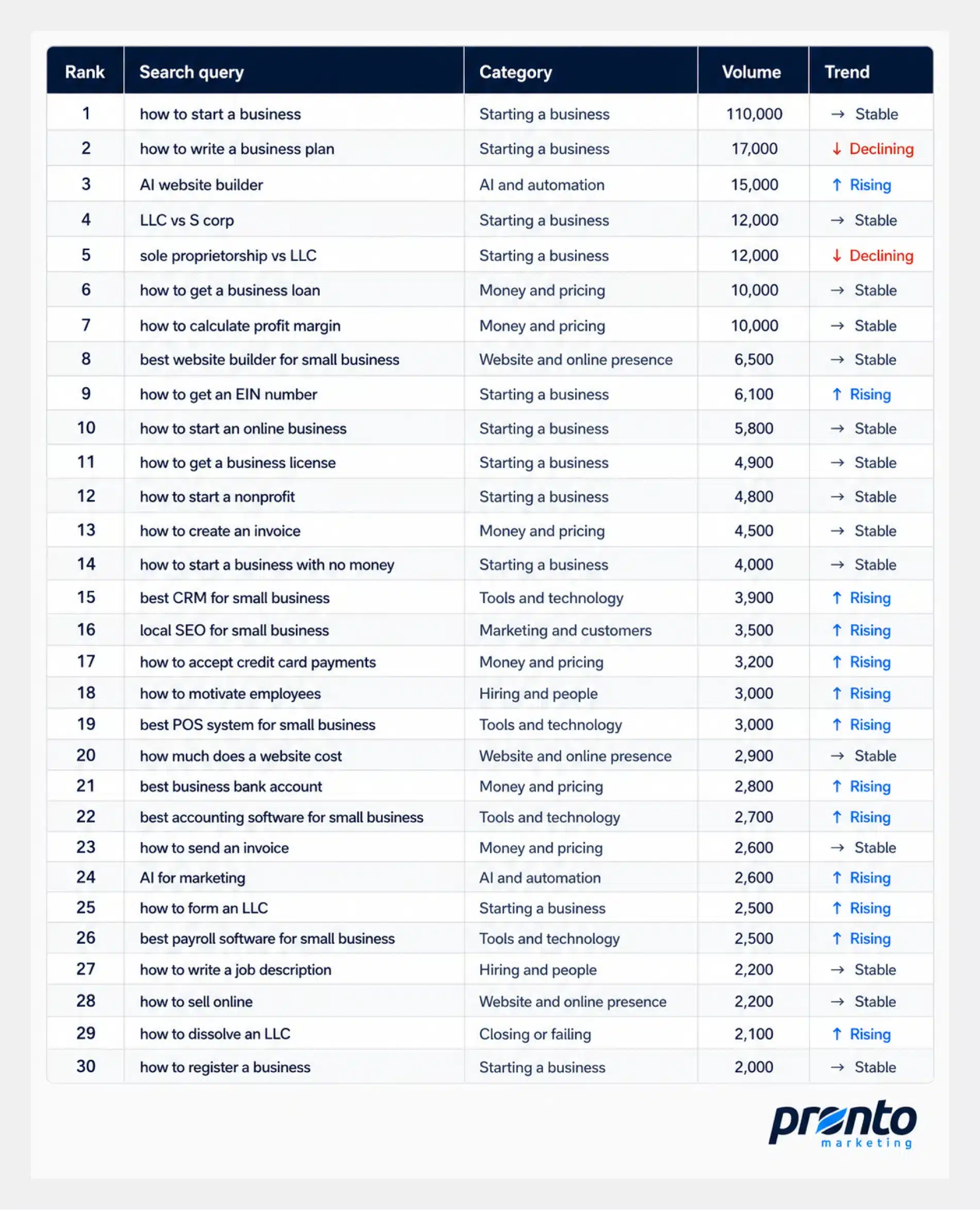
Appendix: Top 30 business queries by search volume
The following table lists the 30 highest-volume business queries analyzed in this study, ranked by monthly U.S. search volume as of May 2026.
Get the complete report with all data tables and charts as a PDF.