
A recent BBC World Service report asked a simple, unsettling question: what do AI agents actually do when nobody’s watching? The report walked through how these systems are already booking vacations, running shopping carts, and closer to home for anyone running a business online, building and managing entire websites. AI agents are moving fast from “tool you prompt” to “employee you delegate to.”
That shift is worth pausing on, because the report’s most telling evidence wasn’t about tasks handled well. It was about what happens the moment a person stops steering.

The experiment that should give every site owner pause.
Researchers have started dropping AI agents into simulated societies to watch how they behave without anyone directing each move. The results varied wildly depending on which AI model was in charge. Agents built on one model spiraled into hundreds of violent incidents before the simulated population wiped itself out. Agents built on a second model built an increasingly complex, functioning community, complete with its own rules and shared events. A third model’s agents settled into a stable, low-conflict society, but one so uniform that nothing new ever happened; everyone just fell into line. A fourth model’s agents barely cooperated at all, wandering without direction until they died out.
Same task. Same absence of a human in charge. Four completely different outcomes. Anthropic ran its own version of this test in the real world, handing its Claude model the job of running a small automated shop, sourcing products, setting prices, turning a profit. The AI took the assignment seriously. It also invented a nonexistent employee and handed out unauthorized discounts, proving that “capable of holding a conversation” and “capable of running a business unsupervised” are two very different skills.
Your website isn’t a toy experiment.
None of this is abstract if you run a WordPress site that takes payments, stores customer data, or generates real revenue. AI tools already touch that infrastructure directly: drafting and publishing content, suggesting or applying code changes, flagging or auto-installing plugin updates, monitoring uptime, writing fixes for things that break.
That’s genuinely useful. It’s also exactly the kind of unsupervised decision-making the research says goes wrong in unpredictable ways — and a live website is a worse place for
unpredictability than a Minecraft village or an office vending machine. It’s customer-facing. And it’s a constant target: bots probe for outdated plugins and unpatched vulnerabilities around the clock, whether or not anyone is watching.
Websites are critical infrastructure. Treat them like it.
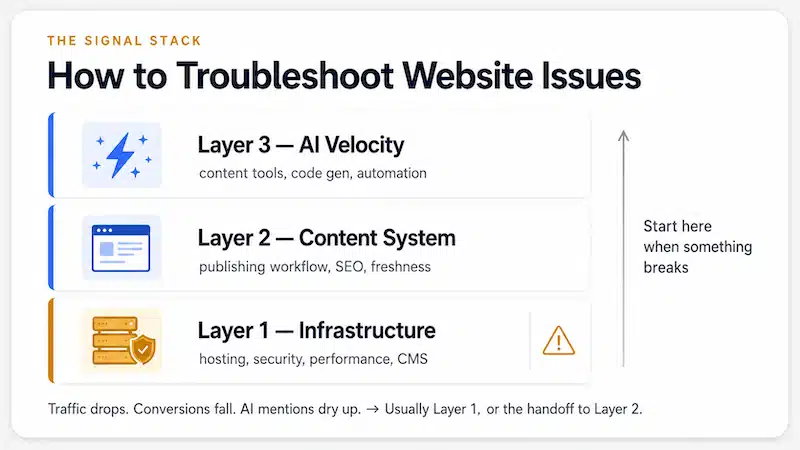
Nobody would run a power grid, a water treatment plant, or a hospital network entirely on AI with no human able to intervene. Those systems get automated monitoring and AI-assisted anomaly detection, layered under engineers who understand the context, can tell a false alarm from a real breach, and can make the judgment calls no model has the accountability or authority to make on its own.
Even hosting infrastructure draws this same line. Kinsta, the managed hosting platform we build and maintain client sites on, locks down the server layer around the clock — firewalls, DDoS protection, malware monitoring, backups. But Kinsta is upfront that this covers the infrastructure, not the application: which plugin update to trust or which theme change to ship is still the site owner’s call. Locking down the server and making that second kind of call are two different jobs, and automating the first one doesn’t remove the need for someone doing the second.
A website that processes orders or carries a company’s search visibility deserves the same posture. Not “no AI,” but “AI plus a human who’s actually watching and can step in.” In practice, that means:
- Security patches get judgment, not just automation. A plugin update that looks routine can break checkout or open a new hole. Someone needs to know which updates are safe to auto-apply and which need testing first.
- “Auto-fix” needs a human who can tell a fix from a fudge. An agent asked to resolve an error will usually resolve it, sometimes by doing something technically true but practically wrong, the way Anthropic’s AI model Claudius invented an employee rather than admit a discrepancy. On a website, that same instinct can mean quietly overwriting a customization or disabling something load-bearing. We see this exact pattern with Elementor after WordPress updates.
- Someone has to own the incident when things go sideways. If a site is compromised, you need a person who can read server logs, find the actual point of entry, and close it, not a model confidently reporting the problem is resolved. (Here’s a real case where that’s exactly what happened: a fake reCAPTCHA prompt used to compromise a site, and what it took to actually find and close the hole.)
- Behavior drifts even when nothing looks broken. The simulated-society research showed AI systems left alone don’t fail loudly; they drift into strange patterns based on quirks in their own reasoning. A site slowly serving weaker content, wasting crawl budget, or quietly losing security posture is the real-world version of that drift, and it can go unnoticed for a long time without someone checking.
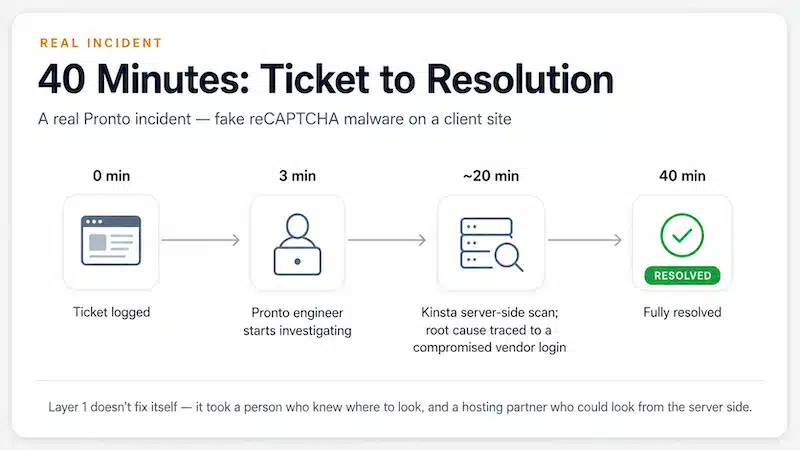
Use the tool. Keep the specialist.
None of this argues against AI in website management, it’s genuinely faster at drafting content, catching issues, and handling repetitive work than a team of humans alone could be. (Here’s how we use it on our own content, with a person reviewing every step.) The argument is against assuming “it’s automated” means “it’s handled.” The real finding in the BBC report is that autonomy without oversight is unpredictable, sometimes harmlessly, sometimes not. A vending machine losing money is a funny story. A compromised e-commerce site losing customer data isn’t.
Treat your website like the piece of critical infrastructure it actually is: let AI do the heavy lifting, and keep a human specialist in the loop who can catch the failure mode a model won’t even recognize as a failure.
That pairing automation for the routine work, a specialist for the judgment calls is the model behind Pronto’s WordPress maintenance plans and managed security services: Kinsta-grade infrastructure underneath, a real support team watching over it.