

You invested in your website. The design looks professional, the pages load fast, and you even spent money on SEO. So why does your inbox keep filling up with leads that go nowhere?
Maybe you’re a commercial landscaping company getting calls from homeowners wanting their garden trimmed. Maybe you’re an IT services firm fielding “how much for a one-time setup?” requests when what you need are recurring managed services contracts. Or perhaps you’re spending real money on ads and still wondering where the right clients are.
It’s a frustrating place for a business owner to be: working hard, investing in the right digital assets, and still getting leads that waste your team’s time.
Here’s the good news: this is a solvable problem. But before diving into the fix, it’s worth understanding exactly what it’s costing you.
The Real Cost of Attracting the Wrong Clients
A wrong-fit lead is an annoyance, but more than that, it’s a measurable drain on your business.
What Is a Wrong-Fit Lead?
A wrong-fit lead is someone your website attracted who was never going to become your ideal client. This happens not because they weren’t interested, but because your site signaled something that didn’t match your actual services, pricing, or target market.
This is different from a low-quality lead (someone who can’t afford you) and a no-show lead (someone who fills out your form and disappears). A wrong-fit lead often does contact you. They’re just looking for something you either don’t offer or don’t want to offer anymore.
What It’s Actually Costing You
The costs compound quickly across three major areas:
| Cost Category | What You're Losing |
|---|---|
| Ad spend | Every click from the wrong audience is money burned. Google Ads pointing at the wrong intent keywords can cost hundreds to thousands of dollars per month with zero return. |
| Sales and staff time | Every discovery call, follow-up email, and proposal written for a wrong-fit prospect steals time from real opportunities. |
| Website investment | If your site was built to attract the wrong buyer (even unintentionally) every dollar spent building and maintaining it has been working against you. |
The 2 Fears Most Business Owners Don’t Say Out Loud
In conversations with business owners dealing with this exact problem, two frustrations come up again and again:
- “We’re working hard but getting leads that waste our time. We suspect it’s the website’s fault, but we don’t know exactly what to fix.”
There’s a gut feeling that something is off, but the root cause is unclear. Is it the SEO? The copy? The design? The offers? Usually, it’s a combination, and that’s precisely why it’s hard to diagnose alone.
- “I don’t know if this is an SEO problem or a conversion problem.”
These two issues often get conflated. SEO determines who finds you. Conversion (messaging, design, positioning) determines who stays and reaches out. When both are misaligned, wrong-fit leads become the norm. The fix requires addressing both together.
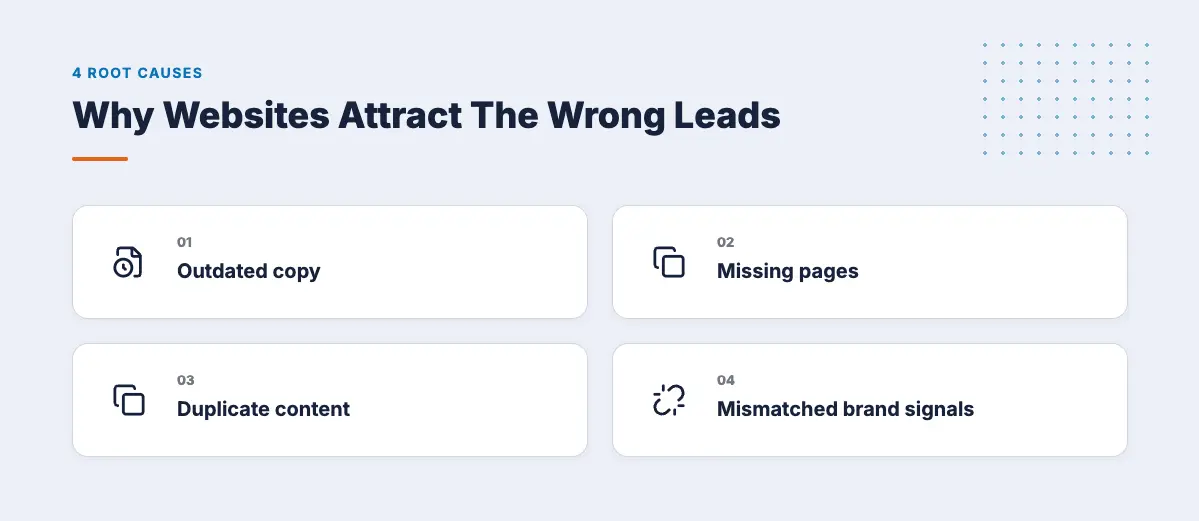
Why It Happens: 4 Root Causes
Websites don’t attract the wrong clients by accident. It most certainly happens because the site has failed to keep pace with how the business has evolved.
1. Your Copy Hasn’t Caught Up with Your Business
Businesses change. They pivot to new markets, drop old services, or move upmarket — but their websites often stay frozen in time.
Take the owner of a commercial landscaping company we worked with. She came to us with a clear problem: her landscape design page was still targeting residential clients, written when the business primarily did backyard gardens. Though the company pivoted to high-end commercial plant accounts in White Plains years ago, the old page was still live and ranking. She was getting Park Slope garden leads when she needed White Plains office plant accounts..
She suspected something in the site’s SEO setup, something she couldn’t see or access herself, was actively steering residential inquiries her way instead of the commercial accounts she was after.
She wasn’t wrong. The SEO was doing exactly what it was set up to do…years ago. The site just never caught up with the business.
2. You’re Missing Pages for the Services You Actually Want to Sell
Search engines can only send people to pages that exist. If you’ve added new service lines, moved into new industries, or expanded your offering but haven’t built corresponding pages, those potential clients will never find you.
Take the case of an IT services firm. There was no dedicated page for AI consulting, a service the firm had started offering, and no industry-specific landing pages for one of their core verticals, home-based care. The site also had keyword ranking gaps around “IT consulting,” one of their primary offerings.
The consequence: Competitors with more complete site structures were capturing leads that should have gone to them. Not because their services were inferior, but because their digital footprint didn’t reflect them.
3. Content Confusion and Duplication Dilute Your Authority
When two pages on your site cover the same topic with similar content, search engines have to guess which one to rank and often deprioritize both. This is called content cannibalization, and it quietly undermines the topical authority your site is trying to build.
For one healthcare-adjacent services business we worked with, the site had an “overview” page and a “treatments and ailments” page that were functionally duplicates. Both covered similar ground without either one being comprehensive enough to rank well. The fix was consolidating them into a single, authoritative service page, which removed the ambiguity for both search engines and visitors.
4. Your Brand Signals Are Sending the Wrong Message
Sometimes the problem isn’t the words; it’s everything around them. Your color palette, your imagery, your logo, and the overall feel of your site all send signals before a visitor reads a single sentence. If those signals speak to the wrong audience, no amount of copy optimization will fully fix it.
This was the defining problem for one MSP (managed service provider) we worked with. Their legacy site prominently featured “data cabling” across multiple pages — a service they had largely phased out. The brand didn’t say “strategic technology partner for professional sectors.” It said “the guys you call to run cable.”
As the company’s president put it: “I don’t think we’re getting anything through the website right now. The only thing we get calls for is data cabling, which we don’t even do anymore… I never get an ‘out of the blue’ call saying, ‘Hey, can you help me with my IT?'”
The brand wasn’t broken. It was just telling the wrong story.
The 3 Surface-Level Symptoms to Look For
Even before a full audit, there are three areas where wrong-client misalignment almost always shows up visibly.
Branding: Your Visual Identity Tells a Story Before Your Copy Does
Colors, typography, logo style, and overall design aesthetic prime a visitor’s perception. A site that looks like it was built in 2014 communicates something very specific about your business, whether you intend it to or not.
This matters especially in service industries where trust is a primary buying factor. If your site looks like your competitors did five years ago, prospects may assume your capabilities are similarly dated. Conversely, a deliberately modern, industry-specific design immediately communicates that you understand the space you operate in.
Images: Stock Photos Are Costing You
Nothing undermines credibility faster than imagery that doesn’t match the reality of your business. Generic stock photos of people shaking hands, anonymous servers in dark rooms, or smiling office workers who clearly aren’t your team send a subconscious signal to visitors: this business is interchangeable.
The right images show the actual work you do, the actual environments you serve, and, ideally, the actual people behind the business. For a commercial landscaping company, that means photos of commercial properties, not suburban backyard gardens. For an MSP, that might mean imagery of mid-market office environments rather than home office setups.
Wrong imagery also compounds SEO issues. If the alt text and file names of your images are tagged with keywords for a phased-out service, you’re actively helping search engines send you the wrong traffic.
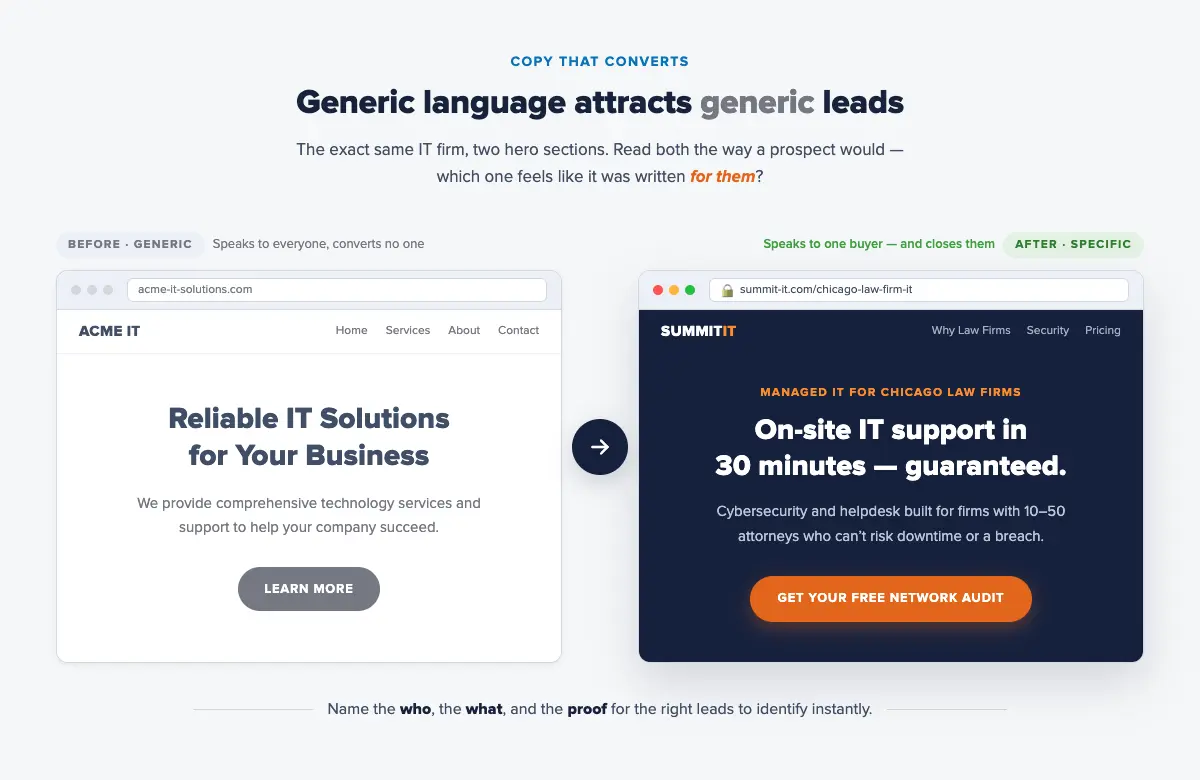
Copy: Generic Language Attracts Generic Leads
The language on your website is the most direct signal to both search engines and visitors about the audience you serve. Broad, inclusive language (“we work with businesses of all sizes across many industries”) might feel safe, but it actively works against you in two ways:
- For AI Search and SEO: Broad language competes with everyone and ranks for nothing specific.
- For conversion: Visitors self-qualify based on whether they feel specifically addressed. Generic copy makes everyone feel equally welcome, and equally uncompelled to act.
Compare these two home page headlines for an IT firm:
| Generic (Wrong Fit) | Specific (Right Fit) |
|---|---|
| "Reliable IT Solutions for Your Business" | "Managed IT Support for Greenville's Professional Services Firms" |
| "We Handle All Your Tech Needs" | "Local-First IT. We're On-Site Within the Hour." |
| "Experienced IT Professionals" | "Strategic Technology Partner for Healthcare, Legal & Finance" |
The specific version won’t appeal to everyone, and that’s exactly the point.
The Misalignment Cheat Sheet
Now that you know what to look for across your brand’s aesthetics, imagery, and copy, use this quick diagnostic table to evaluate your own site.
| Generic (Wrong Fit) | Specific (Right Fit) | Ideal Signal (Right Fit) |
|---|---|---|
| Hero image | Generic stock photo of a handshake or a laptop | Real clients, real team, real work environments |
| Headline | Broad ("IT Solutions for Everyone") | Specific ("Managed IT for Upstate SC Businesses") |
| Service list | Includes outdated or low-value services | Focuses on high-value, recurring, or strategic services |
| Aesthetic | Dated or inconsistent with your positioning | Modern, industry-appropriate, and intentional |
| Blog/Resource topics | Generic how-to content | Niche expertise content that speaks to your ideal client's problems |
What Should Be Done: The Fix Framework
Diagnosing the problem is step one. Here’s how to systematically address it.
Step 1: Audit Your Messaging for Business Reality
Start with a simple question: Does your website reflect who you serve today, or who you served when it was built?
Go through every service page, headline, CTA, and image with that question in mind. Flag anything that points to:
- Services you’ve discontinued or deprioritized
- Client types you no longer target
- Industries you no longer serve or aren’t profitable
- Language that reflects your old positioning rather than your current one
Step 2: Build the Pages You’re Missing
If you’ve added services, expanded into new verticals, or started targeting new industries, create dedicated pages for each. Instead of grouping them under a single page, give each one its own URL, targeted copy, and keyword strategy.
The pages that are commonly missing but critically needed include:
- Industry-specific landing pages (e.g., “IT Support for Healthcare Practices”)
- New service line pages (e.g., “AI Consulting for SMBs”)
- Location pages, if you serve a defined geographic area
- Service-specific FAQs that address the objections your ideal clients actually have
Step 3: Consolidate Thin or Duplicate Content
Run a content audit to identify pages that overlap in topic or intent. For each overlapping pair, ask: can these be merged into a single, more authoritative page? In almost every case, the answer is yes, and the consolidated page will outperform both originals in search.
This is especially important for service-based businesses that have accumulated pages over years without a governing content strategy. Fewer, stronger pages beat many weak ones every time.
Step 4: Realign Your Brand Signals
Once the content is right, make sure the visual identity matches. This doesn’t always mean a full redesign; sometimes it means:
- Replacing stock photos with real client or team imagery
- Updating the home page hero to reflect your current positioning
- Removing legacy service mentions from navigation and footers
- Refreshing copy on key pages to use the specific language your ideal clients understand
If your site is heavily outdated, a full redesign is the right call. The investment pays for itself quickly by generating closable leads.
Step 5: Align Your SEO with Your New Positioning
Updated pages and refreshed copy won’t automatically reset your search rankings. You need to make sure the technical SEO layer reflects the changes too. That means:
- Updating page titles and meta descriptions to match new positioning
- Revising heading structures to target the right keywords
- Updating internal links so the right pages receive the right authority
- Submitting updated sitemaps to Google Search Console
This is also the moment to close any keyword gaps, making sure you’re targeting the terms your ideal clients are searching for, not the terms associated with services you’ve moved away from.
Is Your Website Working for You or Against You?
Take this quick self-check. If two or more of these are true for you, it’s time to look closely at your site’s alignment:
- Your website was built or significantly updated more than 2 to 3 years ago.
- Your business has added, changed, or dropped services.
- You've shifted your target market or moved upmarket.
- The leads you're getting consistently don't match the clients you want.
- You're running paid ads, but the conversions feel off.
- You have multiple pages that cover similar topics.
- Your home page imagery or language still references deprioritized services.
If any of these hit close to home, know you’re not alone — and you’re not out of options.
Key Takeaway
Your website is the most visible expression of your brand’s positioning. When it’s aligned with who you actually serve (in its copy, imagery, structure, and SEO) it works as a filter, drawing in the right clients and making it easy for them to self-qualify.
When it’s misaligned, it works against you in every direction: attracting the wrong inquiries, confusing the right ones, and spending your team’s time on leads that go nowhere.
The fix isn’t always a full rebuild. Sometimes it’s a content audit and a few targeted page updates. Either way, the process starts with an honest look at whether your site still tells the right story about your business.
References and further reading: