
Get the complete report with all data tables and charts as a PDF.
Google search data reveals a fundamental shift in how Americans start businesses, from planning to doing
An original analysis of Google search data by Pronto Marketing – May 2026
Authored by Pierre Mol, Head of Marketing, Pronto Marketing
Key findings
Pronto Marketing analyzed the monthly U.S. search volume for 159 business-related queries using Ahrefs Keywords Explorer, one of the industry’s leading search intelligence platforms. The analysis captures what American business owners and professionals are actively searching for on Google as of May 2026. Here is what the data reveals about the changing nature of American entrepreneurship.
“How to write a business plan” is declining, while the queries that come after a business plan are rising.
At 17,000 searches per month, business plan queries still rank among the highest-volume business searches in America. But the trend is downward. Meanwhile, “how to get an EIN number” (6,100/mo) and “how to form an LLC” (2,500/mo) are both rising, suggesting entrepreneurs are skipping the plan and moving straight to formation.
“How to start a business” remains massive at 110,000 searches per month and is holding steady.
Entrepreneurial ambition is not declining. The desire to start a business is as strong as ever. What’s changing is how people act on that desire. They’re compressing the path from idea to action.
A cluster of early-stage, exploratory queries are all declining simultaneously.
“Sole proprietorship vs LLC” (12,000/mo), “how to name a business” (1,900/mo), “how to start a consulting business” (2,000/mo), “best state to form an LLC” (400/mo), and “how to get funding for a startup” (200/mo) are all trending downward. These are the searches people make when they’re still thinking about starting a business. Their decline suggests fewer people are in the deliberation phase and more are jumping straight to execution.
The “tools arms race” reinforces the pattern: businesses are tooling up immediately.
Every single “best [tool] for small business” query — CRM, accounting, POS, payroll, invoicing, email marketing — is rising. New entrepreneurs are skipping the plan and going directly to assembling their technology stack.
AI may be accelerating the compression.
“AI website builder” (15,000/mo, rising) and “can AI build a website” (400/mo, rising) suggest that AI tools are making it possible to skip steps that once required weeks of planning and vendor selection.
The planning phase is compressing
For decades, the conventional wisdom has been clear: before you start a business, write a business plan. The SBA recommends it. Banks require it for loans. Business schools teach it as a foundational skill. And for years, Google search data reflected this orthodoxy. “How to write a business plan” has been one of the most-searched business queries in America.
It still is. At 17,000 monthly searches, it ranks as the second-highest business query in our dataset, behind only “how to start a business” (110,000/mo). But the trend line tells a different story. “How to write a business plan” is declining. And the queries that represent the next step, actually forming a business, are rising.
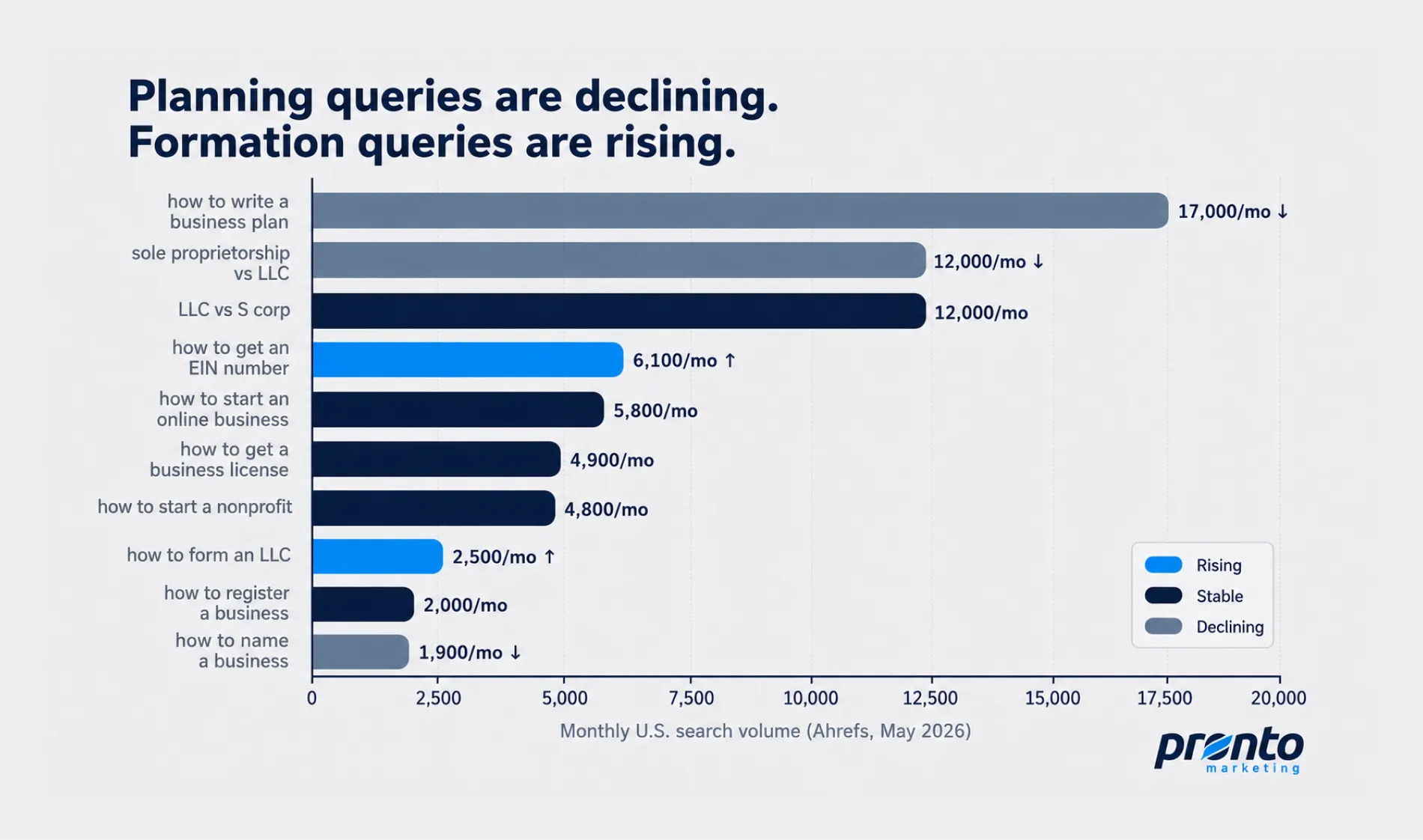
“How to get an EIN number,” one of the first concrete steps in business formation, generates 6,100 monthly searches and is rising. “How to form an LLC” (2,500/mo) is also climbing. These are not aspirational queries. They are transactional. Someone searching for an EIN has already decided to start a business. They are past the planning stage.
The pattern is consistent across multiple signals. “How to register a business” (2,000/mo) is stable. “How to get a business license” (4,900/mo) is stable. The infrastructure of actually starting a business — the legal, regulatory, and administrative steps — remains in steady demand. What’s shrinking is the deliberation that comes before it.
The entrepreneurship funnel is changing shape
One way to understand what’s happening is to think of starting a business as a funnel with three stages: exploration (should I start a business?), planning (how do I structure and plan it?), and formation (how do I legally create it?). Our search data suggests the middle stage, planning, is being compressed or bypassed entirely.
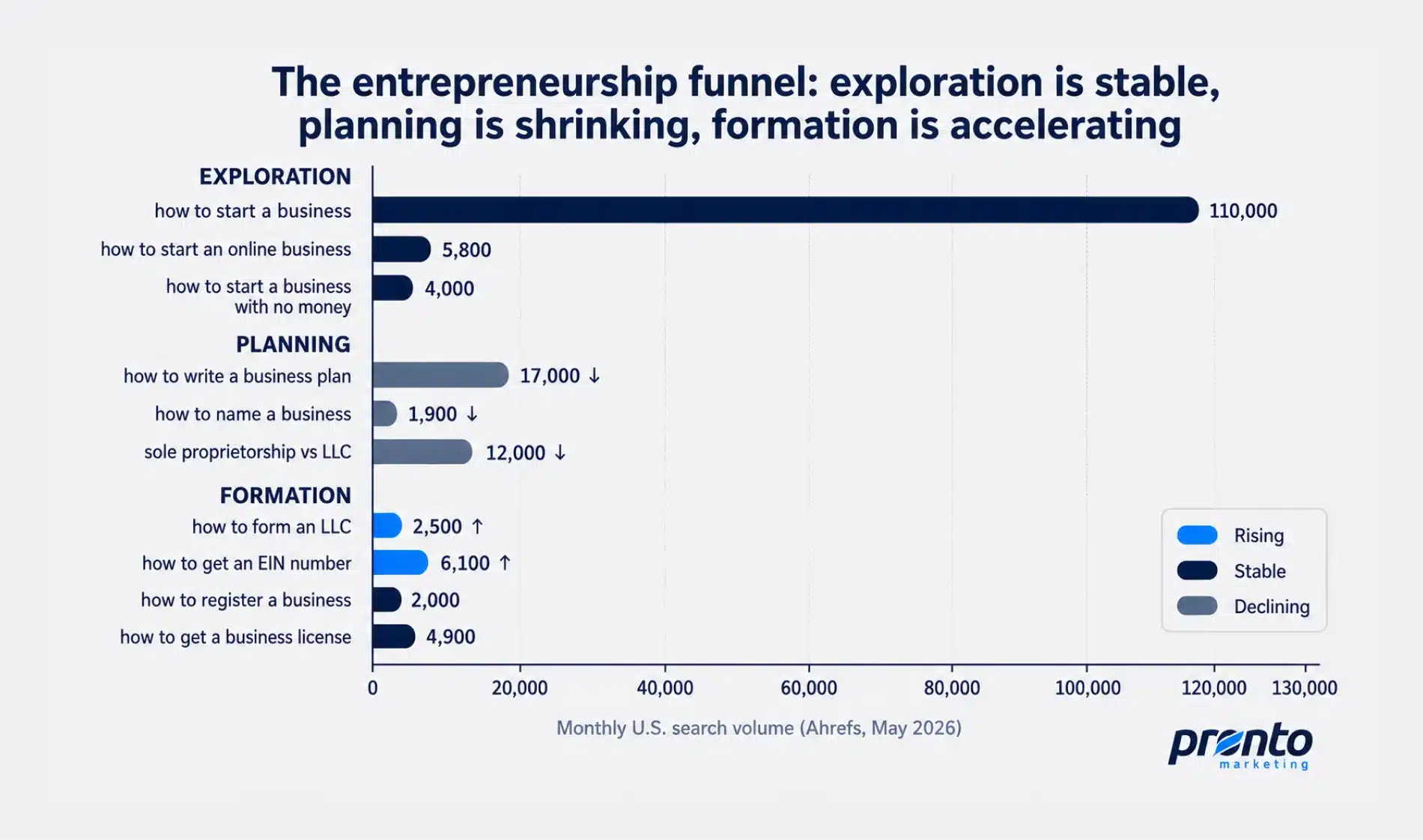
The exploration stage is holding steady. “How to start a business” at 110,000 monthly searches is stable, which suggests the entrepreneurial impulse in America is not weakening. “How to start an online business” (5,800/mo) and “how to start a business with no money” (4,000/mo) are also steady. People are still dreaming of starting businesses at the same rate.
But the planning stage is hollowing out. The cluster of declining queries tells the story clearly:
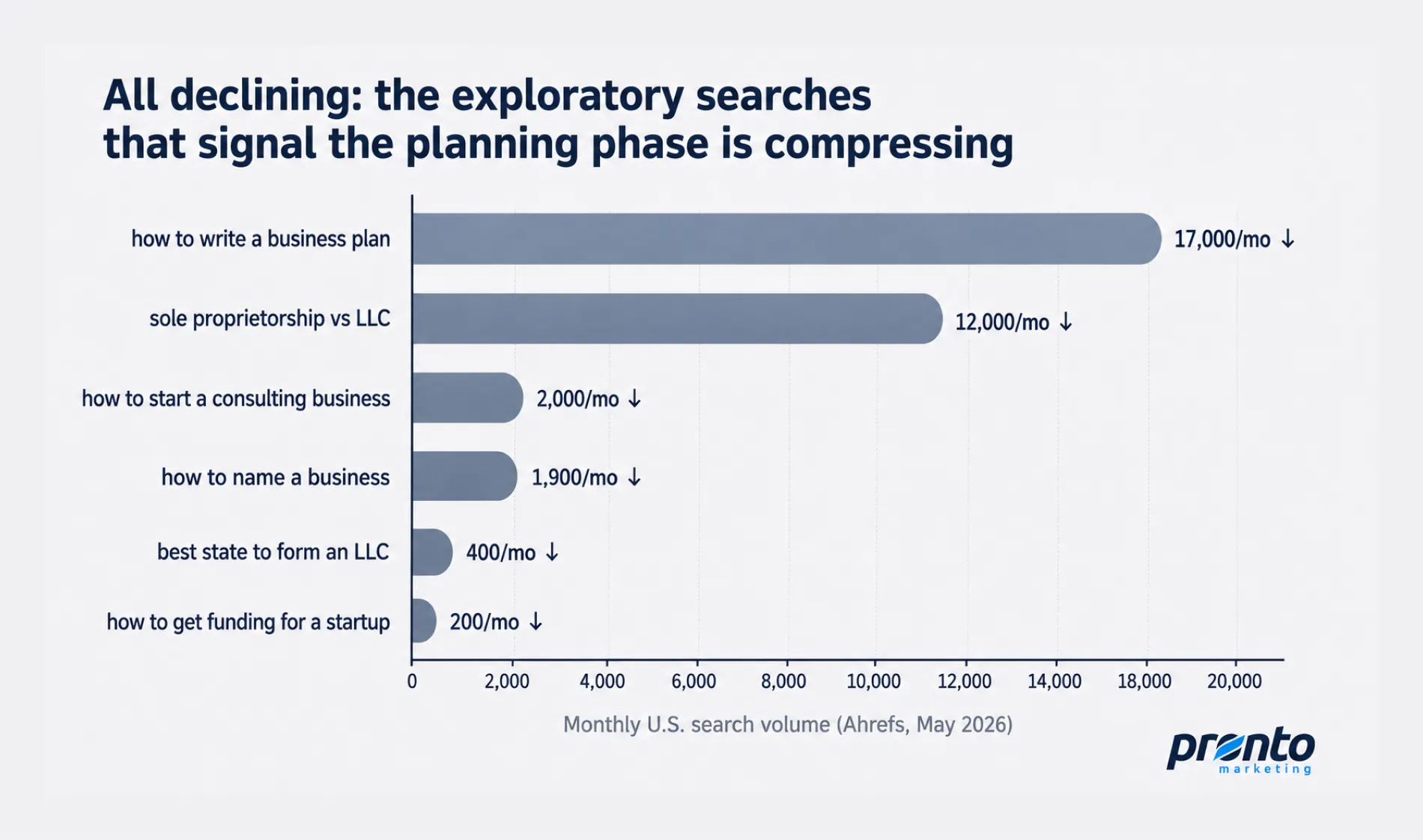
“Sole proprietorship vs LLC” (12,000/mo, declining) is particularly telling. This is the quintessential deliberation query. It’s the business equivalent of test-driving two cars before buying. Its decline suggests that more entrepreneurs are arriving at the formation stage with their decision already made, possibly informed by AI tools, YouTube videos, or social media advice that has replaced the traditional research-and-plan process.
What’s driving the shift
The SaaS acceleration
One explanation is structural: the barriers to starting a business have never been lower. Online LLC formation services (LegalZoom, Incfile, ZenBusiness) have reduced entity creation to a form-filling exercise. Payment processing is instant (Stripe, Square). Website creation is increasingly automated. The technology stack that once required months of planning and vendor evaluation can now be assembled in an afternoon.
Our data supports this. Every single “best [tool] for small business” query in our dataset is rising: CRM, accounting software, POS systems, payroll, invoicing, email marketing, phone systems. The total search volume for tool-selection queries is nearly 16,000 per month, all trending upward. New entrepreneurs are not spending months planning; they are going directly to tooling up.
The AI factor
“AI website builder” generates 15,000 monthly searches and is rising rapidly. “Can AI build a website” (400/mo) is climbing. These signals suggest that AI is further compressing the timeline from idea to execution. A business owner who might once have spent weeks evaluating web designers, comparing platforms, and writing a website plan can now type a prompt and have a working site in minutes.
This compression has cascading effects. If the website is done in a day, there is no need to plan for it. If the business entity is formed online in 20 minutes, there is no need to deliberate over structure for weeks. Each step that gets faster reduces the need for the step before it.
The Great Resignation hangover
There is also a demographic explanation. The 2021–2022 period saw a surge of entrepreneurial exploration driven by the Great Resignation, where millions of workers reconsidering their careers and Googling questions about starting businesses. Many of those exploratory searches (“how to start a consulting business,” “best state to form an LLC”) have now declined as that cohort has either acted on their plans or returned to employment. What remains is a more action-oriented population of entrepreneurs who search less and do more.
“The clients who come to us today are different from five years ago. They already have an LLC, they already have a brand name, and often they already have a logo from an AI tool. What they don’t have, and what they come to us for, is a web presence that actually works: one that ranks on Google, converts visitors, and integrates with their business tools. The planning they skip is the planning they probably need most.”
— Tim Kelsey, Managing Director, Pronto Marketing
What this means for businesses and the people who serve them
If the business plan is declining as a pre-requisite for business formation, the implications extend well beyond search trends.
For business service providers such as web designers, marketing agencies, accountants, lawyers, the shift means that new clients are arriving further along in their journey but with less preparation. They have an LLC but no marketing strategy. They have a website (possibly AI-generated) but no SEO. They have a brand name but no brand positioning. The planning gap doesn’t disappear; it shifts downstream, from a document written before the business launches to a problem solved after the business is already running.
For financial institutions, the decline in “how to write a business plan” queries may signal a growing mismatch between loan requirements (which typically demand a formal business plan) and borrower behavior (which is moving past that step). “How to get a business loan” remains steady at 10,000 monthly searches, but if fewer applicants arrive with formal plans, lenders may need to adapt their processes.
For entrepreneurs themselves, the data is a cautionary note. Skipping the business plan may accelerate launch timelines, but it does not eliminate the strategic questions a business plan is designed to answer: Who is your customer? How will you reach them? What does your cost structure look like? These questions will surface eventually, but the real question is whether the entrepreneur addresses them proactively or reactively.
“There’s a reason the business plan has been a cornerstone of entrepreneurship for decades, it forces you to think through the hard questions before you’re spending money. What we’re seeing in the search data doesn’t mean those questions have gone away. It means people are encountering them later, often after they’ve already launched. That’s where a good web and marketing partner becomes critical. Not just building what the client asks for, but helping them think through what they actually need.”
— Pierre Mol, Head of Marketing, Pronto Marketing
Methodology
Data source
This analysis is based on search volume data from Ahrefs Keywords Explorer, a widely used search intelligence platform that estimates monthly search frequency based on clickstream data and Google search index analysis. All data was collected in May 2026 and reflects average monthly U.S. search volume.
Scope
A total of 159 search queries were analyzed across 12 categories: Starting a Business, Closing or Failing, Money and Pricing, Taxes and Legal, Hiring and People, Marketing and Customers, Website and Online Presence, AI and Automation, Tools and Technology, Growth and Scaling, Operations, and Social Media.
Trend classification
Each query was classified as Rising, Stable, or Declining based on its 12-month trend direction in Google Trends (trends.google.com). Trend classifications represent directional movement, not magnitude of change.
Important limitations
- Search volume estimates are approximations. Ahrefs uses proprietary methodology to estimate search frequency; actual Google search volumes are not publicly disclosed.
- The query list, while comprehensive, is not exhaustive.
- Trend direction (Rising/Declining) reflects the general trajectory over 12 months, not precise magnitude. A “declining” query may have dropped 5% or 50%. This analysis does not distinguish between the two.
- Correlation is not causation. The simultaneous decline of planning queries and rise of formation queries suggests a pattern, but other explanations, including changes in Google’s search algorithm or seasonal variation, cannot be ruled out.
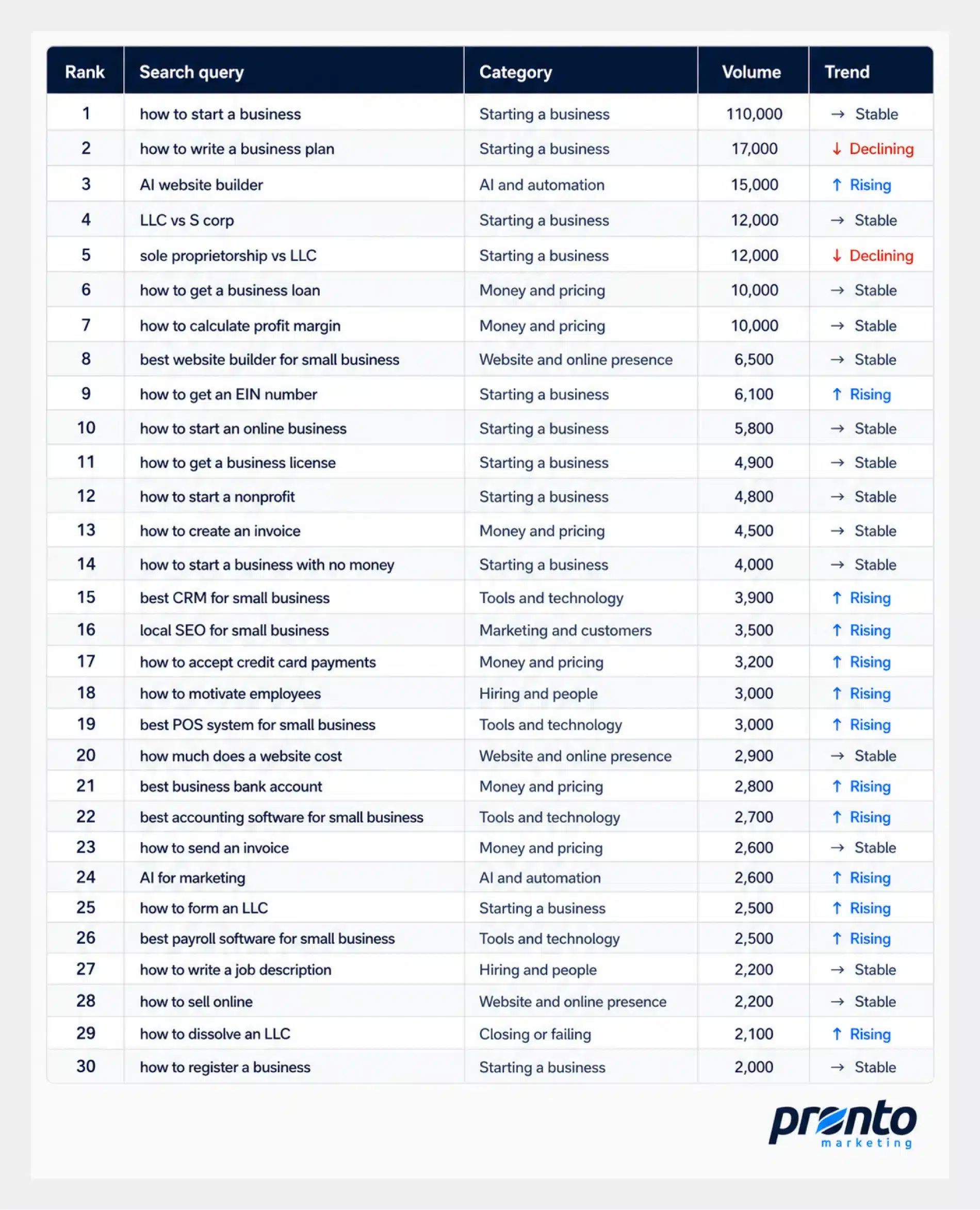
Appendix: Top 30 business queries by search volume
The following table lists the 30 highest-volume business queries analyzed in this study, ranked by monthly U.S. search volume as of May 2026.
Get the complete report with all data tables and charts as a PDF.