ChatGPT and other AI tools favor businesses they can easily understand, trust, and explain. To catch up, focus on searches where buyers choose a provider, then make four things clear on your website: what you do, who you serve, where you work, and proof you can deliver.
How Does ChatGPT Choose Which Businesses to Recommend?
For local recommendations, ChatGPT can search the web and draw on your website, reviews, directories, and “best of” lists.
We asked ChatGPT, “Who are the best managed IT companies in St. Louis?” It came back with a shortlist of six firms, each with a one-line verdict.
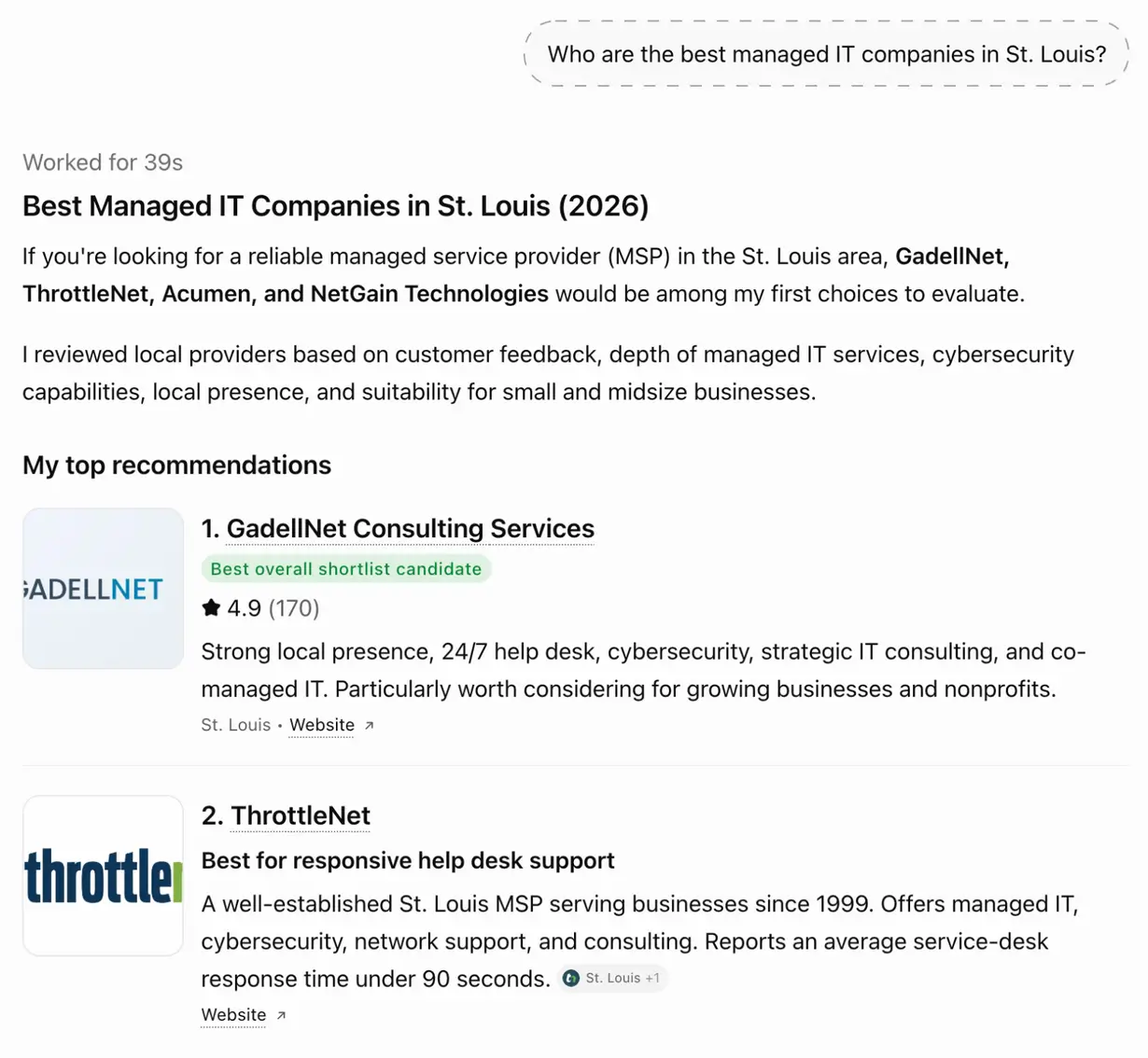
ChatGPT’s answer to “Who are the best managed IT companies in St. Louis?” in October 2026.
Look at how ChatGPT says it chose: customer feedback, depth of managed IT services, cybersecurity capabilities, local presence, and suitability for small and midsize businesses. At the bottom of the results, it even notes that its picks are not “an independently audited ranking of service quality.”
And ChatGPT’s shortlist matters more each year. In BrightLocal’s Local Consumer Review Survey 2026, 45% of consumers said they used ChatGPT or other AI tools for local recommendations, up from 6 percent the year before. The survey also found that 40 percent trust AI platforms to recommend businesses, and 42 percent trust them as much as traditional reviews.
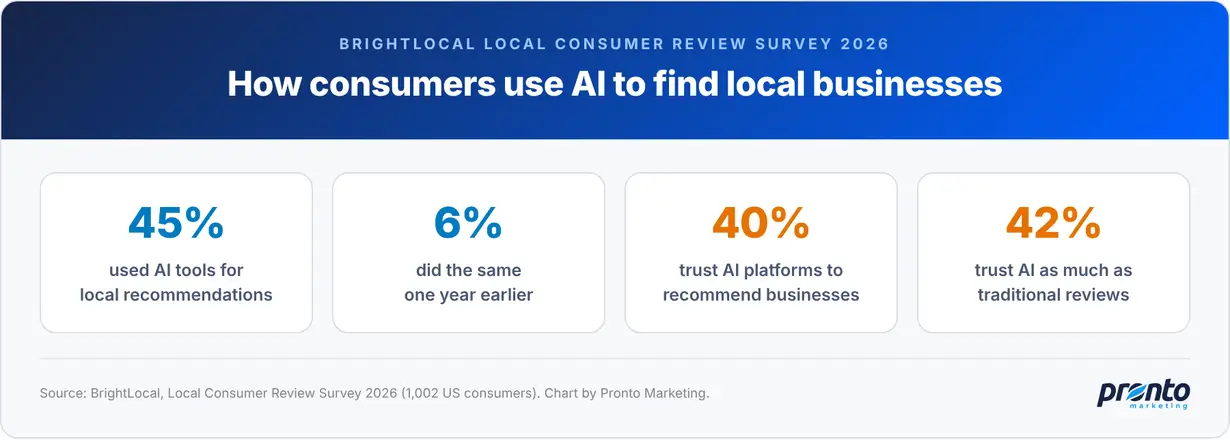
How consumers use AI to find local businesses. Source: BrightLocal, Local Consumer Review Survey 2026.
AI tools now rank third among the sources consumers use for local business recommendations, behind only Google and Facebook. When an AI tool hands a buyer a shortlist, that shortlist can become the list of companies they call. We walk through how this works in our video, Why AI Search Recommends Your Competitors Instead of You.
What Evidence Does AI Look for on Your Website?
AI search recommends businesses whose websites clearly state four things: what they do, who they serve, where they work, and proof they’ve done it before. When a buyer asks a specific question, AI looks for a business it can connect to every part of that question. If your pages leave those connections vague, another business may be easier to match to the question.
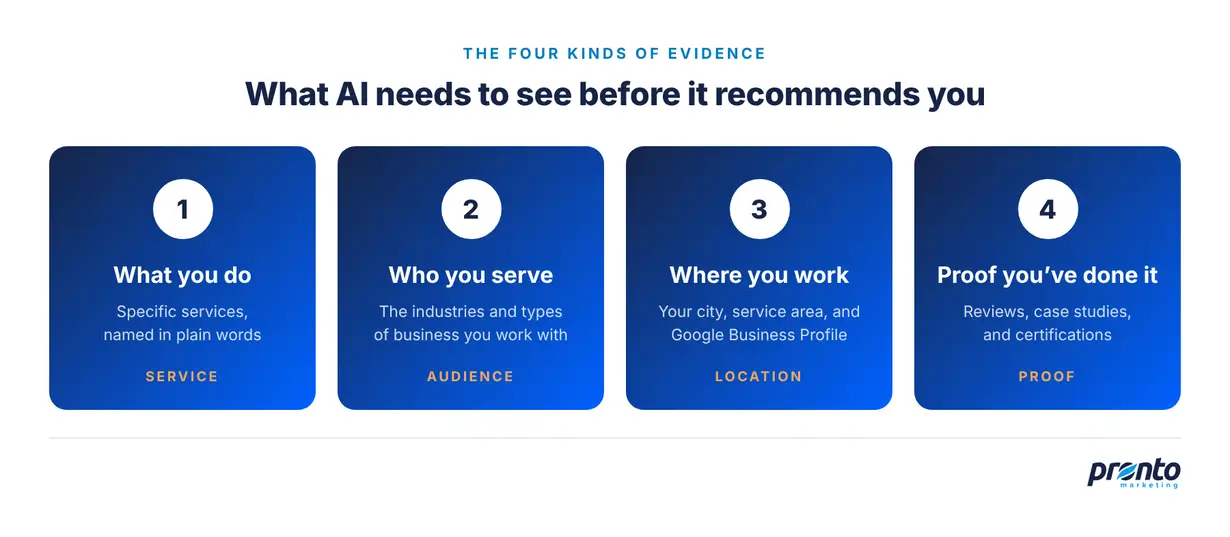
The four kinds of evidence AI looks for before it recommends a business.
- Does your website say exactly what you do?
Try the copy-paste test: take a sentence from your service page and remove your company name. If the sentence could describe almost any business in your industry, it needs more detail. Rewrite it so buyers can tell what you do, who you help, where you work, and what problem you solve.
For example, “We provide managed IT services for growing businesses” fits almost any IT firm. “We provide managed IT support for healthcare practices in Memphis that need secure systems, fast response times, and help staying compliant” fits a specific buyer.
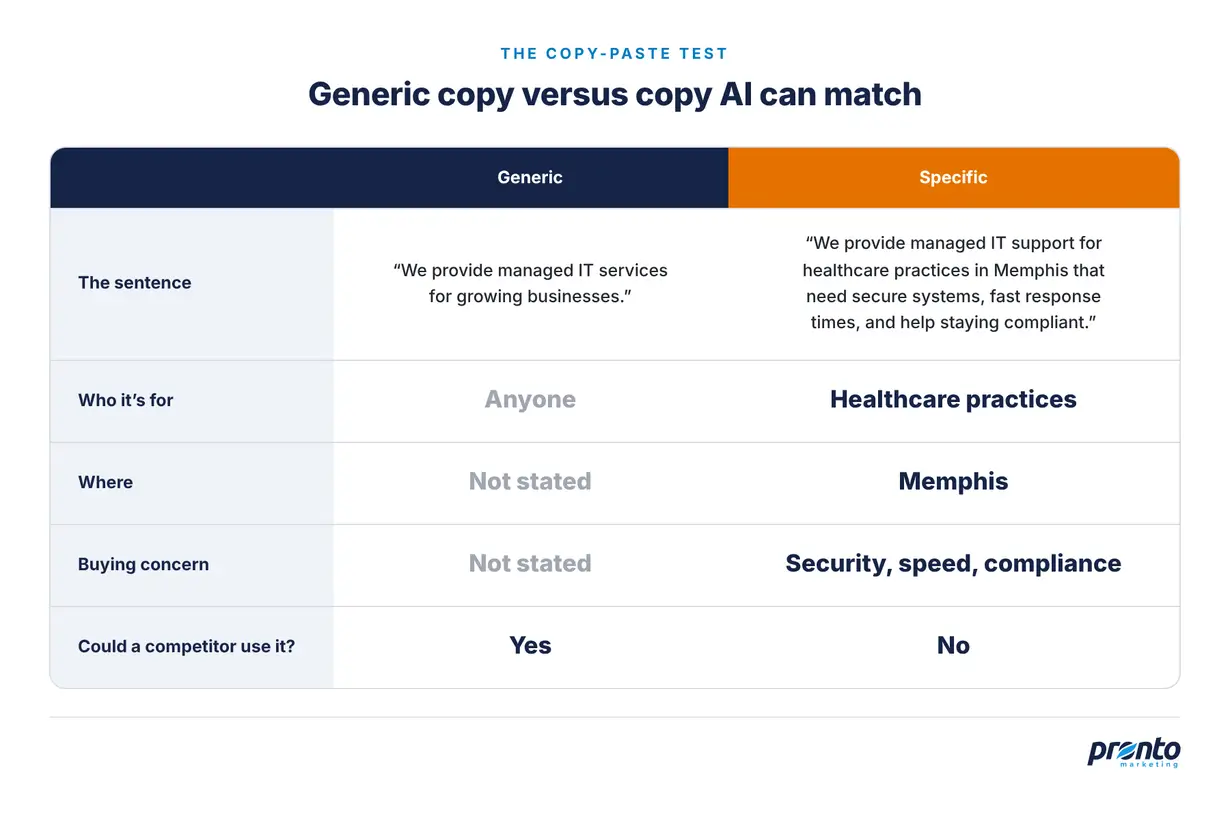
The same sentence, rewritten so AI can match it to a specific buyer.
The rewrite doesn’t guarantee a recommendation, but it gives AI something to match: a service, an audience, a location, and a buying concern.
- Is it obvious who your service is for?
Name the industries or types of business you serve. “Growing businesses” could mean anyone. “Dental practices,” “law firms,” or “manufacturers with 50 to 200 staff” tells AI exactly which questions you answer. If you serve several industries, give each one its own page.
- Is it clear where you work?
AI answers to local questions lean on location signals: the city and service area on your website, your Google Business Profile and Bing Places listings, and your local reviews. Keep your business name, address, and service area the same everywhere they appear, so AI can be confident you serve the place the buyer asked about. If you serve several cities, a page for each one helps.
- Can a buyer see proof?
Reviews, testimonials, case studies, certifications, and examples of real problems you have solved all give AI a reason to trust you. Don’t just say you are trusted. Show it, ideally with proof that matches the buyer’s situation, such as a case study from the same industry.
Which AI Answers Actually Matter for Our Business?
The AI answers that matter the most are the ones where a buyer is choosing a provider, not learning about a topic. Someone asking “What is cybersecurity?” is learning. Someone asking “Which cybersecurity services do small businesses need?” is comparing. Someone asking for “the best cybersecurity companies for healthcare practices in Memphis” has a need, an industry, a location, and a reason to act.
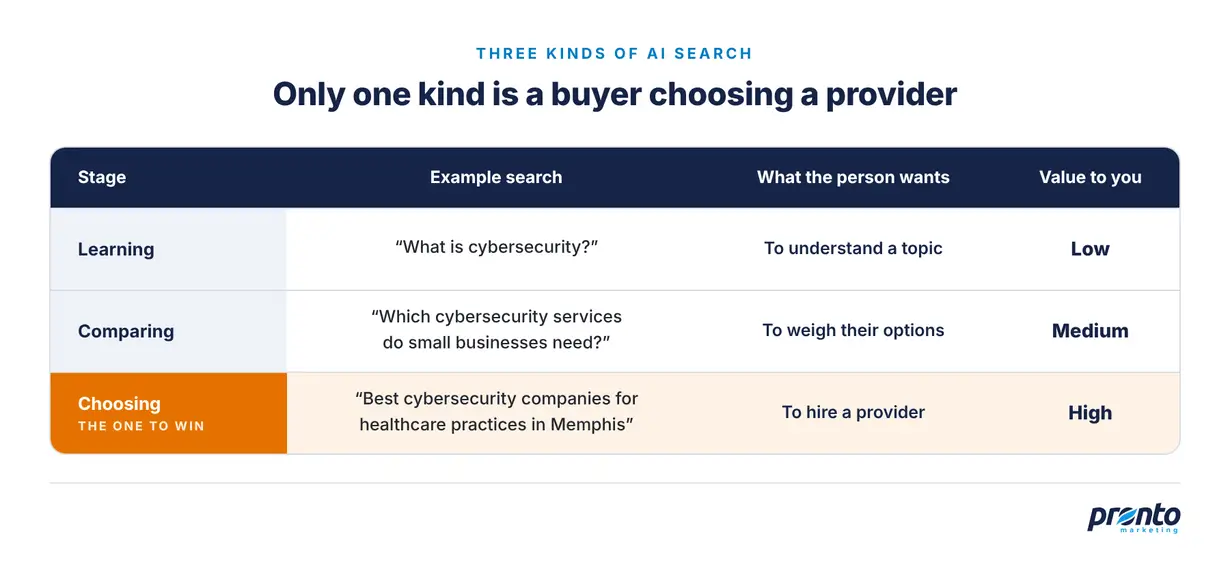
Three kinds of AI search. Only the last one is a buyer choosing a provider.
Appearing in a few answers can be valuable when the people asking are ready to choose a provider. Being listed as a source under a general answer isn’t the same as being the business AI recommends.
To find the searches worth winning, rate each one on three things: how closely it matches what you sell, how close the person is to buying, and how much that customer would be worth. Start there, not with 100 new blog posts.
Do We Need Special Tricks or Files to Show Up in AI Search?
No. Special files and shortcuts don’t guarantee a recommendation. Start with solid SEO, then use AI search tracking to identify which content and sources need attention.
You will hear about files promoted as a shortcut to AI recommendations, hundreds of AI prompt pages, fake mentions around the web, and rewriting your whole site for robots. Skip them, and put the effort into two kinds of work instead.
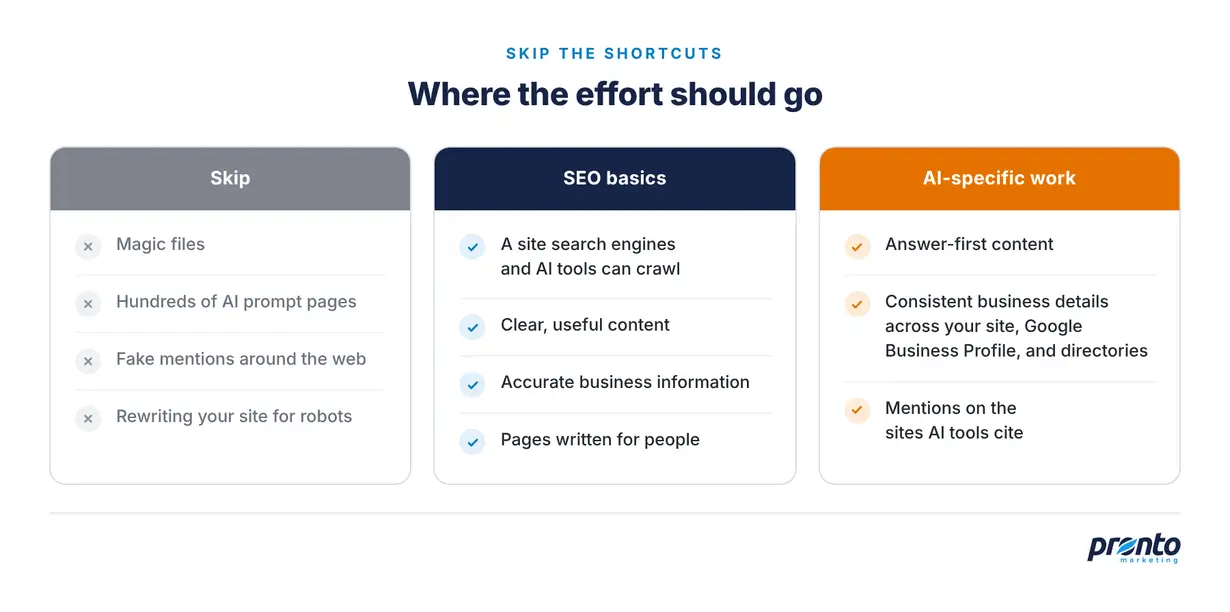
Where the effort should go, and where it shouldn’t.
The SEO basics come first: a site that search engines and AI tools can crawl, clear and useful content, accurate business information, and pages written for people. Google’s own guidance for AI Overviews and AI Mode says normal SEO best practices apply, with no special optimizations required. The additional focus for AI search is measuring whether you appear in answers to buyer questions and identifying the sources those answers cite. Our article on why SEO and AI work better together goes deeper.
Use those findings to prioritize work that overlaps with SEO. Write answer-first content, keep your business details consistent across the web, and earn mentions on the sites AI tools cite. For a step-by-step walkthrough, see our guide on how to show up in AI search results.
How Can We Check Who AI Recommends Instead of Us?
To find out who AI recommends instead of you, ask it the questions your buyers ask, note who shows up and why, and compare their pages to yours.
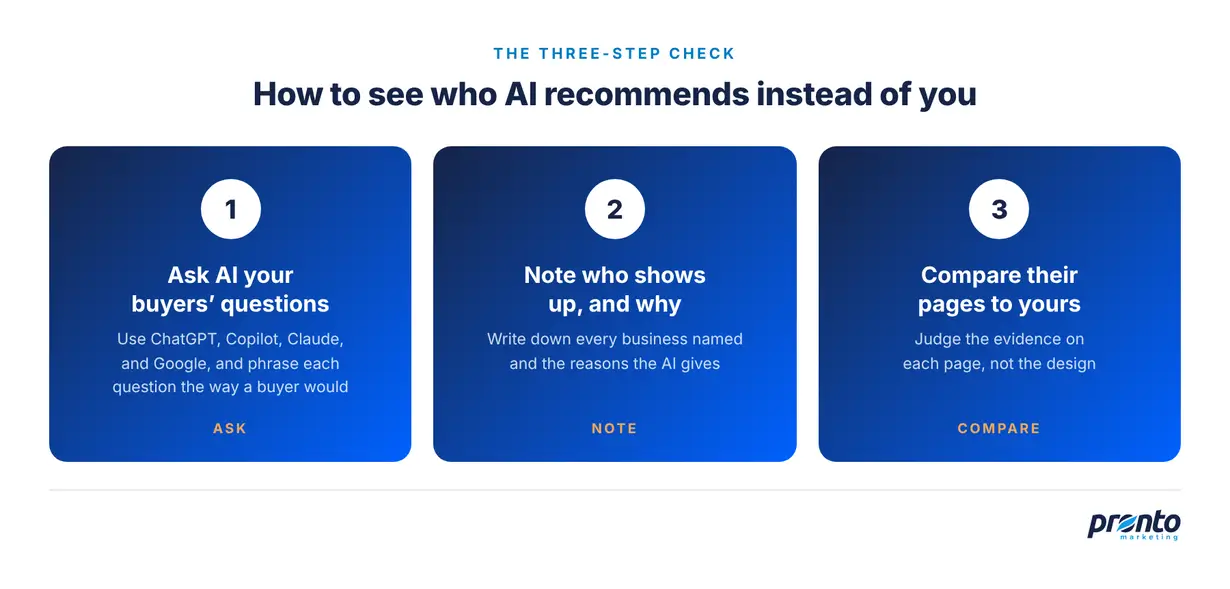
A three-step check you can run yourself.
Use ChatGPT, Copilot, Claude, and Google, and phrase each question the way a buyer would just before hiring someone like you. Then compare those companies’ pages to yours on evidence rather than design. Can AI understand your fit, see your proof, and explain why someone should choose you?
Beyond testing it yourself, answer engine optimization (AEO) platforms such as Peec AI, HubSpot AEO, and Ahrefs Brand Radar track the questions you care about across several AI tools over time. They are most useful when you are running a specific campaign and need regular reporting.
Frequently Asked Questions
Which AI tools should we check first?
Start with the ones your buyers use. ChatGPT is the most widely used AI assistant, and Google’s AI Overviews appear above regular search results. Then add Copilot and Claude, especially if your buyers use them at work. Copilot is built into Microsoft 365, which many businesses use every day.
How long does it take to start showing up in ChatGPT?
Expect months rather than weeks. Our AI search optimization clients usually see the first measurable movement within two to three months. We measure AI visibility by how often a business appears in answers to the buyer questions we track. How fast you get there depends on how far behind you are and how often ChatGPT and other AI tools refresh their sources.
Can a smaller business show up in ChatGPT ahead of bigger competitors?
Yes. Size alone doesn’t decide it. ChatGPT recommends the businesses it can match to the question, so a 20-person firm with clear pages for healthcare practices in Memphis can beat a national provider with vague copy for that search.
The Bottom Line on Competitors Showing Up in ChatGPT
Your competitor doesn’t need to be better than you to show up in ChatGPT ahead of you. Their online presence may make them easier for AI to understand, trust, and explain. Find the searches where buyers choose a provider, and make the evidence on your site obvious. Skip the shortcuts, start with solid SEO, and use AI search tracking to guide your next improvements.
Would you like to know which competitors ChatGPT recommends instead of you, and why? Our AI search optimization services start with an audit of where you stand today.