
A practical pros-and-cons guide for local IT providers thinking about OpenAI's new advertising platform — who it's right for, who it's not, and how to tell the difference.
OpenAI recently launched advertising inside ChatGPT. For MSPs who’ve built their lead generation on Local SEO, Google Ads, and referrals, the obvious question is: should I pay attention to this?
The honest answer is: probably not right now, but for the right MSP, in the right location, targeting the right buyer, there’s a real opportunity worth exploring.
THE BOTTOM LINE UPFRONT
ChatGPT ads are not a replacement for Google Search or referrals. They’re a new way to reach a specific buyer earlier in their decision process: the non-technical SMB operator who just realized their IT situation is a problem.
For local US MSPs willing to test a problem-led offer in the right verticals, it’s worth a small experiment. For everyone else, watch and wait.
What are ChatGPT Ads, exactly?
In early 2025, OpenAI began rolling out a sponsored results format inside ChatGPT. When a user asks a question that matches an advertiser’s targeting, a clearly labeled ad can appear at the bottom of ChatGPT’s response. Critically, the ad doesn’t change or influence what ChatGPT actually says. It sits below the answer as a separate, labeled unit.
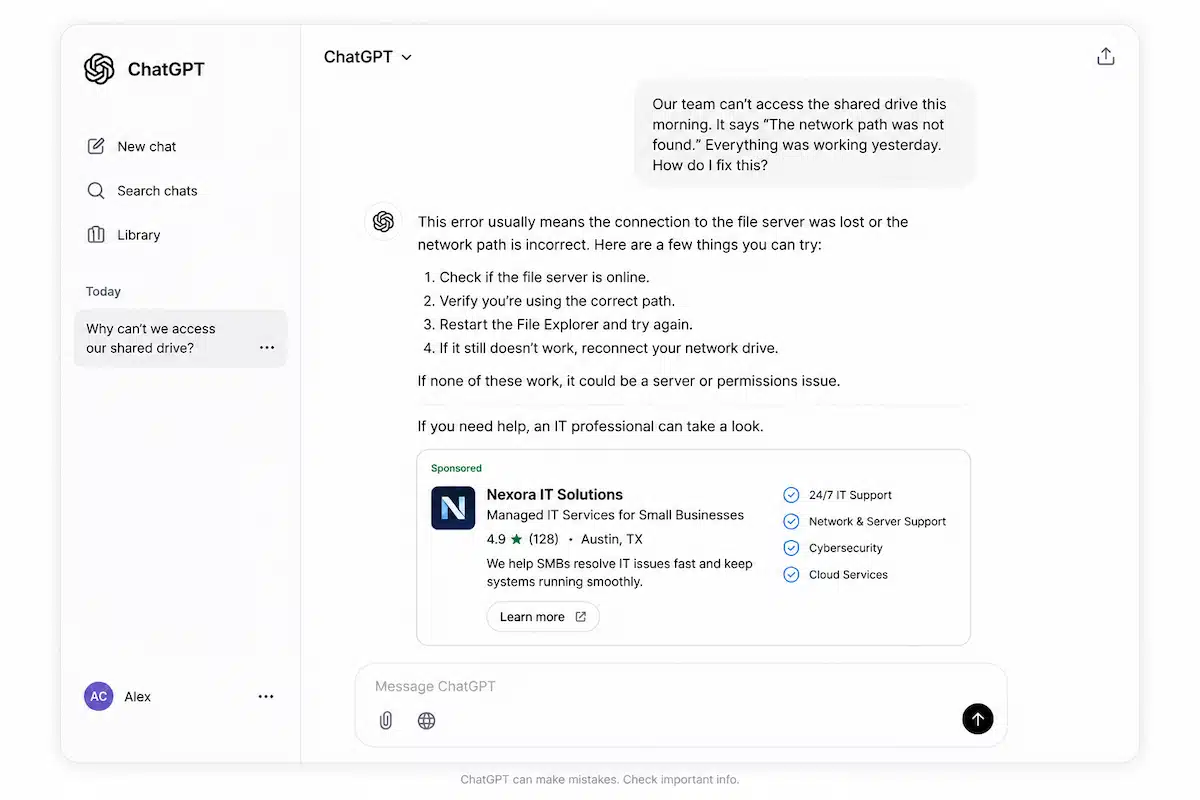
How it works:
User asks ChatGPT a question
Example: "How do I know if my small business needs an IT support company?"
ChatGPT answers normally
The ad has no influence over what ChatGPT says. The answer is unchanged.
A labeled ad appears below the response
Matched to the context and intent of the conversation — not an exact keyword.
User clicks through to the advertiser's landing page
OpenAI reviews the ad copy, creative, and landing page for policy compliance.
Targeting works differently here than on Google. There are no exact-match keywords. Instead, OpenAI uses broad context signals, in particular the theme and intent of the conversation, to match ads. This matters for how you’d structure your campaign, and we’ll come back to it.
One other important note on reach: ads are currently shown only to Free and Go tier users. ChatGPT Plus, Pro, Business, Enterprise, and Edu accounts do not see ads. This isn’t a dealbreaker for MSPs. in fact, it shapes exactly who you’d be targeting.
Who is actually seeing these ads?
This is where the channel gets strategically interesting for MSPs and where answrering “should I try ChatGPT ads?” gets tricky.
The audience most likely to see ChatGPT ads is the non-paying, non-technical business user: someone using the free tier or entry-level paid Go plan to research a business problem they’re not sure how to solve. For IT services, that often means one specific kind of person.
The buyer you're actually reaching
Office managers, practice managers, operations leads, and business owners at SMBs with 10–100 employees who are responsible for IT decisions (not because they volunteered, but because nobody else did). Their IT strategy is “ask Dave, he knows computers.” Dave is exhausted. And now Dave’s boss is using ChatGPT to figure out if there’s a better way.
This is a real audience segment that existing channels often miss. Google Search captures people who already know they need an MSP and are comparing providers. Referrals reach people who’ve been told by a trusted contact to call you. ChatGPT can reach people earlier in the buyer’s journey, such as at the moment they’re realizing their IT situation is actually a problem, not just an inconvenience.
That’s a meaningful distinction. It makes this less a replacement for your existing lead gen and more of an early-funnel education channel.
The pros and cons for MSPs
Why it could work
Reaches buyers at problem-discovery stage before they know they need you
Targets non-technical decision-makers who rarely click Google ads
Less competitive than Google Search for now (early-mover window)
Context-based matching means intent signals without keyword battles
Fits naturally with assessment and consultation offers
MSPs categorized as "local services" — a supported ad type under OpenAI's policy
Why it might not
No ads on most paid plans, meaning sophisticated buyers won't see them
Platform is new: measurement and attribution tools are still limited
Context targeting is less precise than search intent keywords
Requires purpose-built landing pages and offers (not just sending traffic to a homepage)
Ad policy requires careful framing around cybersecurity and compliance claims
Uncertain ROI makes it hard to justify over proven channels
Is your MSP eligible to run these ads?
Generally, yes. OpenAI’s current ad policy lists local services as a supported category, and managed IT services fits cleanly within that. MSPs are in a much more straightforward position than advertisers in legal, financial, healthcare, political, or regulated-goods categories.
That said, how you frame your services matters. The positioning that works well from an IT services perspective can stray into language OpenAI’s policy flags if you’re not careful about it.
Safe to Promote
Managed IT support
Cybersecurity assessment
Microsoft 365 setup and security
Backup and disaster recovery
Device management
Help desk support
Business continuity planning
IT readiness audit
Avoid This Framing
Hack-proof your business
Recover any password
Bypass security restrictions
Fear-heavy ransomware shock claims
Guaranteed compliance or breach prevention
Anything that reads like surveillance or credential access
Note on regulated verticals
If you’re specifically targeting dental practices, medical clinics, law firms, or accounting firms, your ad copy and landing pages need to be unambiguous that you’re selling IT services and not healthcare, legal, or financial services. OpenAI reviews landing pages as well as ad copy, so make sure the destination is as clear as the ad.
Which verticals are worth testing first?
Not every SMB vertical is equally worth targeting via this channel.
The best-fit industries are those where IT pain is real and operational, the decision-maker is non-technical, and downtime or data exposure would be genuinely damaging, but where the business doesn’t have (or can’t justify) an internal IT team.
| Industry | Why It's a Good MSP Fit | Policy Risk |
|---|---|---|
| Construction, engineering & architecture | Field teams, file access, laptops, project docs, remote work, device support. Decision-makers are often operations or admin leads, not technical pros. | Low |
| Manufacturing & industrial SMBs | Downtime is expensive, systems often aging, cybersecurity and backups matter. Strong recurring MSP fit. | Low |
| Nonprofits | Often under-resourced, handle donor and staff data, need affordable support, and leadership may self-educate via ChatGPT. | Low |
| Dental and medical practices | High operational need: devices, phones, backups, email, Wi-Fi, workstations, practice software. Avoid patient-care or medical-advice contexts. | Medium |
| Law firms & professional services | High need for confidentiality, secure email, backups, remote access, and uptime. Avoid framing around legal advice or case issues. | Medium |
If you’re running a first test, start with the low-risk verticals: construction and engineering, manufacturing, nonprofits, and general SMBs with 10–100 employees. Once you have a baseline and understand how the platform behaves, layer in the regulated-adjacent sectors with appropriately scoped ad copy.
What offer should you lead with?
This is where most MSPs would go wrong. “Managed IT Services” is category language (ie. functional, but forgettable). It also doesn’t match how a non-technical SMB operator actually searches for help. They don’t know whether they need “managed services.” They know they have a problem.
The best performing offers for this channel will be low-friction, diagnostic, and locally anchored:
- Free IT Risk & Readiness Assessment (the strongest fit for this audience)
- Cybersecurity checkup
- Microsoft 365 security review
- Backup and disaster recovery audit
- “Do we need an MSP?” consultation (especially effective framing for this channel)
- IT support cost estimate
Your ad messaging should match the questions the buyer is actually typing into ChatGPT. Lead with problem moments, not service descriptions:
Angles that work in this channel
- “Is your business ready for outsourced IT?”
- “Worried about backups, ransomware, or Microsoft 365 security?”
- “Outgrown your current IT setup?”
- “Need reliable local IT support without hiring in-house?”
- “Is one person still handling all your company’s tech?”
How to measure whether it's working
Don’t judge this channel by clicks alone — that’s the wrong signal for MSP lead generation.
A click from a solo consultant at a 3-person startup and a click from an operations manager at a 60-person manufacturing firm look the same in a click report. They’re not the same lead.
Track what matters for MSP qualification:
- Assessment requests and booked consultations
- Phone calls and form fills from targeted geographies
- Whether prospects have enough users, locations, devices, and recurring support needs to be a viable managed services client
- Service page visits (not just homepage bounces)
- Lead-to-qualified-opportunity conversion rate, compared to your other channels
Given that this is an early-funnel channel, expect longer sales cycles on ChatGPT-sourced leads compared to someone who searched “IT support near me.” Budget your expectations accordingly.
Frequently Asked Questions
Will ChatGPT ads replace Google Ads or Local Services Ads?
No, at least not in any foreseeable timeframe. Google still wins when someone is already searching for “IT support near me” or comparing managed IT providers. ChatGPT ads are useful when someone is asking questions like “How do I know if my business needs an MSP?” or “How do I stop having constant IT problems?” earlier in the process, at problem discovery rather than vendor selection.
My clients are mostly in-house IT managers, is this channel relevant for me?
Probably not as a primary focus. Technical buyers are more likely to be on paid ChatGPT plans that don’t show ads, and they’re better reached via Google Ads, referrals, and search. This channel’s strongest signal is the non-technical operator: the practice manager, office manager, or executive director responsible for IT because no one else is.
I target a specific metro area. Does local targeting work?
Local targeting support is still developing on OpenAI’s platform. The current guidance is to make location signals clear in your ad copy, landing pages, and offer (e.g., “Free IT Assessment for [City] Businesses”). This helps both with relevance matching and with ensuring the leads you generate are actually in your service area.
Do I need a special landing page or can I send traffic to my website?
You need a dedicated landing page or at minimum a purpose-built service page that directly matches the ad offer. OpenAI reviews landing pages as part of ad approval, so a generic homepage won’t serve you well on policy or conversion. The page should match the problem framing of the ad, make the local focus clear, and have a single conversion action (typically an assessment request or consultation booking).
What's the minimum budget to run a meaningful test?
OpenAI hasn’t published official minimum spend guidance for the self-serve platform. As a general principle for any new channel test, run long enough to gather statistically meaningful data on the metrics that matter (consultation requests, not just clicks) before making a go/no-go call. A 90 day test with a fixed budget is a reasonable starting point and gives you enough time to iterate on your offer and messaging.
Our assessment
ChatGPT ads are a legitimate early-funnel channel for local MSPs who target non-technical SMB operators, lead with diagnostic offers like a free IT assessment, and have the landing page infrastructure to support it. They’re not a silver bullet, and they’re not a replacement for Google Search or referrals.
The MSPs most likely to see results are those in competitive local markets, focused on industries like construction, manufacturing, and nonprofits, who are willing to run a disciplined 90 day test and measure qualified opportunities, not just clicks.
References and further reading
- Ads in ChatGPT (OpenAI Help Center)
- Open AI Advertising Policies + Legal aspects to comply with
- OpenAI Advertisers Overview (placeholder service page)
- Open AI Ads Manager (create and set up your account)