
Get the complete report with all data tables and charts as a PDF.
Search data reveals that local Google visibility has become the dominant marketing strategy for small business, while traditional advertising queries decline.
An original analysis of Google search data by Pronto Marketing – May 2026
Authored by Pierre Mol, Head of Marketing, Pronto Marketing
Key findings
Pronto Marketing analyzed the monthly U.S. search volume for 159 business-related queries using Ahrefs Keywords Explorer. Among them, 20 queries focused specifically on marketing, customer acquisition, and online visibility. The pattern they reveal is striking: small businesses have largely abandoned the question of whether to market online, and are now focused almost entirely on one specific channel: local Google visibility.
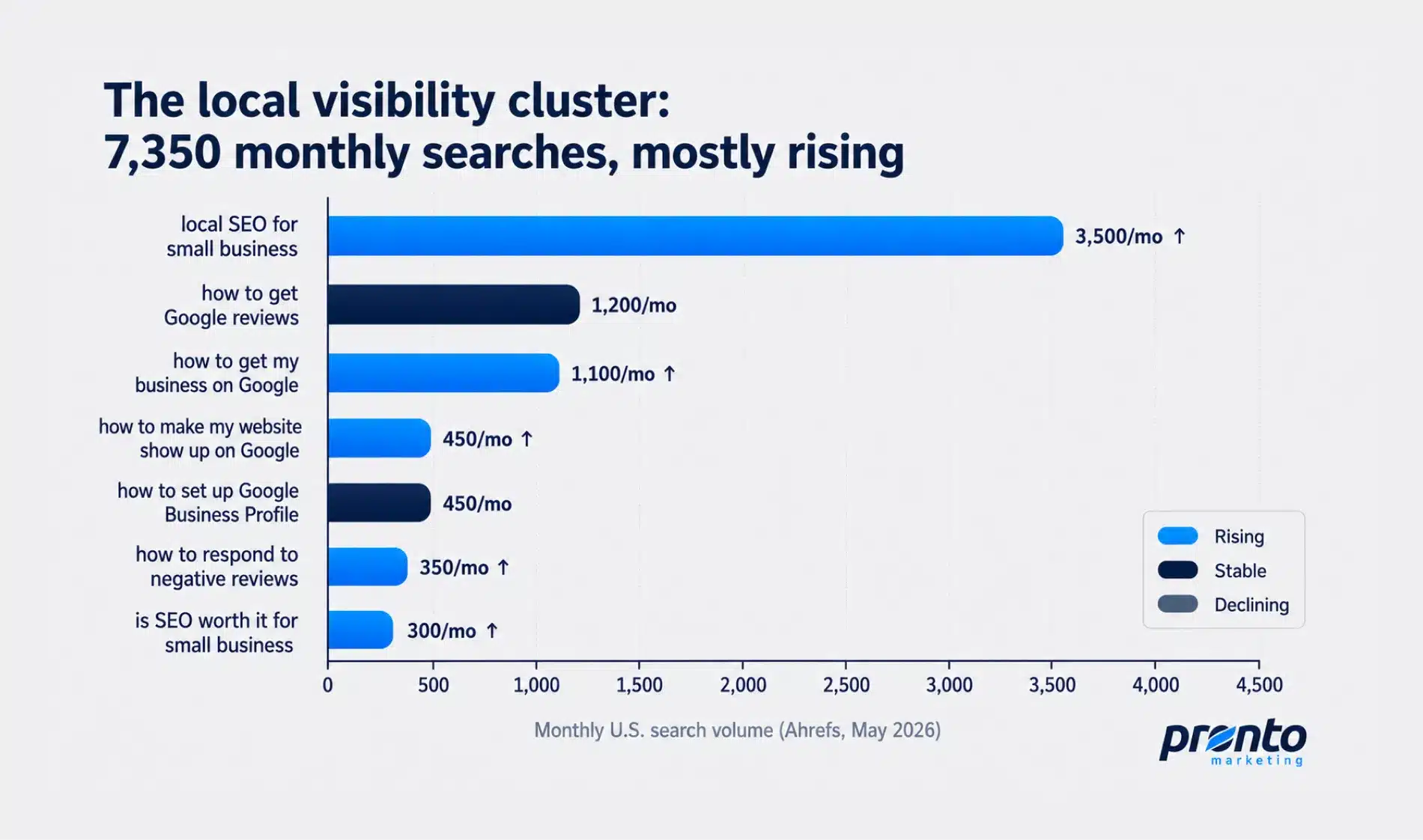
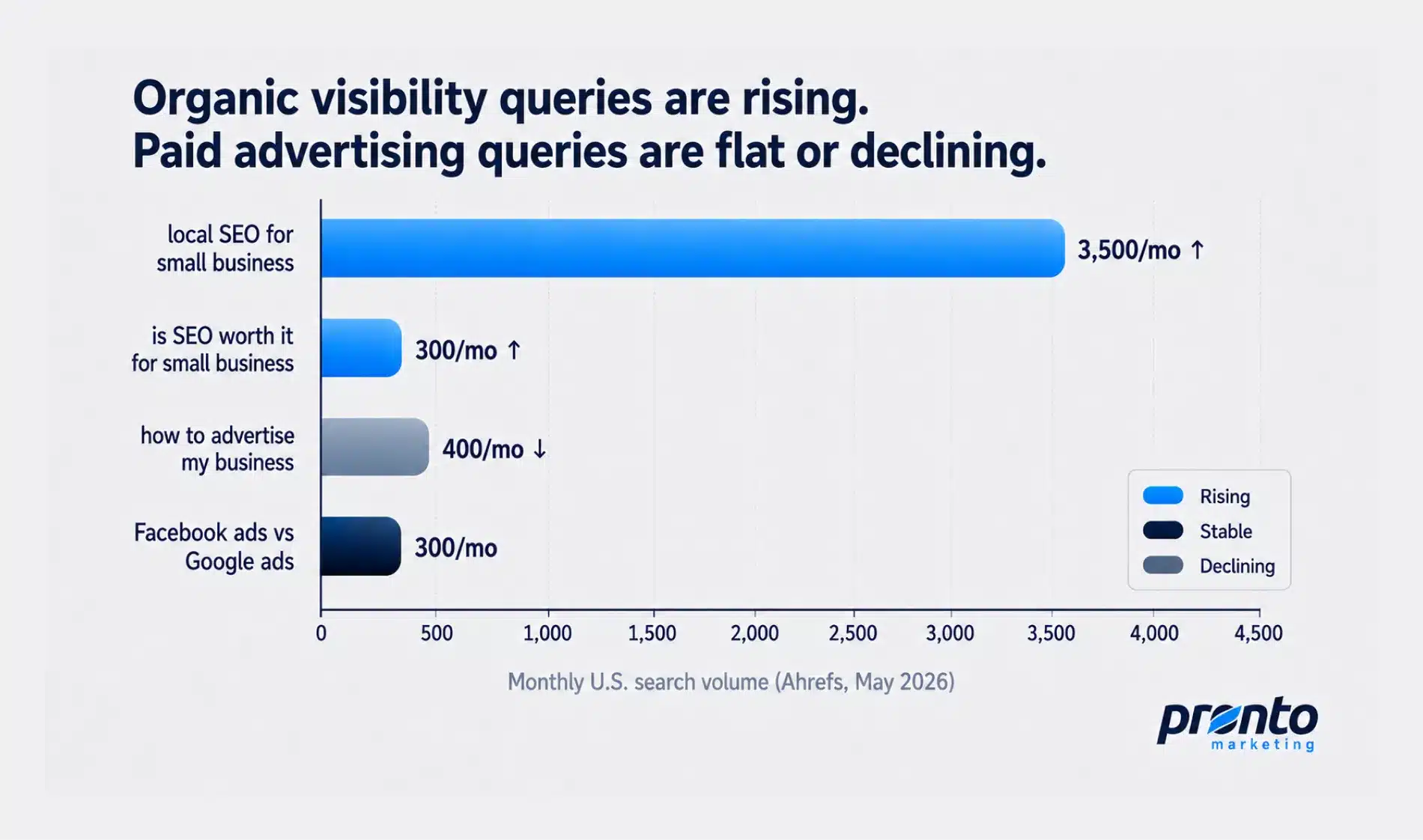
“Local SEO for small business” is the most-searched marketing tactic in America at 3,500 searches per month and rising.
It outpaces every other marketing query in our dataset, including “how to market a small business” (900/mo), “how to do email marketing” (600/mo), and “how to advertise my business” (400/mo, declining).
The “local visibility cluster” with seven Google-focused queries collectively generates over 7,350 monthly searches.
This cluster includes local SEO, Google reviews, Google Business Profile setup, negative review management, and website-to-Google visibility questions. It represents the single largest concentration of marketing search demand for small businesses.
“How to advertise my business” is declining, while “how to respond to negative reviews” is rising.
Small businesses are shifting from asking how to push messages out (advertising) to asking how to manage what customers find when they search (reputation). The marketing mindset is moving from broadcast to presence.
“Is SEO worth it for small business” generates 300 searches per month and is rising.
This signals a growing cohort of business owners who have heard about SEO but remain skeptical about its value. A gap between awareness and trust that the industry has not yet closed.
Paid advertising queries are flat or declining. Organic visibility queries are rising.
“Facebook ads vs Google ads” (300/mo) is stable. “How to advertise my business” (400/mo) is declining. Meanwhile, every local visibility query except Google reviews is rising. The shift from paid to organic is unmistakable in the search data.
Local Google visibility dominates small business marketing search
When a small business owner opens Google and searches for marketing help, what do they type? The answer, according to our data, is not “how to run Facebook ads” or “how to build a brand.” It is, overwhelmingly, some variation of “how do I show up on Google?”
The data reveals a clear hierarchy. At the top sits “local SEO for small business” at 3,500 monthly searches and rising (more than any other specific marketing tactic query). Below it, a cluster of related queries forms what we call the “local visibility cluster”: getting Google reviews, appearing on Google Maps, setting up Google Business Profile, making a website rank, and managing online reputation.
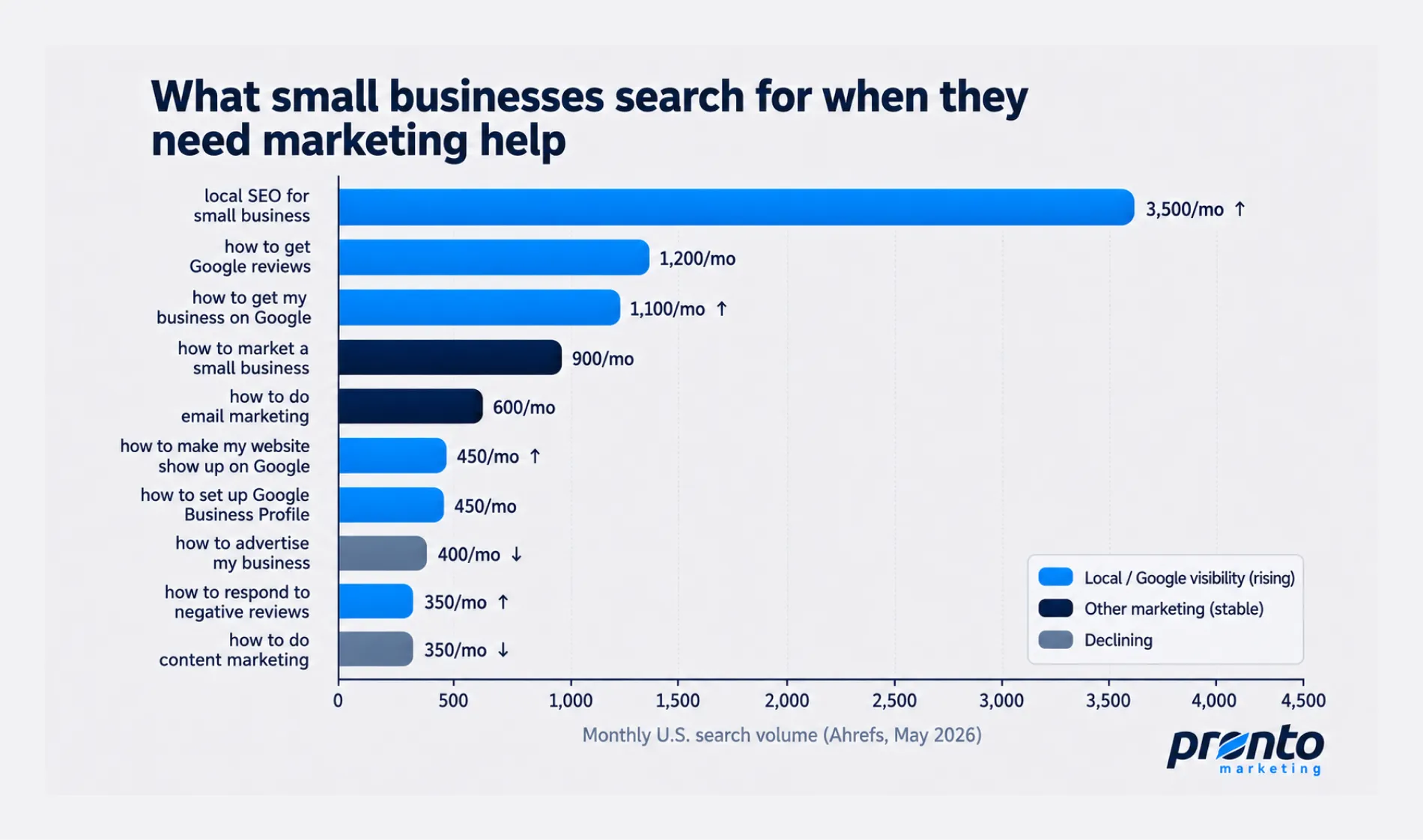
Collectively, the local visibility cluster generates over 7,350 monthly searches. More than all other marketing queries in our dataset combined. This is not a marginal preference. It is a wholesale reorientation of small business marketing strategy toward a single platform: Google.
From advertising to presence: the mindset shift
The decline of “how to advertise my business” (400/mo, declining) alongside the rise of “how to respond to negative reviews” (350/mo, rising) captures a fundamental change in how small business owners think about marketing.
Advertising is about pushing a message outward, placing an ad, buying a click, running a campaign. Presence is about what customers find when they come looking for you: your Google reviews, your Business Profile completeness, your website’s position in search results. The search data suggests that small businesses are moving from the first mindset to the second.
This shift makes intuitive sense. For a local plumber, dentist, or accountant, the most valuable marketing asset is not a Facebook ad, it is being the first map result when someone in their city searches for their service. Google’s own data has consistently shown that a majority of local searches lead to a store visit or phone call within 24 hours. Small business owners appear to have internalized this: local Google visibility is not one marketing channel among many. It is the marketing channel.
“How to do content marketing” (350/mo, declining) reinforces the pattern. Content marketing such as blogging, social media posting, newsletter writing, requires ongoing time investment with uncertain returns. Local SEO and Google Business Profile optimization, by contrast, offer a more direct path: optimize your listing, collect reviews, show up when someone searches. For a time-constrained business owner, the calculation is straightforward.
“The businesses that come to us are rarely asking about brand awareness or content strategy. They’re asking one question: ‘How do I show up when someone in my city Googles what I do?’ Everything else — the website, the SEO, the review management — flows from that single goal. Local visibility isn’t part of their marketing strategy. It is their marketing strategy.”
— Pierre Mol, Head of Marketing, Pronto Marketing
The SEO skepticism gap
“Is SEO worth it for small business” generates 300 monthly searches and is rising. This is a small number in absolute terms, but it reveals something important: there is a growing population of business owners who have heard about SEO, understand it matters, and are still not convinced it works.
This skepticism gap is significant because it exists alongside intense demand for the outcomes that SEO delivers. The same business owner searching “is SEO worth it” is likely also searching “how to get my business on Google,” which signals that they want the result but are unsure about the mechanism. The industry has succeeded in selling the destination (Google visibility) but has not fully closed the sale on the vehicle (SEO services).
For agencies, consultants, and freelancers selling SEO services, this is both a challenge and an opportunity. The challenge: prospective clients arrive skeptical and need to be convinced with transparent results, clear timelines, and honest limitations. The opportunity: the demand for the outcome is enormous and growing, and whoever can bridge the trust gap will capture a large and expanding market.
The complete marketing search landscape
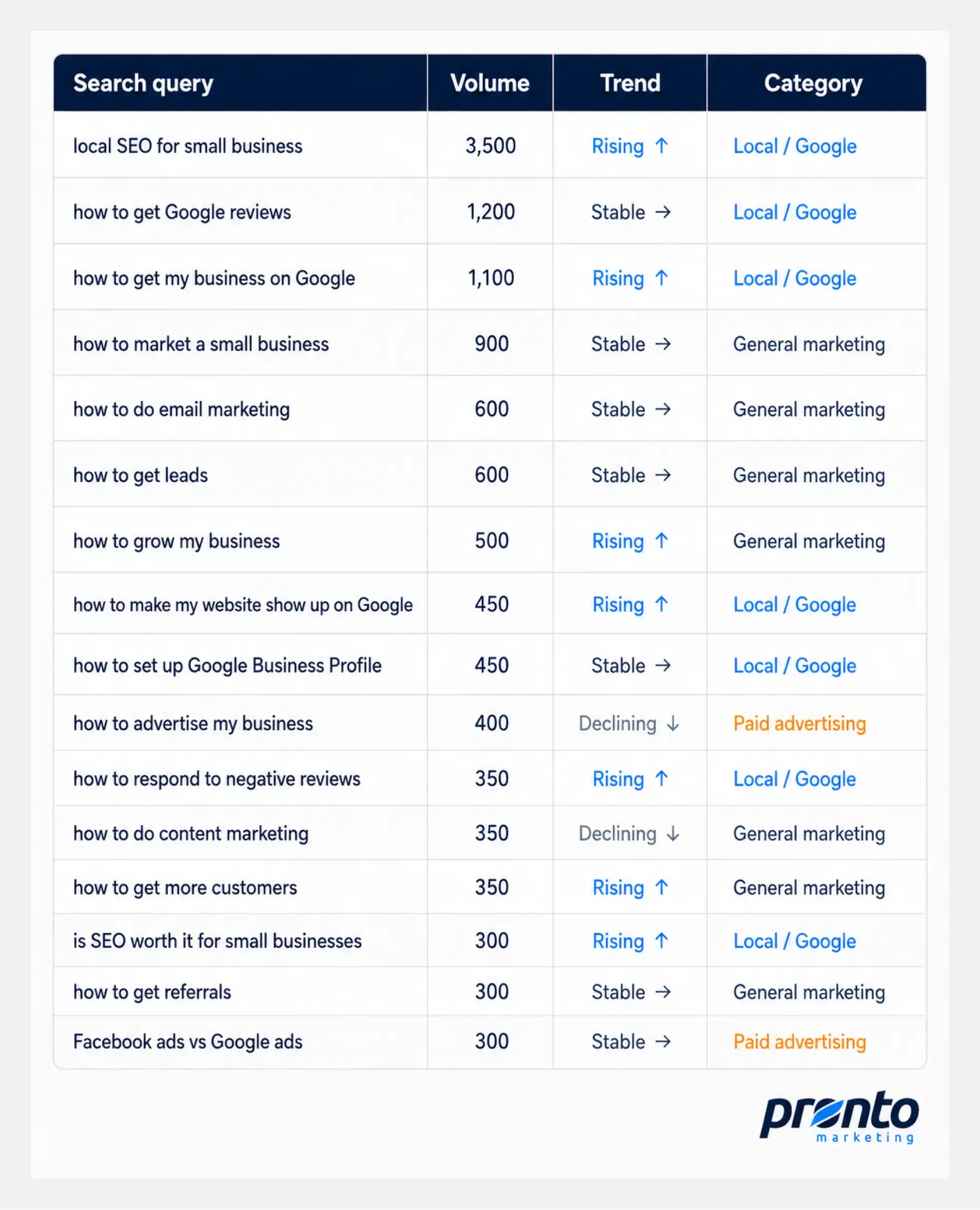
The table below shows all 16 marketing and customer acquisition queries in our dataset, categorized by focus area. The pattern is clear: local/Google visibility queries dominate, general marketing queries hold steady, and paid advertising queries are flat or declining.
What this means
For small business owners, the data validates what many already sense intuitively: Google is where your customers are looking for you. Investing in local SEO, collecting Google reviews, and maintaining a complete Google Business Profile is not optional digital housekeeping, it is the most important marketing investment you can make.
For marketing agencies and web service providers, the data points to where demand is concentrating. Services that directly improve local Google visibility with GBP optimization, local SEO, review management, website speed and mobile optimization, are aligned with the strongest current in small business marketing demand. Services that require a longer sales cycle or more abstract value proposition, including content marketing, brand strategy, social media management, face a harder sell, not because they lack value, but because they don’t match the immediate, concrete language that business owners use when searching for help.
For Google itself, the data underscores the platform’s extraordinary dominance of small business marketing attention. When the single most-searched marketing query in America is about how to rank on Google, and the fastest-declining marketing query is about how to advertise in general, the platform has effectively become the market.
“Every business owner we talk to wants the same thing: more phone calls, more foot traffic, more leads from people in their area. They don’t care about algorithm updates or domain authority scores. They want to show up when someone nearby searches for what they do. Our job is to make that happen and prove it’s working because the data shows they’re still not sure it will.”
— Tim Kelsey, Managing Director, Pronto Marketing
Methodology
Data source
This analysis is based on search volume data from Ahrefs Keywords Explorer, a widely used search intelligence platform that estimates monthly search frequency based on clickstream data and Google search index analysis. All data was collected in May 2026 and reflects average monthly U.S. search volume.
Scope
A total of 159 search queries were analyzed across 12 categories. This report focuses on 20 queries in the Marketing and Customers category, supplemented by related queries from the Website and Online Presence and Social Media categories.
Trend classification
Each query was classified as Rising, Stable, or Declining based on its 12-month trend direction in Google Trends (trends.google.com). Trend classifications represent directional movement, not magnitude of change.
Important limitations
- Search volume estimates are approximations. Actual Google search volumes are not publicly disclosed.
- The marketing query list is representative but not exhaustive. Queries about specific platforms (e.g., “how to run Google Ads”) were not included in this analysis.
- Search behavior does not directly measure marketing spend or strategy adoption. A decline in “how to advertise my business” does not mean businesses are spending less on advertising, it means fewer people are searching for that information on Google.
- Google Trends classifications (Rising/Stable/Declining) represent general direction, not precise magnitude.
Appendix: Top 30 business queries by search volume
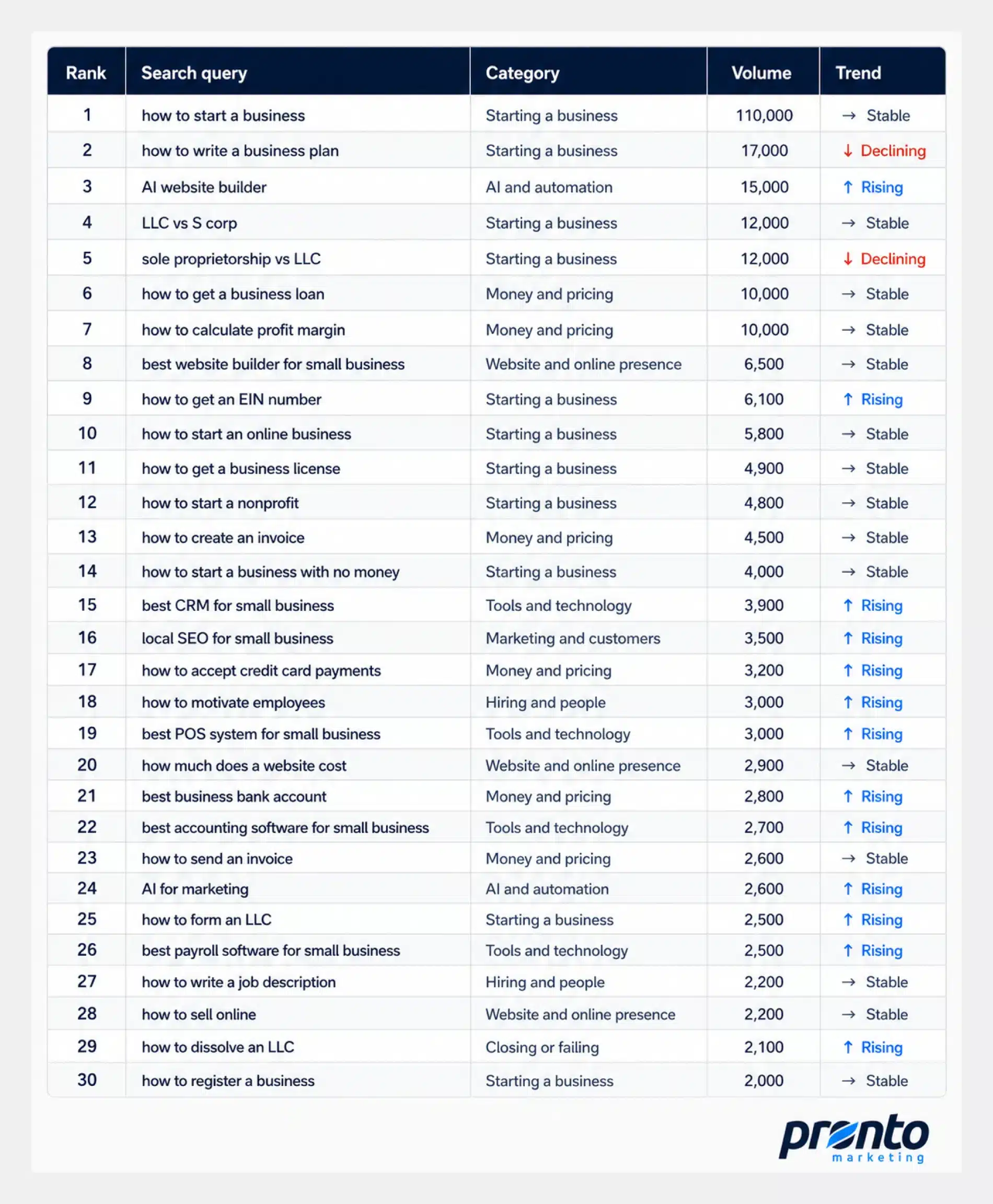
The following table lists the 30 highest-volume business queries analyzed in this study, ranked by monthly U.S. search volume as of May 2026.
Get the complete report with all data tables and charts as a PDF.