


If your cost per lead went up after you opened a second office, that number alone cannot tell you whether you have a problem. To judge a cost per lead, you need two other numbers: what a client is worth to you, and how many leads it takes to sign one. Most MSPs we talk to know the first number and have never worked out the second. This article works out both for one example firm, using the same math we run for our MSP marketing clients.
No more than four to six months of that client’s monthly fee, if you have measured how long your clients stay. If you have not, use three months until you have. Many MSP marketing agencies use three months as a rule of thumb, but MSP clients typically stay five to eight years, so you can afford to spend more. For a client paying $4,000 a month, that is $16,000 to $24,000, enough to pay for 52 to 77 leads at $310 each for every client you sign. A rising cost per lead is only a problem if it pushes the cost of a signed client past that ceiling. To check, count how many leads it takes to win a client in each market.
The numbers in this article come from one example firm, Marlowe IT, a managed services provider in Nashville with a second office in Chattanooga. The firm is made up, but every figure comes from MSPs we have worked with or spoken to.
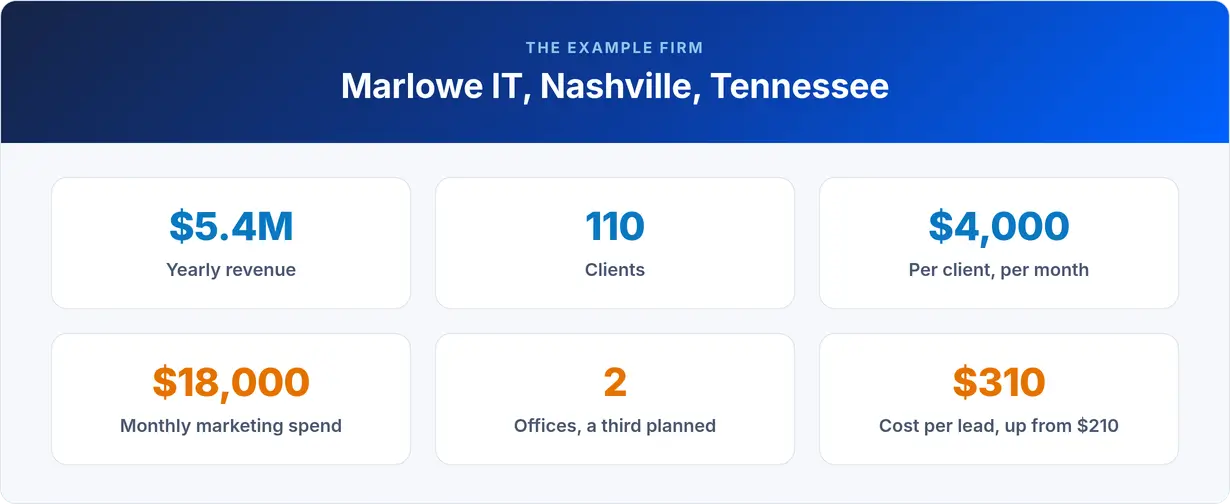
The example firm at a glance.
How Much Can an MSP Afford to Pay for a New Client?
No more than four to six months of that client’s monthly fee.
A common rule of thumb among MSP marketing agencies is to spend three months of the client’s fee. It is a cautious number that pays for itself within a year at typical margins, which suits a business that loses customers quickly. MSP clients tend to stay for many years. Client churn at MSPs is commonly around 12 percent a year, which works out to an average relationship of about eight years. Most estimates put the typical MSP client relationship at five to eight years. A client paying $4,000 a month tends toward the top of that range, because switching IT providers is disruptive for a business that size. With retention like that, you can afford to spend four to six months of fees to win a client.
| Per signed client | The usual rule | With MSP retention |
|---|---|---|
| Months of the client’s fee | 3 | 4–6 |
| Ceiling | $12,000 | $16,000–$24,000 |
| Leads you can pay for at $310 each | 39 | 52–77 |
| Payback on gross profit | 7.5 months | 10–15 months |
The ceiling for a client paying $4,000 a month. Payback is calculated on gross profit rather than revenue.
The months-of-fee rule comes from agency guidance, not published research, so it helps to compare it with industry data. ConnectWise’s benchmarking unit, Service Leadership, puts the average cost of winning a new MSP customer at about $26,000. A ceiling of $16,000 to $24,000 sits below that, so it is not an aggressive target. You can also check it against your own numbers. Assume a blended gross margin of 40 percent, or use your own if you know it. At that margin, a client paying $4,000 a month brings in about $1,600 a month in gross profit. Even a $24,000 acquisition cost is paid back in about fifteen months, and a client like this typically stays for 72 to 96 months.
There is one condition. Only use the higher ceiling if you have measured your own client retention. Many MSPs have a sense of how long clients stay but no actual figure. If you do not have that figure yet, use three months until you do.
Why Did Our Cost Per Lead Go Up When We Opened a Second Location?
Four reasons: the same budget is split across two markets, the new market has no conversion history, clicks cost different amounts in each city, and your reviews do not carry over. None of them mean the expansion was a mistake.
The same budget now covers two places, so each market gets less spend and usually a worse price per lead. A new market also has no conversion history. Google’s automated bidding learns from past conversions, so in a new market it has little data to work with for the first few months. Clicks also cost different amounts in different cities. When we priced MSP search terms, a click on “managed IT services” cost about $30 in Los Angeles and about $2.50 in Boise.
There is one more reason, and it is often the first one MSPs notice: the reviews and reputation that make leads cheaper at home do not carry over to a new city. We cover that in a separate article, Why Your Google Reviews Don’t Travel.
For Marlowe, the combined effect is a cost per lead that rose from $210 to $310 in fourteen months. None of this means you should stop spending in the new market. The real problem is that the blended cost per lead no longer shows how each market is doing.
Is a Higher Cost Per Lead Actually a Problem?
Only if it pushes the cost of a signed client past the ceiling. At $310 a lead, a $16,000 ceiling leaves room for about 52 leads per signed client. A lead here means any call or form from a real prospect, not only qualified leads.
So the question is not whether $310 is too high. The question is whether you can see what each market costs, and with one blended figure covering two markets, you cannot. Say $12,400 of Marlowe’s $18,000 a month goes on ads, split evenly between the two offices, and it produces 40 leads. That is $310 a lead, and it can hide two very different situations.
| Cost per lead | Home metro | New metro | Blended |
|---|---|---|---|
| Breakdown A New metro is expensive |
$214 29 leads from $6,200 |
$564 11 leads from $6,200 |
$310 40 leads from $12,400 |
| Breakdown B The metros are close |
$295 21 leads from $6,200 |
$326 19 leads from $6,200 |
$310 40 leads from $12,400 |
Illustrative math. Both breakdowns produce the same blended cost per lead.
In breakdown A, leads in the new metro cost more than two and a half times what they cost at home, and that market needs attention. In breakdown B, the two metros cost about the same, and the firm has a volume problem rather than a location problem. The same blended figure fits both situations, so it cannot tell you which one you are in. For that, you need the numbers for each market separately.
The number that tells them apart is leads per client won. Multiply it by the cost per lead in each market to get the cost of a signed client there. That is the number to compare with your ceiling. In breakdown A, if the new metro needs 20 leads to sign a client, each client there costs about $11,300. That is under a $16,000 ceiling, but it is more than six times what the home metro pays at eight leads per client.
Some MSPs already do this. One MSP client of ours, with about $8 million in yearly revenue, spends about $20,000 a month on Google Ads, split evenly between two locations, and their marketing director could tell us which of the two was underperforming. Their budget was already split by market, which is what makes that comparison possible.
The person who runs marketing at another MSP put the same problem plainly on a call with us, before taking the decision back to their owner: “We still got to determine whether or not doing the Google Ads is worth it right now based on whether or not we’re going to get enough business in the geographic area.” That is a question about one market, and it needs numbers from one market to answer.
What Four Questions Should You Audit Before Moving Any Budget?
Check that you can track each market separately, count leads per client won, identify each market’s main competitor, and confirm prospects can find you locally.

The four checks we run before recommending any change to what an MSP spends.
1. Can you tell your markets apart in your own numbers?
Every call and form needs a source and a location recorded against it, carried through to the PSA, the system that runs your tickets and billing. MSP deals sign months after the lead arrives, so if the location is only recorded in the ad platform, you will never connect a signed client back to the market that produced it. Without this, a market problem and a channel problem look identical. Firms that have to guess between the two usually cut the wrong one.
2. How many leads does each market take to produce a client?
Count leads per client won, separately for the home market and the new one. Cost per lead does not show you this number, and it is what tells you whether a market is producing clients or only leads. It takes close to a year of signed clients before the number is reliable, so start counting now rather than when the third office opens.
3. Who is the incumbent in each market, and where do they advertise?
Your main competitor in the new market is probably not the one you compete with at home, and they have usually been there longer than you. Check what they rank for and whether they bid on search terms there at all. A market where the established competitor is not running ads is cheaper to enter. That is worth knowing before you set a budget there.
4. Can prospects find you in each market?
You need a verified Google Business Profile and a real page on your website for every metro you sell into, including any you plan to open. Ads that send people to a page that never mentions their city convert worse and cost more per click, which raises your cost per lead. We explain why local presence matters in Why Your Google Reviews Don’t Travel.
How Should an MSP Budget Marketing for a Second Location?
Set a budget for each market and measure it against your ceiling, rather than running one blended budget.
Run the four checks and you will find one of three situations. The first is a tracking problem, where questions one and two cannot be answered yet, and moving budget will not help until they can. The second is a waste problem, where one market costs more per signed client than the ceiling allows, and you need to fix how that money is spent before adding more. The third is a market that deserves more budget, where a signed client costs about half the ceiling or less, and the right move is to spend more there.
A tracking problem is the cheapest of the three to fix, so rule it out first.
Once you know which situation you are in, the next question is how to split the money across metros. We cover that in Running Google and Microsoft Ads Across Multiple Metros.
What Not to Do Yet
Hold off on a rebrand, a third office, or a new marketing channel until you can see your numbers for each market. None of these is a bad idea on its own. But none of them helps you work out what a client costs in each market, and adding them first makes that harder to see.
If Your MSP Is Not This Firm
The same approach works for other MSPs. A single-market MSP does not have the blended-number problem, so there is only one ceiling and one lead count to work out. An MSP whose average client pays $1,200 a month has a ceiling nearer $5,000 to $7,000 and less room for error, so the audit is even more important. An MSP that already records the market on every inquiry can skip to the second question and have an answer this week. The four checks are the same for any size of MSP. Only the ceiling changes.
Frequently Asked Questions
What is a good cost per lead for an MSP?
A good cost per lead is anything below your ceiling divided by the number of leads it takes to sign one client. Your ceiling is four to six months of a client’s monthly fee, or three months if you have not measured how long your clients stay. For example, if a client pays $4,000 a month and it takes 20 leads to sign one, the ceiling is $16,000 and any cost per lead under $800 is fine. The right figure depends on what a client is worth to you, so an industry average will not tell you much.
How much should an MSP spend on marketing to open a second location?
Work backwards from your growth target rather than picking a percentage. Multiply the number of new clients you want each month by the ceiling, and that is the most you should spend acquiring them. Then check that figure against the cost of a signed client in the new market. If that is more than you are willing to spend, set a slower growth target rather than looking for a cheaper channel. As a sense check, MSPs expanding into new metros commonly spend 10 to 20 percent of revenue on sales and marketing.
Why is my cost per lead higher in a new city?
Less spend in each market, no conversion history for Google’s bidding to learn from, and different click prices in different cities. Most of that improves with time, and none of it is a reason to pull out, as long as the cost of a signed client stays under your ceiling.
How long before a new market’s numbers mean anything?
Expect two to three quarters. MSP sales cycles run for months, so it takes that long before leads per client won is worth reading, and closer to a year before you would act on it with confidence. That is why the tracking needs to be in place before the spending starts.
The Bottom Line on What a Client in a New Market Should Cost
No more than four to six months of a client’s monthly fee, or three months if you have not measured your client retention yet. For a client paying $4,000 a month, that is $16,000 to $24,000. It is normal for cost per lead to rise when you open a second office, and on its own it is not a warning sign. The real warning sign is not being able to see each market’s numbers separately. An average of two markets cannot tell you which one needs attention.
Would you like us to run this audit on your MSP? Schedule a free consultation and we will show you the numbers before we recommend anything.