

So you’re ready to grow. You have a website, and you know you can do more to maximize its potential. But there’s one tiny problem. How will you drive traffic to your site?
You’re seriously considering Google Ads (formerly known as AdWords). After all, advertising has been an effective means of generating business for centuries. It’s proven. But let’s face it, this whole online advertising thing is foreign territory to you. You’re new to digital marketing, and you’re feeling a bit uncertain. Or maybe just nervous. Questions race through your mind.
Is Google Ads a good investment? Will it deliver a lucrative return on investment (ROI)? Or will you lose ungodly amounts of money?
Also, are there any alternatives to generating traffic?
No need to worry. There are four crucial questions to ask yourself that will help you decide whether Google Ads is right for you. And there are also online marketing alternatives. We’ll cover all this below, but first, what are the advantages and disadvantages of Google Ads?
The pros and cons of Google Ads
Like everything in life, Google Ads is no different — there’s both good and bad about the advertising system. Here are some important benefits and drawbacks to consider:
Pros
Skyrocket to page 1 of Google: Do you like instant results? Most people do. And if you use Google Ads effectively, you could easily land on the first page of Google as soon as today. And we’re not talking about just anywhere on the page (like at the bottom or even the middle). Google Ads can skyrocket your website straight to the top, so that your website is the very first thing potential clients see. Imagine how much traffic you could get, how much profits would pour in! But wait a second. Aren’t users less likely to click on an ad?
Well, not exactly. According to a study by WordStream, an online advertising management platform, nearly half of online searchers couldn’t differentiate between ads and organic search results (the websites that appear under the ads). Searchers are just like us. They want instant results, and many won’t care whether or not the first result they see is an ad.
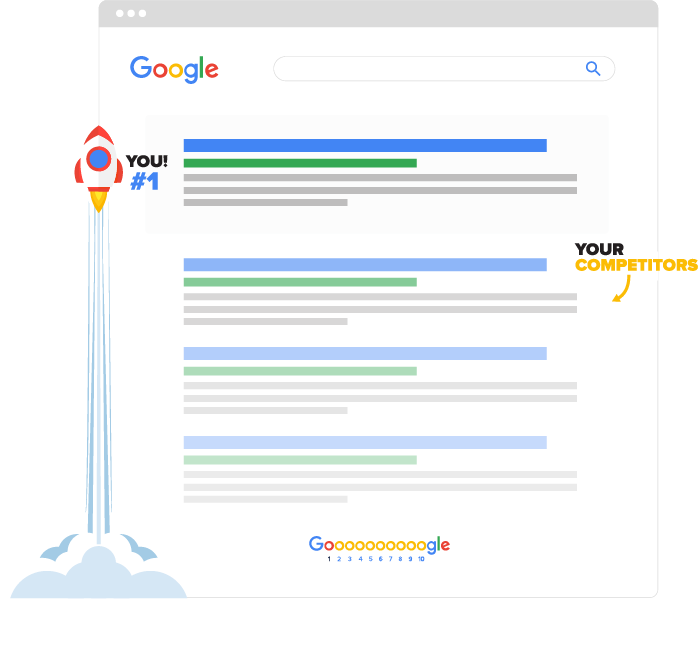
It’s possible to “fly” past your competition on page 1 with Google Ads
Advertise to your perfect client: How do you do that? You “just” need to bid on the correct keywords: the ones your ideal clients are typing into search engines. These are the search terms that the big boys, your competitors, are likely ranking for organically. Competing for these keywords through traditional SEO tactics requires lots of time. But with Google Ads, you can jump the line. You can cut in front of them with an ad that targets the most lucrative keywords that will land the largest ROI.
Cons
You could lose tens of thousands of dollars: Yes, you read that correctly. A highly relevant keyword may cost more than $40 a click — and there’s no guarantee that one click will convert. In fact, most clicks won’t convert. How do we know?
While Google Ads conversion rates (CVR) vary by industry, according to WordStream the average is 3.75%. That means one in 26 people who click your ad may take your desired action, whether that’s to buy a product, join your mailing list, or sign up for a free consultation. Do the math and you’ll quickly see how expensive this can get: over $1,000 per conversion. If you don’t know what you’re doing and aren’t monitoring your campaigns closely, that cost can quickly explode to well over $10,000. Yikes.

Never “sleep” on your ad campaigns, literally or figuratively. Mistakes are costly.
You could lose even more if you lack expertise: Bear in mind, 3.75% is the average. If you’re completely new to this and try to go it alone, your CVR will likely be much lower. Perhaps two to three times lower. What does that mean for your business? One conversion could potentially cost $2,000 to $3,000. Unless you’re selling Hummers, submarines, or your company name is Microsoft or Amazon, then this could mean huge losses. But there is a workaround.
If you’re a beginner and serious about Google Ads, you could either hire an expert or spend time learning how to effectively run ads. Both these options will cost you time or money, which most small businesses are short on.
Is Google Ads the best place to start?
We hope we didn’t scare you with that last bit about losing money. That’s not our intention. But we do want to be realistic and speak to you straight. Truthfully, Google Ads is a great solution for some small businesses. How do you know if that’s you?
Here are four questions to ask yourself:
1. What is my budget? By now, you know Google Ads is expensive. Which is why your budget is a critical factor to take into consideration. For example, our Google Ads service recommends a minimum budget of $1,000 a month for three months. That said, our team of experts have a combined experience of 25+ years running Google Ads campaigns. We understand the platform and can get you results.
If you’re completely new to Google Ads and wish to go it alone, we’d recommend Google AdWords Express, which is a simplified version of Google Ads that enables you to run ads locally. Bear in mind, AdWords Express offers much less control over campaign optimization and therefore could lead to poor results. But it’s a safer bet for those who are just starting out and are overwhelmed by Google Ads.
2. How much is a conversion worth to you? Remember how we mentioned you could pay $40 for a single click? Depending on the cost of your product or service, this may be a reasonable price. For example, let’s say you’re selling wind turbines, a high-ticket product that costs over a million dollars. If it takes you 100 clicks to convert one lead, that’s a $4,000 investment for a sale worth potentially hundreds of thousands of dollars. Suddenly, $40 a click seems like a bargain. And we’re not just talking about single sale products.
At Pronto, the lifetime value of a lead for some of our clients can be $100,000+. So again, $40 a click doesn’t seem so bad. So how much is a conversion worth for you? How much do your products and services cost? What is the lifetime value of a client? If the answer to these questions is a very high figure, then Google Ads may be the right investment to start with.
3. How talented is my Google Ads Campaign Manager? The answer to this question can mean the difference between tens of thousands of dollars. What is your Campaign Manager’s track record? Can he or she write compelling ad copy? Track and understand data properly? If your specialist has experience, he or she may be able to beat the average CVR. But if you are a newbie doing it yourself or hire an inexperienced vendor, then your CVR and ROI will likely tank.
4. Will my website convert? Here’s something you may not have considered: the quality of your website plays a huge role in your Google Ads success. Why? Because a confusing, disorganized, unattractive website won’t convert. To do well with Google Ads, you need to be directing leads to pages with smart copy, and a clean and attractive design. A landing page can also be beneficial, though it’s not always necessary.
What are your Google Ads alternatives?
Most SMBs don’t have the cash flow for Google Ads, at least when they’re just getting started with marketing. Thankfully, you have some alternative ways to get high-quality traffic from Google:
Website optimization through on-site SEO
Optimizing your website’s on-site SEO is fundamental to success online. Our client results speak for themselves — most see a 50% increase in traffic within the first six months of launching their Pronto website. That said, in the long run, on-site SEO will not get you to #1 on Google. What will?
Off-site SEO
This is where real growth, ROI, and reaching Google’s coveted first page comes in. While on-site SEO involves optimizing your website — keyword research, meta tags, alt text, etc. — off-site SEO is more about optimizing your online presence, which mostly involves getting other websites to link to your site.
When another website links to yours, they basically tell Google they trust your site as a credible source of information. In other words, a link is like a vote of confidence in your site’s authority or popularity. The more links you get from relevant, trustworthy websites, the higher you’ll rise in Google rankings.
Blogging
You’ve almost certainly heard of blogging. And publishing blogs regularly can raise your ranking in search engines organically (without the use of paid advertising). While some people say blogging is dead, we beg to differ. In fact, below is a graph that shows the increased web traffic a client of ours gained from blogging.
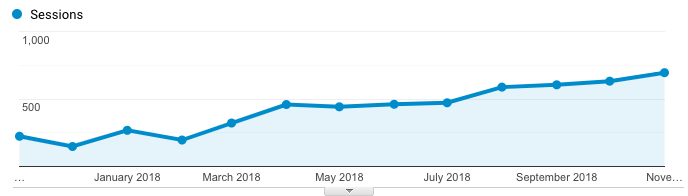
In November 2017, our client signed up for our custom blogging program and received 224 sessions on one of her articles. As you can see, traffic to that article increased over the year, resulting in 695 visitors in November 2018. That’s a traffic increase of over 200%.
Where to go from here?
By now you’ve probably made up your mind about whether Google Ads is right for you. If it’s not, no worries. For the majority of our clients, we recommend them to begin with a combination of the three alternative marketing activities above and then start Google Ads once they’ve gained some marketing traction.
So what now?
We’ve got some good news for you. This is the first of a four-part blog series where we cover the three Google Ads alternatives — on-site SEO, off-site SEO, and blogging — and how they help you grow your business online.
In the meantime, if you ever have questions, don’t hesitate to get in touch. Our marketing experts are here for you 24 hours a day, five days a week, and we’re happy to help. Talk soon.